Taylormade Spider Putter Specs Chart
The TaylorMade Spider putter family is one of the most recognized mallet lines in golf, but the specs vary significantly across models. If you’re comparing the Spider GT, Spider X, Spider EX, or the newer Spider Tour series, the differences in head weight, toe hang, and hosel options matter more than the paint job.
Below is a practical breakdown of the current Spider lineup, what the numbers mean for your stroke, and how to pick the right configuration.
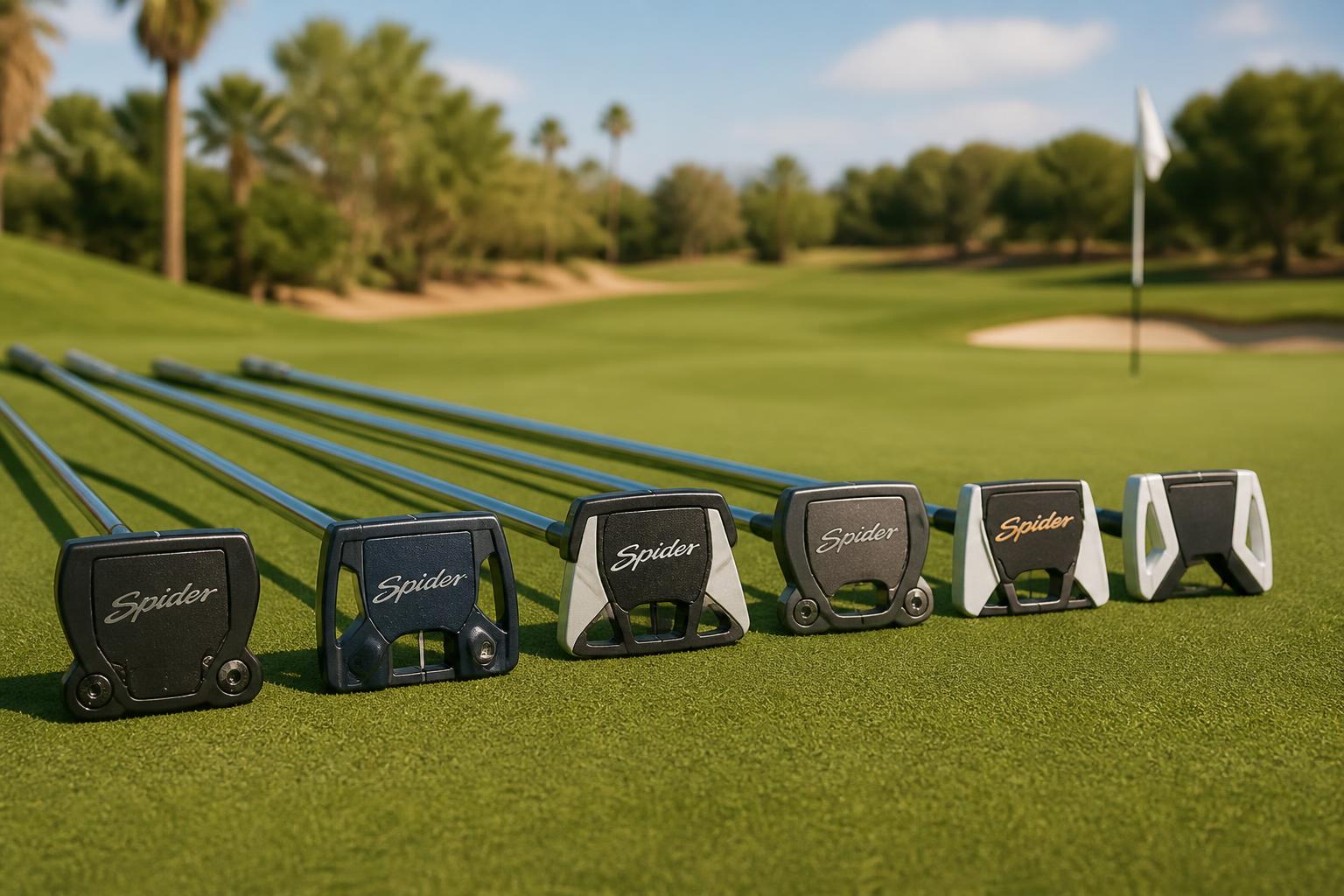
Current Spider Model Specs at a Glance
| Model | Head Weight | Toe Hang | Hosel Options | Stock Lengths | Loft |
|---|---|---|---|---|---|
| Spider GT (Notchback / Short Slant) | 355g | Face-balanced to slight toe hang | Short Slant, Single Bend | 33″, 34″, 35″ | 3° |
| Spider GT (Splitback / Single Bend) | 365g | Face-balanced | Single Bend | 33″, 34″, 35″ | 3° |
| Spider X (Hydro Blast) | 360g | Face-balanced (Single Bend) / Toe hang (Short Slant) | Single Bend, Short Slant, Heel Shaft | 33″, 34″, 35″ | 3° |
| Spider EX (Double Bend) | 365g | Face-balanced | Double Bend, Short Slant | 33″, 34″, 35″ | 3° |
| Spider Tour (2023) | 365g | Varies by hosel | Short Slant, L-Neck, Single Bend | 33″, 34″, 35″ | 3° |
Important: TaylorMade adjusts specs between production runs. Verify the exact head weight and toe hang on the specific model you’re buying, especially if you’re purchasing used or from a discount retailer.
What the Specs Mean for Your Stroke
Head Weight: 355g vs. 365g
The heavier 365g head (found in the Spider GT Splitback, EX, and Tour) provides more stability through impact. Golfers who tend to decelerate on short putts often benefit from the extra mass. The 355g head in the Notchback is slightly easier to swing for players who prefer a lighter feel or who play on very fast greens where touch matters more.
Decision rule: If you miss short putts left or right due to a shaky stroke, choose the 365g version. If your distance control is the bigger issue, the 355g gives you more feel.
Practical implication: If you’re currently gaming a 355g Spider and consistently leave 15-foot putts short on slow greens, the extra 10g in a 365g model can help you maintain pace without forcing a longer stroke. But if you play on fast municipal greens in summer, the heavier head can make 3-foot putts feel dead and unresponsive — that’s a sign to stick with the lighter version rather than chasing stability you don’t need.
Toe Hang: Face-Balanced vs. Toe-Hang
This is the most critical spec for matching a Spider to your stroke:
- Face-balanced (Single Bend or Double Bend hosels): The face points straight up when you balance the putter on your finger. Best for players with a straight-back, straight-through stroke (minimal rotation).
- Slight toe hang (Short Slant hosel): The toe drops slightly. Suits players with a slight arc in their stroke.
- Moderate toe hang (L-Neck on Spider Tour): The toe drops more noticeably. Designed for stronger arcs.
Common mistake: Buying a face-balanced Spider because it looks stable, then wondering why you’re pulling putts. If your stroke naturally rotates the face open and closed, a face-balanced head will fight that motion.
How to verify your stroke type: Set up a phone on the ground face-on to your putter at address. Make five practice strokes and watch the putter head in slow motion. If the face stays square to the target line through impact, you’re straight-back-straight-through. If the toe rotates past the heel at impact, you have an arc stroke. This takes two minutes and removes the guesswork from the toe-hang decision.
Hosel Options and Offset
- Single Bend: Face-balanced, minimal offset, suits straight strokes.
- Double Bend: Face-balanced, more offset (about a shaft width), helps players who tend to hook putts.
- Short Slant: Slight toe hang, moderate offset, the most versatile option for golfers who aren’t sure of their stroke type.
- L-Neck: Moderate toe hang, minimal offset, traditional look at address.
Decision rule: If you currently play a blade with a plumber’s neck, the Short Slant or L-Neck will feel most familiar. If you’re coming from a center-shafted putter, the Single Bend is the closest match.
Mismatch warning: The Double Bend hosel’s extra offset can cause problems for players who already fight a push. The offset delays face closure, which exaggerates an open face at impact for golfers with slower hand action. If you tend to block putts right, test the Single Bend version before committing to the Double Bend — the visual alignment at address can mask a fundamental mismatch that shows up only after you’ve paid for the club.
Why the Spider Is So Popular on Tour
The Spider’s success on the PGA Tour isn’t just marketing. The high moment of inertia (MOI) comes from the heavy steel frame positioned around the perimeter, with lightweight aluminum in the center. That weight distribution keeps the face stable on off-center hits.
As of the 2024 season, TaylorMade Spider putters have been used for multiple PGA Tour wins each year. The Spider Tour model specifically has been in the bags of several top-50 players. However, the #1 putter on the PGA Tour varies by season—Scotty Cameron (Titleist) and Odyssey (Callaway) regularly trade the top spot with TaylorMade. No single brand has a permanent lock on that title.
What this means for your purchase: Tour usage tells you the design is sound, but it doesn’t tell you which hosel or head weight fits you. The players using Spider putters on tour have custom lie angles, grip sizes, and sometimes custom head weights that aren’t available at retail. Treat tour success as a quality signal, not a fitting recommendation.
What Is a TaylorMade Spider Putter Worth?
Prices vary depending on the generation and condition:
- New Spider GT / EX: $299–$349 retail
- New Spider Tour (2023+): $349–$399
- Used Spider X (2–3 years old): $150–$220 depending on condition
- Older Spider models (2017–2019): $100–$180
Warning: If you see a “new” Spider for under $200 from an unauthorized seller, it’s likely counterfeit. Check the serial number on the hosel and confirm the weight ports are genuine—counterfeits often use glued weights instead of the screw-in design.
Verification step: Before buying used, remove the weight screws with the included wrench (or a standard Torx bit) and check that they’re actual metal weights, not plastic fillers. Also, flip the putter over and look for a laser-etched serial number on the sole — genuine Spiders have this; counterfeits typically have a painted or stamped number that wears off.
How to Choose the Right Spider for Your Game
1. Determine your stroke type. Have a fitter watch you putt, or record yourself from face-on. If your putter face stays square through impact, go face-balanced. If it opens and closes, go toe-hang.
2. Pick the hosel that matches. Single Bend for straight strokes, Short Slant for slight arcs, L-Neck for stronger arcs.
3. Choose your length. Most golfers fit into 34″ or 35″. If you’re under 5’8″, test 33″ before assuming you need a longer putter.
4. Decide on head weight. Test both 355g and 365g versions on the practice green. Pay attention to your distance control on 20–30 foot putts, not just feel at address.
5. Check the grip. Spider putters come with a variety of grip sizes. The stock grip is midsize, but if you have larger hands, consider a jumbo option before buying.
Common Mistakes When Buying a Spider Putter
- Ignoring toe hang. This is the #1 fitting error. The Spider looks like one putter, but the hosel changes the entire behavior.
- Buying based on what a pro uses. Tour players have specific head weights and lie angles customized to their stroke. Your off-the-rack model won’t match theirs.
- Assuming all Spiders are the same. The Spider GT Notchback and the Spider Tour are different putters in feel, sound, and stability. Test them side by side.
- Skipping the lie angle check. Spider putters are offered in standard lie (70°), but if you have a steep or shallow posture, a 2° lie adjustment can make a significant difference in start line.
Trade-off to consider: The Spider Tour’s softer feel comes from a more complex multi-material construction, but that also makes it the most expensive model in the lineup. If you’re on a budget, the Spider GT offers 90% of the stability at a lower price point. The main thing you give up is the Tour’s slightly more refined sound at impact — a preference, not a performance gap.
FAQ
Why is the TaylorMade Spider putter so good?
The Spider’s performance comes from its high MOI design. The heavy steel frame around the perimeter keeps the face stable on off-center hits, which reduces distance loss and direction error on mishits. The multi-material construction also produces a soft, muted feel that many golfers prefer over firmer inserts.
Is the TaylorMade Spider the best putter?
No putter is objectively the best for every golfer. The Spider is one of the most stable mallets available, and its tour success proves it works for elite players. However, golfers with strong arcs may find a toe-hang blade more consistent, and players who prefer a firmer feel often choose Odyssey or Scotty Cameron options. The best putter is the one that fits your stroke and inspires confidence.
What is the #1 putter on the PGA Tour?
The #1 putter brand on the PGA Tour changes by season. Scotty Cameron and Odyssey have historically traded the top spot, with TaylorMade Spider putters consistently ranking in the top three. As of recent seasons, Odyssey has held the highest percentage of putters in play, but TaylorMade’s Spider line is the most-used single mallet model.
What is a TaylorMade Spider putter worth?
A new Spider GT or EX retails for $299–$349, while the Spider Tour runs $349–$399. Used prices depend on age and condition: a 2–3 year old Spider X typically sells for $150–$220, and older models from 2017–2019 go for $100–$180. Counterfeit models are common at prices well below these ranges, so verify the serial number before purchasing.

Michael Reeves is a PGA Professional with over 20 years of experience in competitive golf and instruction. A former Division I collegiate player at the University of Texas, he competed on the mini-tours before transitioning to full-time coaching and golf journalism. He has been a certified PGA teaching professional since 2005 and has worked with players at every level, from absolute beginners to collegiate champions.
His writing has appeared in Golf Digest, Golf Magazine, and The Left Rough. At GolfHubz, Michael leads the editorial team, overseeing fact-checking and ensuring every answer meets the same standard he demands on the lesson tee: clear, evidence-based, and immediately useful.
When he’s not writing or teaching, Michael plays to a +1.4 handicap at his home club in Austin, Texas. He has attended over 40 major championships as a journalist and fan, and has played more than 200 courses across 15 countries.
You can reach Michael at [email protected] or follow his occasional swing analysis posts on the site.