Putter Grip Size Chart
Your putter grip is the only part of the club that touches your hands. If the diameter doesn’t match your hand size and stroke type, you’ll compensate with excessive wrist action or grip pressure — two of the most common causes of missed short putts. This guide breaks down the standard size categories, how to measure your hand, and which size fits your game.

Why Putter Grip Size Matters More Than You Think
Grip size directly controls how much your wrists hinge during the stroke. A grip that’s too small forces your hands to overwork, leading to a “flippy” stroke that’s hard to repeat under pressure. A grip that’s too large restricts wrist action, which helps some players but can kill feel for those who prefer a more active stroke.
The key trade-off is control vs. feel. Larger grips reduce hand action and promote a pendulum stroke. Smaller grips increase feedback and allow for more wrist hinge. Neither is objectively better — it depends on your stroke mechanics and what you’re trying to fix.
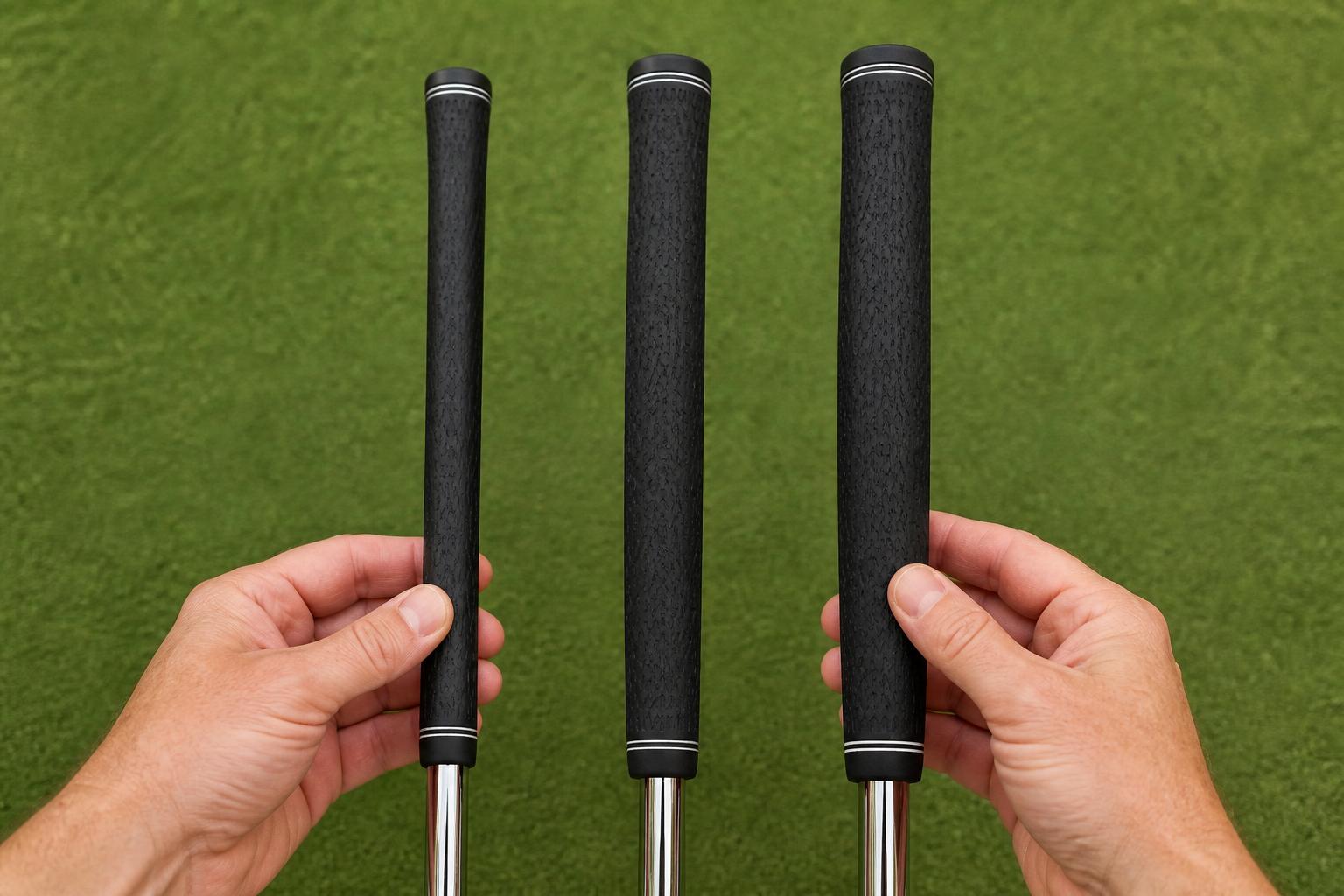
What this means for your next purchase: If you’re currently missing short putts left or right, a larger grip may steady your stroke. If your problem is distance control on lag putts, a smaller grip will give you more touch. Choose the size that addresses your most frequent miss, not the one that looks like what tour players use.
Standard Putter Grip Size Categories
Putter grips come in five general diameter ranges. These aren’t universal standards across all brands, but they give you a reliable baseline when comparing options.
| Grip Size | Core Diameter (approx.) | Best For |
|---|---|---|
| Undersize | 0.50″ – 0.55″ | Small hands, players who want maximum feel |
| Standard | 0.55″ – 0.60″ | Average hand size, traditional feel |
| Midsize | 0.60″ – 0.70″ | Medium-to-large hands, stroke stabilizers |
| Jumbo | 0.70″ – 0.80″ | Large hands, heavy wrist action correction |
| Oversize | 0.80″+ | Maximum stroke stability, arthritic hands |
These measurements refer to the core diameter — the widest point of the grip’s cross-section. Most manufacturers list this spec on the product page or packaging.
How to verify fit on your actual putter: Before buying, check your putter’s shaft diameter at the grip end. Most putters use either 0.58″ or 0.60″ butt diameters, but some older models and certain brands (notably Ping) use different sizes. If you buy a grip with the wrong core size for your shaft, it won’t seat properly — it will either slide on too easily and twist during your stroke, or resist installation and bulge in the middle. Check the manufacturer’s spec sheet for both the grip’s core size and your putter’s butt diameter before ordering.
How to Measure Your Hand for a Putter Grip
You don’t need special tools. Here’s a practical method that takes under a minute:
1. Measure your glove size. If you wear a golf glove, your size gives you a starting point. Men’s M/L typically pairs with standard grips; men’s XL and above often fits midsize better.
2. Check your finger-to-palm ratio. Place your dominant hand flat on a table. If your middle finger is noticeably longer than your palm width, you may prefer a slightly larger grip to fill the hand.
3. Test your current grip pressure. Hold your putter normally. If your knuckles are white or your forearms tense up, your grip is likely too small — you’re squeezing to stabilize it. If you feel like you’re “holding a bat” and can’t feel the putter head, it’s too large.
The glove test: Put on your golf glove and grip the putter. The tips of your middle and ring fingers should just barely touch your palm. If they dig into the palm, the grip is too small. If they don’t come close, it’s too large.
Grip Size vs. Stroke Type: Matching Diameter to Mechanics
Your stroke type should influence your grip choice more than hand size alone.
Straight Back-Straight Through Strokers
If your stroke is mostly shoulders with minimal wrist hinge, a midsize or jumbo grip reinforces this pattern. The larger diameter physically limits wrist action, keeping the putter face square through impact. The SuperStroke Zenergy Tour 3.0 Golf Putter Grip with No Taper Enhanced SPYNE Technology, New Multi-Zone Texturing and Tech-Port, Blue/White is a popular choice here — its no-taper design keeps the diameter consistent from top to bottom, which encourages a steady, wrist-free stroke.
Arced Stroke Players
If your putter naturally swings on an arc with some face rotation, a standard or undersize grip gives you the freedom to hinge and release. The SuperStroke Traxion Tour 1.0 Golf Putter Grip, Advanced Surface Texture that Improves Feedback and Tackiness, Minimize Grip Pressure with a Unique Parallel Design, Digi Camo/Tan offers a parallel design that provides consistent feedback without locking your hands into a fixed position.
The “Yips” Fix
Golfers who struggle with the yips — involuntary wrist jerks during the stroke — often benefit from the largest grip they can tolerate. The extra diameter dampens the small muscle movements that cause the problem. This is the one case where bigger is almost always better, regardless of hand size.
Grip Shapes: Taper vs. No-Taper
Size isn’t the only variable. Putter grips also differ in shape, which changes how the grip sits in your hands.
Tapered grips are thicker at the butt end and thinner near the putter head. They mirror the shape of standard iron grips and allow for more wrist hinge. Most traditional putter grips fall into this category.
No-taper grips maintain a consistent diameter throughout. They’re designed to minimize wrist action and promote a pendulum stroke. SuperStroke pioneered this design, and it’s become the default choice for players using a locked-wrist stroke.
Pistol grips have a slight bulge at the top that fits the palm. They provide a reference point for hand placement, which helps players who struggle with inconsistent grip position.
Where this can go wrong: A no-taper grip on a putter with a strong arc stroke can feel like you’re fighting the club. The consistent diameter prevents the natural release your stroke wants, leading to pushed putts right. Conversely, a tapered grip on a straight-back-straight-through stroke can introduce unwanted wrist hinge, creating pulls. Match the shape to your stroke pattern, not just the diameter.
Common Mistakes When Choosing a Putter Grip
1. Assuming Bigger Is Always Better
The oversize grip trend has led many players to choose grips that are too large for their hands. If you have average-sized hands and choose a jumbo grip, you’ll lose all feel for the putter head. You’ll also struggle on fast greens where touch matters most.
2. Ignoring Your Current Miss
Your grip size should address your most common miss. If you pull putts left, a slightly larger grip can reduce the wrist action causing the pull. If you leave putts short, a smaller grip can increase feel and help you judge distance better.
3. Matching Grip Size to Glove Size Only
Hand size is a starting point, not the final answer. A player with large hands but a smooth, arced stroke may prefer a standard grip. A player with small hands but a jerky stroke may need a jumbo. Test multiple sizes before committing.
4. Forgetting About Grip Weight
Larger grips are heavier. A jumbo grip can add 30-50 grams to the putter’s total weight, which changes the swing weight and feel. If your putter already feels head-heavy, a large grip might make it feel too club-heavy. The Karma Dual Touch Black Midsize Putter Grip offers a midsize option that adds stability without dramatically altering the putter’s balance point.
The trade-off to watch for: If you switch from a standard grip (about 60-70 grams) to a jumbo grip (90-110 grams), your putter’s swing weight drops significantly. The head will feel lighter, which can cause you to decelerate through impact. If you go up more than one size, you may need to add lead tape to the putter head or choose a heavier head weight to restore the balance you’re used to.
How to Test Putter Grips Before Buying
You don’t need to buy multiple grips to find your size. Most golf retailers have demo grips you can try. Here’s how to test effectively:
1. Test with your eyes closed. Close your eyes and grip the putter. If you can’t feel the putter head during a practice stroke, the grip is too large. If you feel excessive wrist movement, it’s too small.
2. Hit 10 putts with each size. Don’t just hold the grip — putt with it. Pay attention to distance control. The right size should make 20-30 foot putts feel natural, not forced.
3. Check your grip pressure after 10 minutes. If your forearms are tired, the grip doesn’t fit. You should be able to hold the putter with a 3-4 out of 10 pressure level without feeling unstable.
A quick confirmation step: After installing a new grip, take your normal address position and look at your lead hand. Your top hand’s thumb should sit flat along the front of the grip without your fingers wrapping so far around that your nails dig into your palm. If you can’t keep a light grip pressure without the putter twisting in your hands, the grip is too small. If your hands feel spread too wide or you can’t feel the putter head during practice swings, it’s too large.
The 60-Second Decision Framework
Use this quick checklist to narrow down your options:
- Do you have wrist action in your stroke? Yes → Standard or undersize. No → Midsize or larger.
- Do you pull putts left? Yes → Go one size up from your current grip.
- Do you leave putts short? Yes → Go one size down for more feel.
- Do you have arthritis or hand fatigue? Yes → Oversize with a soft compound.
- Are you between sizes? Choose the larger option. It’s easier to adapt to a slightly large grip than a slightly small one.
Final Thoughts on Putter Grip Sizing
The right putter grip size is the cheapest equipment change you can make that has a measurable impact on your stroke. Start with your hand size, then adjust based on your stroke mechanics and the specific putting problems you’re trying to solve. Test at least two sizes before committing, and don’t be afraid to go against the trend if a smaller grip gives you better distance control. The goal isn’t to match what tour players use — it’s to find the diameter that lets you make a free, repeatable stroke with minimal grip pressure.

Michael Reeves is a PGA Professional with over 20 years of experience in competitive golf and instruction. A former Division I collegiate player at the University of Texas, he competed on the mini-tours before transitioning to full-time coaching and golf journalism. He has been a certified PGA teaching professional since 2005 and has worked with players at every level, from absolute beginners to collegiate champions.
His writing has appeared in Golf Digest, Golf Magazine, and The Left Rough. At GolfHubz, Michael leads the editorial team, overseeing fact-checking and ensuring every answer meets the same standard he demands on the lesson tee: clear, evidence-based, and immediately useful.
When he’s not writing or teaching, Michael plays to a +1.4 handicap at his home club in Austin, Texas. He has attended over 40 major championships as a journalist and fan, and has played more than 200 courses across 15 countries.
You can reach Michael at [email protected] or follow his occasional swing analysis posts on the site.