Odyssey Putter Guide
Odyssey has been the most-played putter brand on professional tours for years, and their lineup spans everything from classic blade shapes to high-MOI mallets. The key is matching the model to your stroke type and visual preference — not just picking the one the pros use.

The Three Main Odyssey Families
White Hot Insert (Classic Feel)
The White Hot insert has been around since 2000 and remains the benchmark for Odyssey feel. It’s a urethane layer over an aluminum backer that produces a soft, responsive sound at impact. If you grew up putting with a White Hot and liked it, the current versions keep that same character.
The Odyssey White Hot OG Putter (Right Hand, 35″, Double Wide, Steel 2023 Shaft) is a direct nod to the original line. The Double Wide head shape gives you a mallet’s stability in a compact profile that still looks blade-like at address. It’s a good middle ground if you’re not sure whether you want a full mallet or a traditional blade.
Ai-ONE (Speed Consistency)
The Ai-ONE line uses an aluminum backer with contours designed by artificial intelligence. The goal is consistent ball speed across the entire face — not just the sweet spot. This matters more than you might think: most amateurs miss the center on a regular basis, and a putt struck slightly off-center loses less distance with this insert.
Two current models use this insert:
- The Odyssey Square to Square Putter (Right Hand, 33 Inches, Jailbird) — a Jailbird mallet with a distinctive two-tone alignment system. The 33-inch length suits players who stand closer to the ball or prefer a more upright posture.
- The PT RH OD SQR to SQR Seven ZT OS 34 — a Seven shape with a Zero Torque (ZT) hosel design. The “OS” means oversize grip, and the 34-inch length fits the average golfer’s setup.
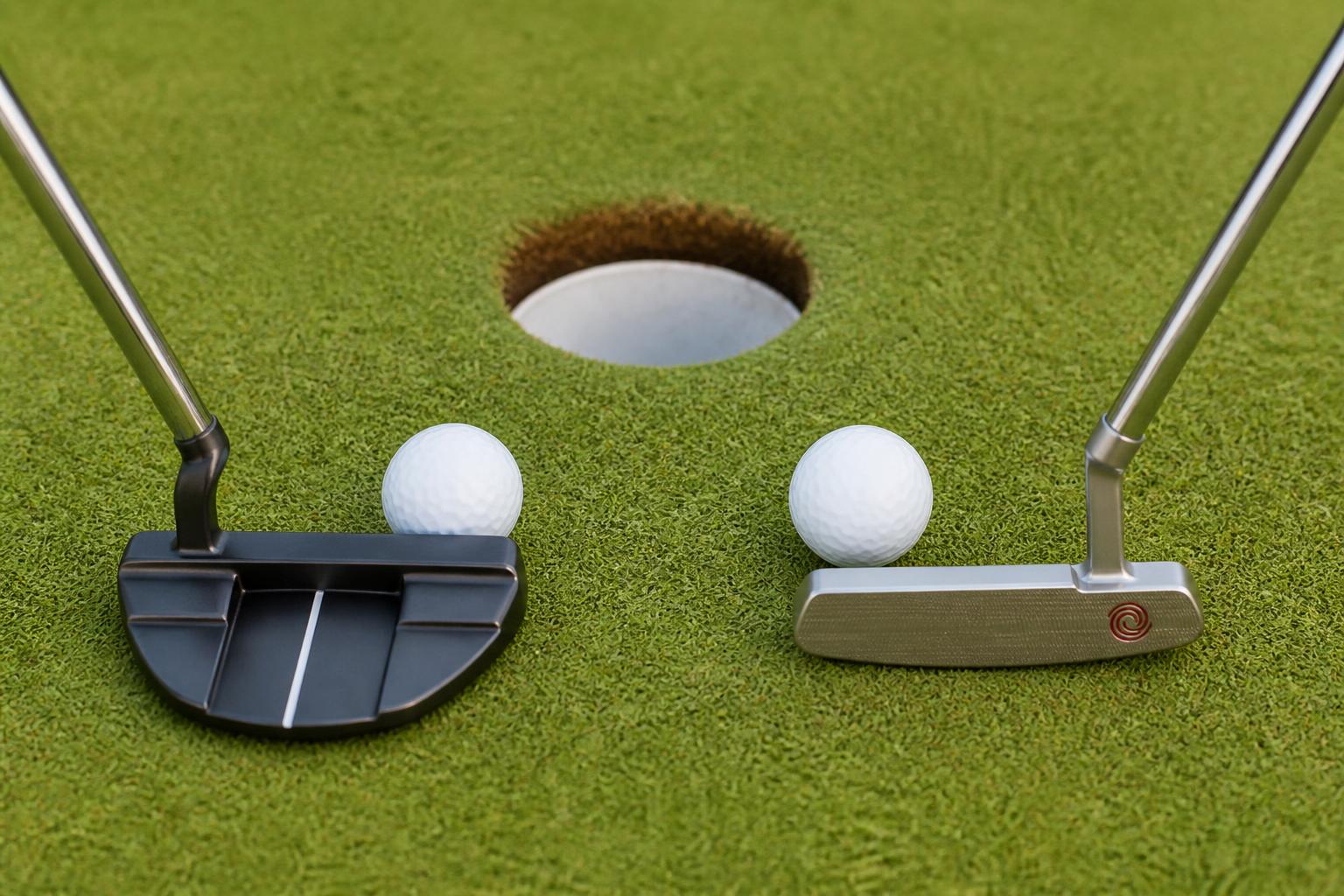
The Ai-ONE insert is the better choice if your miss tends to be off-center. The White Hot is the better choice if you prioritize feel above all else.
Stroke Type: Straight vs. Arcing
Your putting stroke determines which head shape and hosel configuration will work best.
| Stroke Type | What It Looks Like | Best Odyssey Fit |
|---|---|---|
| Straight-back, straight-through | The putter face stays square to the target line through the stroke | Face-balanced mallets (Jailbird, Seven) |
| Slight arc | The putter opens slightly inside on the backswing and closes through impact | Toe-hang blades or mid-mallets |
| Strong arc | The putter swings noticeably inside-outside | High toe-hang blades (classic White Hot #1, #3) |
How to check your stroke: Set up to a straight putt, then make a slow practice stroke. Watch the putter head. If it tracks straight back along the target line, you’re straight-back. If it drifts inside on the backswing, you have an arc.
Alignment: What You See at Address
The Jailbird and Seven models both feature prominent alignment systems, but they work differently:
- Jailbird: Two parallel white lines frame the ball. This works well if you like a “rail” look that visually connects to your target line.
- Seven: A single center line plus the overall shape of the head creates a frame around the ball. This suits players who prefer a simpler, less busy look.
If you struggle with starting putts on line, the Jailbird’s dual lines give you more visual feedback. If you find too much alignment aid distracting, the Seven’s cleaner look may help you focus on speed instead.
Length and Grip Considerations
Length is not just about height — it’s about your posture and eye position.
- 33 inches: Best for players who stand closer to the ball, have a more upright posture, or prefer the putter to feel lighter.
- 34 inches: The standard for most golfers. If you’re between sizes, start here.
- 35 inches: Suits taller players or those who stand farther from the ball.
The ZT Seven comes with an oversize grip, which reduces wrist action in the stroke. That’s a benefit if you tend to get handsy with smaller grips. The Jailbird and White Hot OG come with standard grips, so you may need to swap if you prefer a thicker grip.
Common Mistakes When Choosing an Odyssey Putter
Buying the same model as your favorite pro. Tour players have specific loft, lie, and weight preferences that don’t transfer to your game. Use their model as a starting point, not a final answer.
Ignoring face balance. A face-balanced putter (like the Jailbird) resists opening and closing. If you have an arcing stroke, you’ll fight the putter all day. Match the balance to your natural motion.
Choosing by looks alone. The Seven and Jailbird look similar at a glance, but the Jailbird’s alignment system and the Seven’s ZT hosel feel different through impact. You need to test both, ideally on a putting green with real reads, not just a carpet.
Skipping the lie angle check. Odyssey offers standard lie angles, but if you stand very upright or very hunched, the putter’s sole won’t sit flat. This causes pushes or pulls. Get your lie angle checked at a fitting if you’re between postures.
How to Test an Odyssey Putter Before Buying
1. Test on a real green. A putting mat tells you about feel but not about how the putter handles slope and grain.
2. Hit 10 putts from 6 feet with each model. Track makes and misses, but also pay attention to where misses go. A consistent miss pattern tells you about face balance and alignment fit.
3. Try the same model in two lengths. The difference between 33 and 34 inches is small but noticeable in posture. Pick the one that lets your eyes sit directly over the ball.
4. Compare inserts back-to-back. Hit the White Hot OG and an Ai-ONE model in the same session. The feel difference is immediate — you’ll know which one you prefer within a few putts.
Verification step: After settling on a model, hit 20 putts from 8 feet. If your misses cluster within 2 feet of the hole on either side, the putter is working with your stroke. If you see a one-sided miss pattern (everything pushing right or pulling left), the lie angle or face balance is off — don’t assume you’ll “adjust” to it.
When to stop and get help: If you’ve tested three different Odyssey models and every one produces the same miss pattern, the putter isn’t the problem — your setup or stroke mechanics need attention. At that point, book a putter fitting or a lesson before spending more money. A fitting will measure your lie angle, stroke path, and face angle at impact, which will tell you exactly what head shape and hosel you need.
Frequently Asked Questions
What is the difference between the White Hot and Ai-ONE inserts?
The White Hot is a urethane layer over a flat aluminum backer, producing a soft feel. The Ai-ONE uses a contoured aluminum backer designed to maintain ball speed on off-center hits. The Ai-ONE is more forgiving; the White Hot is more traditional in feel.
Should I choose a blade or a mallet?
Blades suit players with arcing strokes who want more feel. Mallets (like the Jailbird or Seven) suit players who want stability and forgiveness, especially on off-center strikes. If you’re not sure, a mid-mallet like the Double Wide is a safe compromise.
Does the Zero Torque hosel really make a difference?
The ZT hosel reduces the putter’s tendency to twist during the stroke. This helps if you have a lot of hand action or tend to manipulate the face. If your stroke is already stable, the difference is less noticeable.
What length Odyssey putter should I use?
Most golfers fit into 34 inches. If you’re under 5’8″ or stand close to the ball, try 33. If you’re over 6’0″ or stand far from the ball, try 35. The best test is whether your eyes sit directly over the ball at address.
Can I change the grip on an Odyssey putter?
Yes. Odyssey putters use standard grip shafts, so any putter grip will fit. If you prefer a thicker grip or a different texture, swapping is straightforward.

Michael Reeves is a PGA Professional with over 20 years of experience in competitive golf and instruction. A former Division I collegiate player at the University of Texas, he competed on the mini-tours before transitioning to full-time coaching and golf journalism. He has been a certified PGA teaching professional since 2005 and has worked with players at every level, from absolute beginners to collegiate champions.
His writing has appeared in Golf Digest, Golf Magazine, and The Left Rough. At GolfHubz, Michael leads the editorial team, overseeing fact-checking and ensuring every answer meets the same standard he demands on the lesson tee: clear, evidence-based, and immediately useful.
When he’s not writing or teaching, Michael plays to a +1.4 handicap at his home club in Austin, Texas. He has attended over 40 major championships as a journalist and fan, and has played more than 200 courses across 15 countries.
You can reach Michael at [email protected] or follow his occasional swing analysis posts on the site.