Callaway Rangefinder Guide
Callaway makes some of the most recognizable rangefinders in golf, and for good reason. But the lineup can be confusing — different models, slope switches, magnification specs, and price points. This guide breaks down what actually matters when you’re comparing Callaway rangefinders, so you can match the right tool to how you actually play.
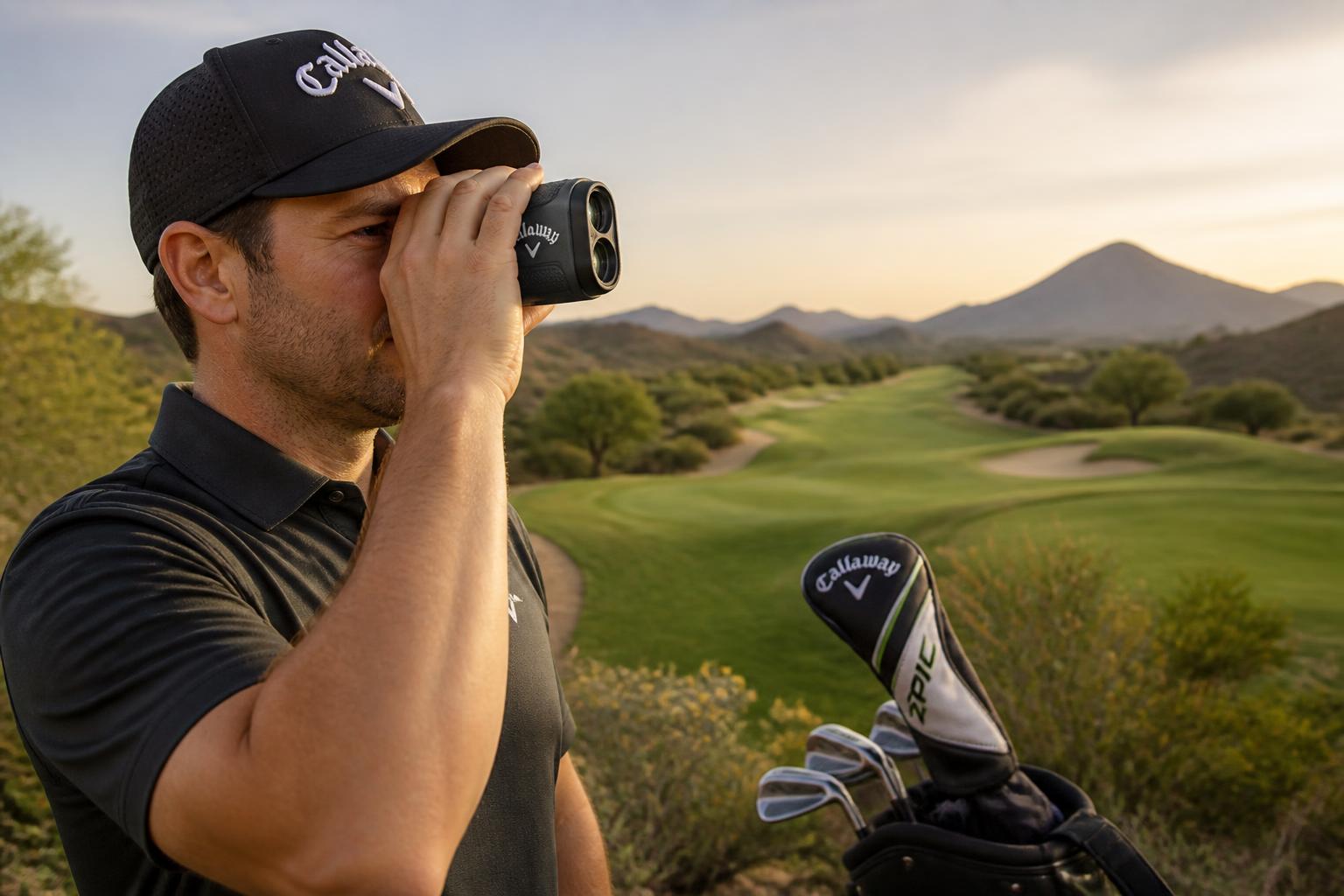
Why a Rangefinder Beats a GPS Watch (and When It Doesn’t)
A laser rangefinder gives you exact distance to the flagstick or any target you can see — a tree line, a bunker lip, a hazard carry. A GPS watch gives you front/middle/back numbers but can’t lock onto a specific pin tucked behind a bunker.
Choose a rangefinder if:
- You want precise yardages to the flag, not just the green
- You play courses with blind shots or elevation changes
- You prefer shooting practice targets on the range
Choose GPS if:
- You want quick front/middle/back numbers without lifting the device
- You struggle with shaky hands or slow play
- You rarely need exact pin distances
Most players who take scoring seriously end up with a laser. Callaway’s rangefinders sit in the mid-to-premium range, competing directly with Bushnell and Precision Pro.
Key Specs to Compare on Any Callaway Rangefinder
Slope vs. Non-Slope
Slope mode adjusts distance based on elevation change — uphill plays longer, downhill plays shorter. That’s a genuine scoring advantage on hilly courses.
The catch: Slope is illegal in tournament play under USGA rules. Most Callaway models include a slope switch that turns the feature off and makes the device tournament-legal. If you compete, verify the switch is easy to toggle mid-round.
Decision rule: If you play casual rounds only, slope is worth it. If you compete, make sure the model has a legal toggle — and remember to flip it before your round starts.
Magnification
Callaway rangefinders typically offer 6x or 7x magnification. At 6x, you’ll see the flag clearly up to about 200 yards. At 7x, target acquisition gets easier at longer distances, especially on par 5s or when the flag is tucked behind a hazard.
Trade-off: Higher magnification can amplify hand shake. If you don’t have steady hands, a 6x model with image stabilization features may serve you better than a 7x without.
Range Capability
Most Callaway models measure 500 to 1,000+ yards. Here’s the honest truth: you rarely need more than 300 yards. Unless you hunt or want to shoot distant landmarks for course management, a 500-yard unit is plenty. Don’t pay extra for range you’ll never use.
Flag Lock and Vibration
Flag lock technology confirms you’ve hit the flag, not the background trees. Vibration feedback tells you without looking away from the target. This is a quality-of-life feature that speeds up play and reduces doubt.
Common mistake: Assuming flag lock works perfectly every time. On busy backgrounds — trees directly behind the pin — even good rangefinders can grab the wrong target. Learn to scan slowly across the flag rather than holding dead center.
Callaway Rangefinder Models: What’s Actually Different
Callaway’s lineup has shifted over the years. Here’s what you need to know about the current and recent models:
Callaway 300 Pro
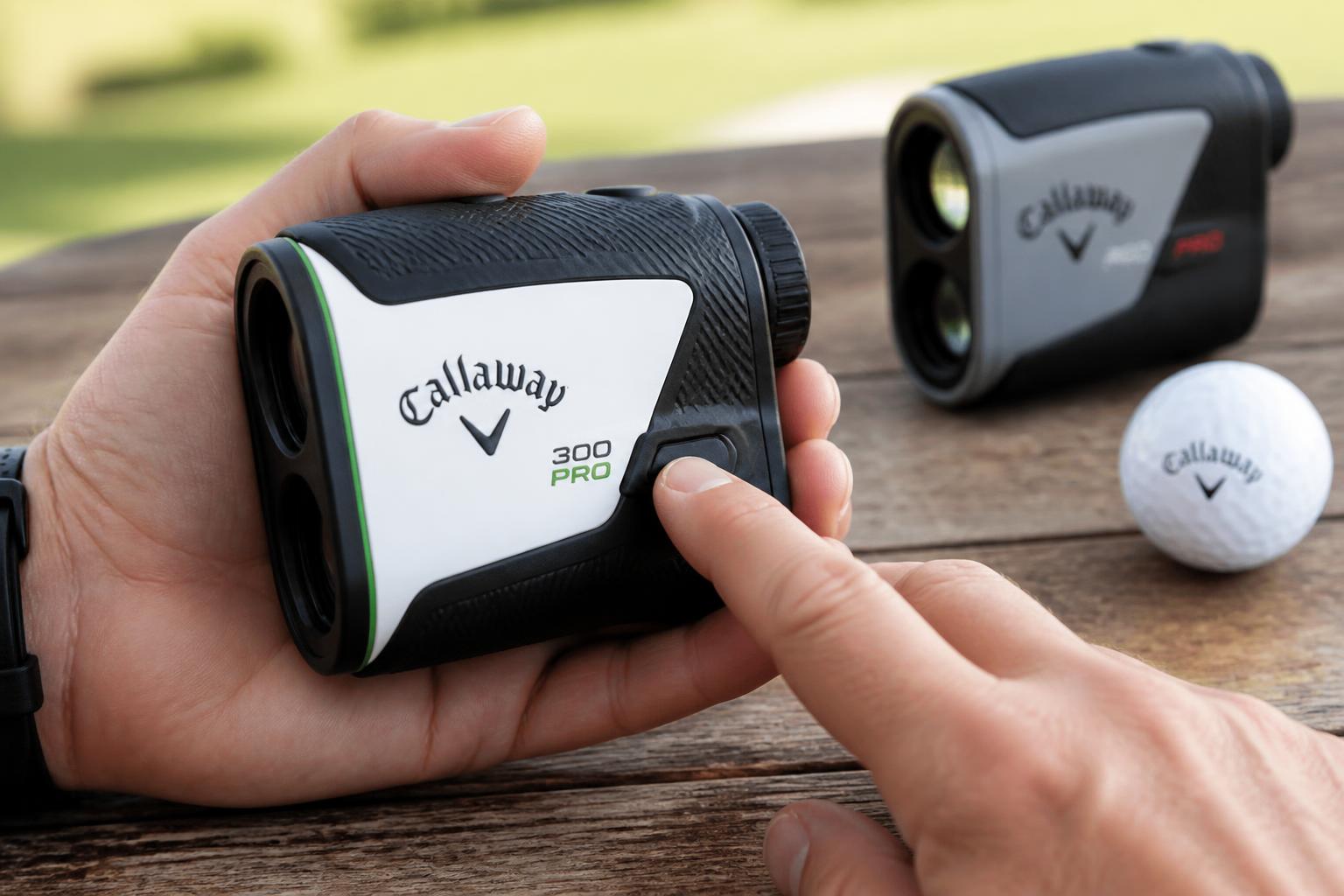
The 300 Pro is Callaway’s most popular model. It offers 6x magnification, slope with a legal toggle, and a range of about 5 to 540 yards. It’s a solid mid-range option for players who want slope without paying flagship prices.
Who it fits: The majority of recreational golfers. If you’re not sure which model you need, this is the safe starting point.
Callaway 200
The 200 is the budget-friendly option. It skips slope entirely, which makes it automatically tournament-legal. You get 6x magnification and reliable flag lock at a lower price point.
Who it fits: Players who compete, or anyone who wants a simple, no-frills device that does one job well.
Callaway 300
The base 300 sits between the 200 and 300 Pro. It offers 6x magnification and flag lock but no slope. If you want the 300’s build quality without the slope feature, this is your pick.
Who it fits: Tournament players who want the 300 series ergonomics without paying for slope they can’t use.
Callaway Pro SL2
The Pro SL2 is Callaway’s premium offering. It adds 7x magnification, a longer range, and a more refined slope system. It’s lighter than the 300 series and designed for players who want the best optics Callaway offers.
Who it fits: Better players and those who want maximum clarity at distance. The 7x magnification helps on long approaches and par 5s.
How to Choose: A Simple Decision Framework
Step 1: Do you compete?
- Yes → Skip slope or verify the toggle is legal and easy to use
- No → Slope is a genuine advantage on hilly courses
Step 2: What’s your typical approach distance?
- Under 150 yards → Any model works; don’t overpay for range
- 150–200 yards → Flag lock reliability matters most
- Over 200 yards → Consider 7x magnification for clearer target acquisition
Step 3: What’s your budget?
- Entry → Callaway 200 (no slope, tournament legal)
- Mid → Callaway 300 Pro (slope + toggle, 6x)
- Premium → Callaway Pro SL2 (slope + toggle, 7x)
Step 4: How steady are your hands?
- Shaky → Prioritize lighter weight and 6x over 7x
- Steady → 7x magnification helps on long targets
Common Mistakes to Avoid
Mistake 1: Paying for range you’ll never use. A 1,000-yard rangefinder doesn’t make you a better golfer. The flag is never more than 250 yards away for most approach shots.
Mistake 2: Forgetting the slope toggle before a tournament. This is the most common rangefinder penalty in amateur golf. Make flipping the switch part of your pre-round routine.
Mistake 3: Shooting the flag instead of the front of the green. On approach shots, the flag might be tucked near the back. Shoot the flag, then check the front edge to understand your miss distance.
Mistake 4: Not practicing with it. A rangefinder is a tool, not a magic wand. Spend 10 minutes on the range shooting different targets before your first round with it.
Mistake 5: Ignoring battery life. Callaway models use either CR2 batteries or rechargeable lithium cells. If you play 50+ rounds a year, a rechargeable model saves money long-term. Keep a spare battery in your bag either way.
How to Use a Callaway Rangefinder Effectively
Step 1: Acquire the target. Look through the viewfinder and place the reticle on the flagstick. Use the focus ring to sharpen the image if your model has one.
Step 2: Scan slowly. Move the device across the flag, not toward it. This helps the laser differentiate the flag from the background.
Step 3: Wait for confirmation. When you feel the vibration or see the lock indicator, you have your number.
Step 4: Factor in slope (if enabled). The displayed number is your adjusted distance. Trust it, but understand it’s a calculation based on elevation, not wind or temperature.
Step 5: Make your club decision. Use the rangefinder number as your starting point, then adjust for wind, lie, and your personal shot shape.
When to stop troubleshooting and seek support: If your rangefinder consistently fails to lock onto a flag from under 200 yards in clear conditions — even after cleaning the lens and replacing the battery — the internal laser or sensor may be faulty. At that point, stop troubleshooting and contact Callaway support or check the warranty. Most issues that persist after a fresh battery and lens cleaning are hardware-related, not user error.
FAQ
Is a Callaway rangefinder worth the price compared to cheaper brands?
Callaway rangefinders typically cost more than generic Amazon brands but less than Bushnell’s top-tier models. You’re paying for build quality, reliable flag lock, and a brand with a warranty. If you play 20+ rounds a year, the investment pays off in faster play and better club selection.
What does slope mode actually do?
Slope mode uses an internal inclinometer to measure the angle between you and the target. It then calculates the adjusted distance — for example, a 150-yard shot uphill at a 10-degree incline might play like 160 yards. The device displays the adjusted number, not the straight-line distance.
Can I use a slope rangefinder in tournament play?
Only if the slope function is turned off. Callaway models with a slope toggle are legal when the feature is disabled. Verify the switch is in the correct position before your round — this is the most common rangefinder penalty in amateur golf.
How often do I need to replace the battery?
Most Callaway rangefinders get 3,000 to 5,000 measurements per battery. For a typical golfer playing 30 rounds a year, that’s roughly 18 to 24 months. Keep a spare battery in your bag — they’re small and easy to lose.
What’s the difference between 6x and 7x magnification?
6x magnification brings a flag at 100 yards to appear as if it’s about 17 yards away. 7x makes it appear closer — about 14 yards away. The practical difference is target acquisition speed on long shots and in cluttered backgrounds. For most players, 6x is sufficient; 7x helps if you have good eyesight but play long courses.
Do I need a rangefinder if I already use a GPS app on my phone?
GPS apps give you front/middle/back numbers but can’t lock onto a specific pin. They also drain your phone battery and require you to pull out your phone on every shot. A rangefinder is faster, more precise, and keeps your phone in your pocket. If you’re serious about approach play, the upgrade is worth it.

Michael Reeves is a PGA Professional with over 20 years of experience in competitive golf and instruction. A former Division I collegiate player at the University of Texas, he competed on the mini-tours before transitioning to full-time coaching and golf journalism. He has been a certified PGA teaching professional since 2005 and has worked with players at every level, from absolute beginners to collegiate champions.
His writing has appeared in Golf Digest, Golf Magazine, and The Left Rough. At GolfHubz, Michael leads the editorial team, overseeing fact-checking and ensuring every answer meets the same standard he demands on the lesson tee: clear, evidence-based, and immediately useful.
When he’s not writing or teaching, Michael plays to a +1.4 handicap at his home club in Austin, Texas. He has attended over 40 major championships as a journalist and fan, and has played more than 200 courses across 15 countries.
You can reach Michael at [email protected] or follow his occasional swing analysis posts on the site.