Cobra King Tec Irons Specs Chart
If you’re comparing Cobra King Tec irons, the specs vary significantly depending on which generation and model you’re looking at. The King Tec line has gone through several iterations since its debut, and each version has different lofts, offsets, and stock shaft options. This guide breaks down the specs for each model so you can match the right set to your swing.
One important note before you start comparing: the specs below reflect the current-generation King Tec lineup. If you’re looking at a used set from an earlier release year, the lofts and lengths may differ by a degree or half-inch. Always verify the specific model year before ordering replacement shafts or making gapping decisions based on these numbers.
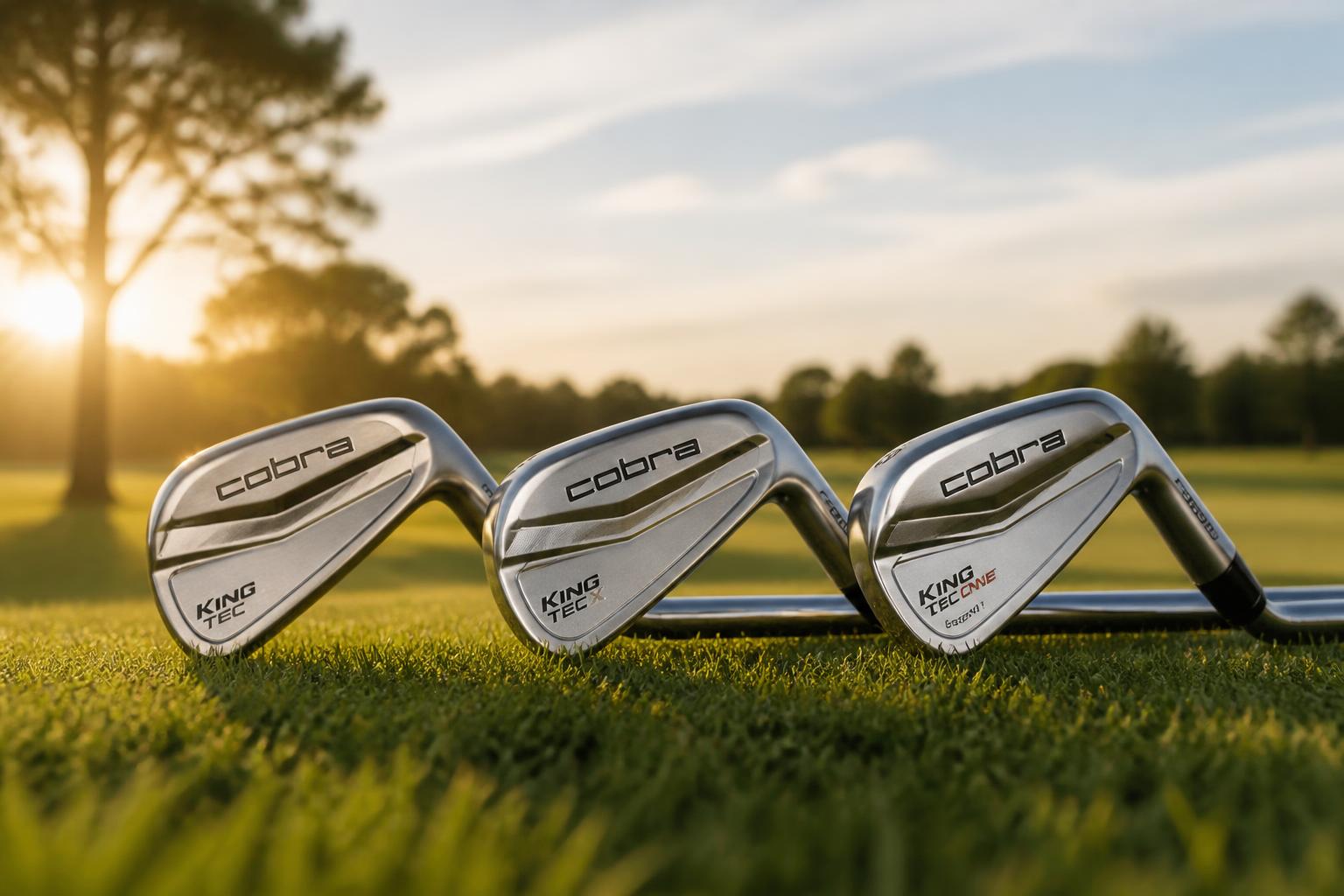
King Tec vs. King Tec X vs. King Tec One Length: What’s the Difference?
Cobra currently offers three distinct King Tec iron families, and they’re not just cosmetic variations. Each targets a different player profile:
| Model | Player Profile | Key Design Feature |
|---|---|---|
| King Tec | Better player seeking workability | Compact shape, forged feel, less offset |
| King Tec X | Mid-handicap looking for forgiveness | Slightly larger profile, more offset, higher launch |
| King Tec One Length | Golfers wanting swing consistency | All clubs built to 7-iron length |
The King Tec X also comes in a One Length version, which uses the same head design but with a single shaft length throughout the set.
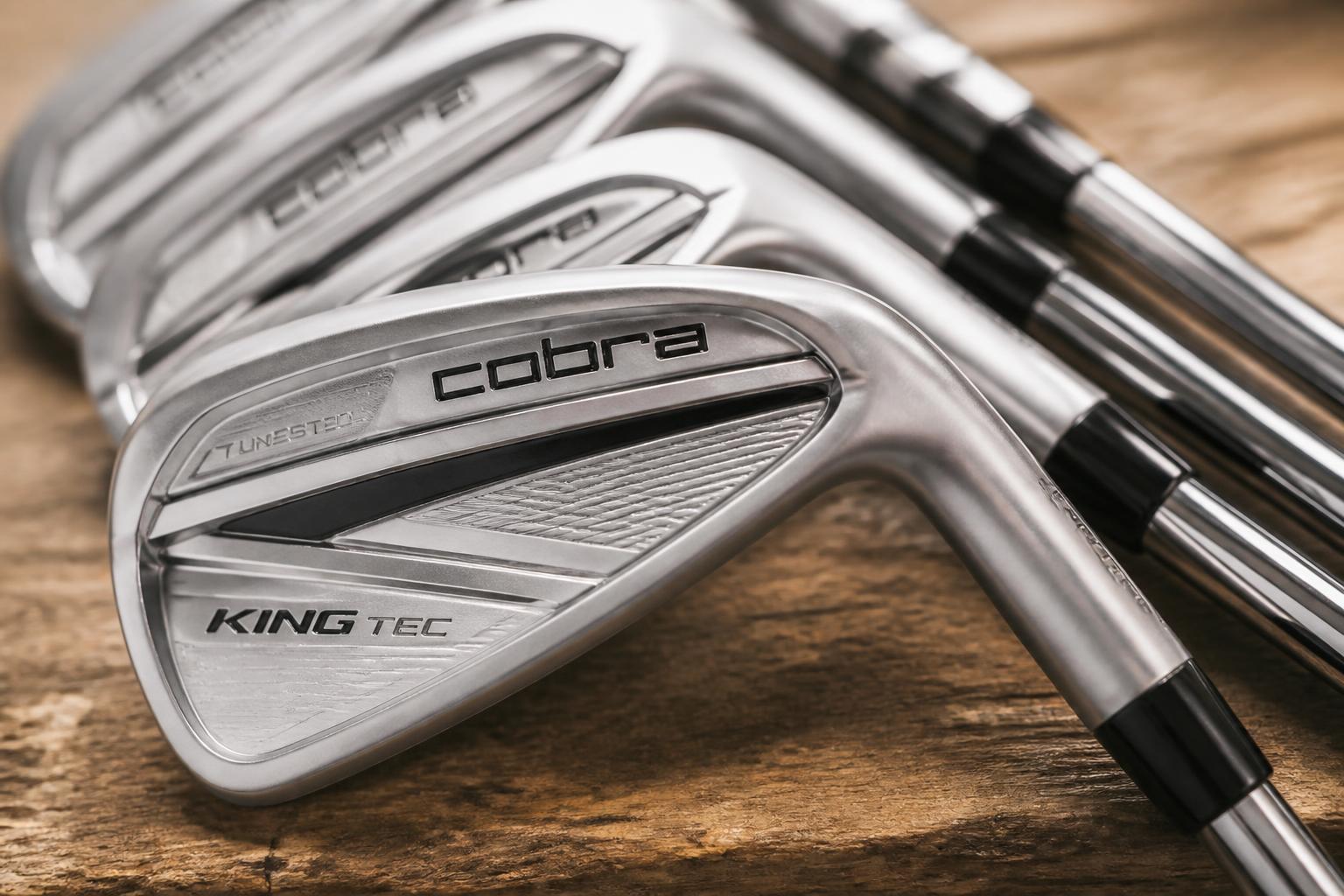
Cobra King Tec Irons Specs (Current Generation)
The current King Tec irons use a hollow-body construction with a forged PWRSHELL face insert. Here are the key specs for the standard King Tec model:
| Club | Loft | Lie Angle | Offset | Length (Steel) | Length (Graphite) |
|---|---|---|---|---|---|
| 4 Iron | 19.5° | 60.5° | 3.2mm | 38.5″ | 39″ |
| 5 Iron | 22.5° | 61.0° | 2.8mm | 38″ | 38.5″ |
| 6 Iron | 25.5° | 61.5° | 2.4mm | 37.5″ | 38″ |
| 7 Iron | 29.0° | 62.0° | 2.1mm | 37″ | 37.5″ |
| 8 Iron | 33.0° | 62.5° | 1.8mm | 36.5″ | 37″ |
| 9 Iron | 38.0° | 63.0° | 1.6mm | 36″ | 36.5″ |
| PW | 43.0° | 63.5° | 1.4mm | 35.75″ | 36.25″ |
| GW | 48.0° | 63.5° | 1.2mm | 35.5″ | 36″ |
Stock shafts: KBS Tour Lite steel (regular, stiff, x-stiff) or UST Mamiya Recoil ESX graphite (senior, regular, stiff).
What the Standard King Tec Specs Mean for Your Game
The 29° 7-iron in the standard King Tec is moderate by modern standards — not as strong as game-improvement sets, but not as traditional as a blade. If you’re coming from a set with a 34° 7-iron, you’ll gain roughly a half-club of distance purely from the stronger loft. That’s worth knowing before you get excited about hitting your 7-iron farther; the ball flight will also be lower, so if you already struggle to hold greens, the standard King Tec may not help.
The offset progression from 3.2mm in the 4-iron down to 1.4mm in the pitching wedge is designed to help you square the face on longer clubs while keeping the short irons looking cleaner at address. If you’ve played blades or players’ cavities in the past, the 4-iron offset will be visible but not distracting.
Cobra King Tec X Irons Specs
The King Tec X is the more forgiving sibling. It has a wider sole, more offset, and stronger lofts to help get the ball airborne:
| Club | Loft | Lie Angle | Offset | Length (Steel) | Length (Graphite) |
|---|---|---|---|---|---|
| 4 Iron | 18.5° | 60.5° | 3.8mm | 38.5″ | 39″ |
| 5 Iron | 21.5° | 61.0° | 3.4mm | 38″ | 38.5″ |
| 6 Iron | 24.5° | 61.5° | 3.0mm | 37.5″ | 38″ |
| 7 Iron | 28.0° | 62.0° | 2.6mm | 37″ | 37.5″ |
| 8 Iron | 32.0° | 62.5° | 2.3mm | 36.5″ | 37″ |
| 9 Iron | 37.0° | 63.0° | 2.0mm | 36″ | 36.5″ |
| PW | 42.0° | 63.5° | 1.8mm | 35.75″ | 36.25″ |
| GW | 47.0° | 63.5° | 1.6mm | 35.5″ | 36″ |
Stock shafts: KBS Tour Lite steel or UST Mamiya Recoil ESX graphite.
The King Tec X lofts are about 1° stronger than the standard King Tec through the set. That translates to roughly 2–3 yards more distance per club, assuming the same swing.
The Trade-Off You Need to Know About
That extra distance comes with a real consequence: less stopping power. A 28° 7-iron launches lower and lands with more roll-out than a traditional 34° 7-iron. If you play on firm, fast greens, you’ll need to account for that extra release. If you play on soft courses or hit down steeply on the ball, it’s less of an issue.
The King Tec X also has noticeably more offset than the standard King Tec — 2.6mm vs. 2.1mm in the 7-iron. For a golfer who naturally draws the ball, that extra offset can turn a slight draw into a hook. If you already fight a hook, the standard King Tec or a different model entirely is the safer choice.
Cobra King Tec One Length Specs
The One Length version is different from everything else in the King Tec lineup. Every iron in the set is built to the length of a standard 7-iron (37″ with steel shaft). The lofts match the King Tec X, but the lie angles are adjusted to account for the single-length setup:
| Club | Loft | Lie Angle | Offset | Length |
|---|---|---|---|---|
| 4 Iron | 18.5° | 60.0° | 3.8mm | 37″ |
| 5 Iron | 21.5° | 60.5° | 3.4mm | 37″ |
| 6 Iron | 24.5° | 61.0° | 3.0mm | 37″ |
| 7 Iron | 28.0° | 61.5° | 2.6mm | 37″ |
| 8 Iron | 32.0° | 62.0° | 2.3mm | 37″ |
| 9 Iron | 37.0° | 62.5° | 2.0mm | 37″ |
| PW | 42.0° | 63.0° | 1.8mm | 37″ |
| GW | 47.0° | 63.0° | 1.6mm | 37″ |
Stock shaft: KBS Tour 90 steel (regular, stiff) or UST Mamiya Recoil ES 460 graphite (senior, regular, stiff).
The idea behind One Length is that you use the same setup, ball position, and swing for every iron. If you struggle with long irons because of inconsistent setup, this approach eliminates that variable. The tradeoff is that you lose some distance on the long end and gain some on the short end compared to variable-length sets.
How to Check If One Length Is Right for You
Before committing to One Length, do a quick test at your local shop: hit your current 7-iron, then hit your current 4-iron. If the 4-iron feels uncomfortable primarily because of the longer shaft and different lie angle — not because of the smaller head — One Length could solve that problem. If you hit your 4-iron fine but just don’t get enough height, One Length won’t fix that; you’d be better off with the standard King Tec X or a hybrid replacement.
One Length also changes your wedge gapping. Your pitching wedge will fly noticeably farther than a traditional PW because it’s built at 7-iron length with a 42° loft. If you’re used to hitting full pitching wedges from 120 yards, expect that number to jump to 130–135. You’ll need to adjust your approach shots or add a gap wedge to fill the distance gap.
Loft Comparison: King Tec vs. King Tec X vs. Competitors
The King Tec X lofts are aggressive. A 28° 7-iron is about 2–3° stronger than what you’d find in a traditional players’ iron. Here’s how they stack up against similar models:
| Iron | Cobra King Tec X | Titleist T200 | Callaway Apex 21 | TaylorMade P790 |
|---|---|---|---|---|
| 7 Iron | 28° | 30.5° | 30° | 30.5° |
| PW | 42° | 43° | 42° | 45° |
If you’re coming from an older set with traditional lofts (like a 34° 7-iron), you’ll see a full club or more of distance increase. That’s not because the King Tec is hotter — it’s because the lofts are stronger.
Why This Matters for Your Set Gapping
If you’re mixing King Tec irons with your existing wedges, pay close attention to the gap between your pitching wedge and your sand wedge. The King Tec X PW at 42° leaves a large gap to a typical 56° sand wedge — that’s 14° of separation. You’ll want a gap wedge around 50° to fill that space. The King Tec X GW at 47° helps, but you’ll still have a 9° jump to a 56° sand wedge, which is manageable but on the edge of creating distance gaps.
Swing Weight and Total Weight
Stock swing weights for the King Tec line are typically D2–D3 with steel shafts and D1–D2 with graphite. The One Length models come in slightly heavier at D3–D4 because the shorter long irons need extra head weight to match the feel of the 7-iron.
Total weight varies by shaft choice:
- KBS Tour Lite stiff: ~115g shaft weight
- KBS Tour 90 stiff (One Length): ~100g shaft weight
- Recoil ESX graphite stiff: ~85g shaft weight
If you’re sensitive to swing weight, check with your fitter before ordering. Cobra offers adjustable weights in the King Tec line, but the stock setup is what most golfers will play.
How to Verify Your Swing Weight at Home
If you’re concerned about swing weight, you can check it without a professional fitting. Place the club on a 14-inch swing weight scale (available at most golf shops) with the grip resting on the fulcrum point. A reading of D2–D3 is the stock target for steel-shafted King Tec irons. If your reading comes in at C9 or below, the club will feel noticeably lighter through the swing — that’s a sign the head weight or shaft weight doesn’t match the stock spec.
Grip and Stock Setup
All King Tec irons come standard with a Lamkin Crossline grip (58 round, 58 rib available as a custom option). The grip is standard size with about 4 wraps of tape, which puts it close to midsize.
If you prefer a different grip size, factor that into your order — changing grip size affects swing weight slightly. A move from standard to midsize adds roughly 5–7 grams, which can shift swing weight by about half a point.
How to Read the Spec Chart for Your Game
If you’re a mid-handicapper: The King Tec X is the safer choice. The extra offset and wider sole help with launch and forgiveness on off-center hits. The stronger lofts give you the distance you expect from modern irons.
If you’re a lower handicap: The standard King Tec gives you a more compact shape and less offset. You’ll have an easier time working the ball, but you’ll give up some forgiveness on mishits.
If you struggle with long irons: The One Length version is worth a serious look. The 4, 5, and 6 irons are the same length as your 7-iron, which removes the setup changes that cause thin and fat shots.
The Practical Next Step
Before you order, write down your current iron distances and your typical miss pattern. If your misses are mostly thin shots on long irons, One Length directly addresses that. If your misses are mostly hooks, the extra offset in the King Tec X will make things worse — go with the standard King Tec. If your misses are mostly fat shots, the wider sole of the King Tec X will help you glide through turf more consistently.
Common Spec-Related Questions
Do the King Tec irons have adjustable lofts?
No. The King Tec irons are fixed-loft. You can bend them 2° flat or upright at a qualified fitter, but they don’t have the adjustable hosel found on some other Cobra models.
Are the King Tec X lofts too strong for a high handicapper?
The 28° 7-iron means you’ll hit the ball farther, but you’ll also get less height and more roll-out. If you need help getting the ball in the air, consider the standard King Tec or a hybrid-iron set like the Cobra Golf Men’s Baffler Hybrid Iron Set, which replaces the long irons with hybrids entirely. The Baffler set uses hybrids for the 4 and 5 irons and hollow hybrid-irons for the 6 and 7, which gives you higher launch on the long end without sacrificing precision on the short end.
What’s the difference between King Tec and King Tec X in terms of feel?
The standard King Tec uses a forged face insert and has a softer feel at impact. The King Tec X is still forged but feels slightly firmer due to the larger head and different internal construction. Both are noticeably softer than cast irons.
Can I mix King Tec and King Tec X in the same set?
Yes, and it’s a common combo. Many golfers play King Tec X in the 4–6 irons for forgiveness and switch to the standard King Tec in the 7–PW for more control. The lofts are close enough that you won’t create a major gap.
How do I verify which generation of King Tec irons I’m looking at?
Check the sole of the club for the model name and the hosel for a serial number. The current generation has “King Tec” or “King Tec X” stamped on the sole near the toe. Earlier versions may have “King Forged Tec” or different badge colors. If you’re buying used, ask the seller for a clear photo of the sole and the 7-iron loft — that will tell you which generation you’re getting.
Choosing Your Specs: The Bottom Line
The right King Tec model comes down to your miss pattern and what you want from your irons. If you want maximum forgiveness and distance, the King Tec X is the pick. If you want a compact look with workability, the standard King Tec fits better. And if your inconsistent ball striking comes from setup changes between clubs, the One Length version removes that problem entirely.
Whichever model you choose, get properly fit for shaft flex and lie angle. The stock specs are a starting point, not a final answer. A 2° lie adjustment can be the difference between consistent draws and a two-way miss. And if you’re buying used, verify the model year before you commit — the specs change between generations, and what you see in this chart applies to the current lineup.

Michael Reeves is a PGA Professional with over 20 years of experience in competitive golf and instruction. A former Division I collegiate player at the University of Texas, he competed on the mini-tours before transitioning to full-time coaching and golf journalism. He has been a certified PGA teaching professional since 2005 and has worked with players at every level, from absolute beginners to collegiate champions.
His writing has appeared in Golf Digest, Golf Magazine, and The Left Rough. At GolfHubz, Michael leads the editorial team, overseeing fact-checking and ensuring every answer meets the same standard he demands on the lesson tee: clear, evidence-based, and immediately useful.
When he’s not writing or teaching, Michael plays to a +1.4 handicap at his home club in Austin, Texas. He has attended over 40 major championships as a journalist and fan, and has played more than 200 courses across 15 countries.
You can reach Michael at [email protected] or follow his occasional swing analysis posts on the site.