Ping i530 Irons Specs Chart
The PING i530 irons sit in a specific spot in PING’s lineup: they blend distance and forgiveness in a compact shape that doesn’t look like a game-improvement club. If you’re comparing specs across the set — lofts, lengths, lie angles, swing weights — this guide gives you the numbers in one place, plus what they actually mean for your bag.
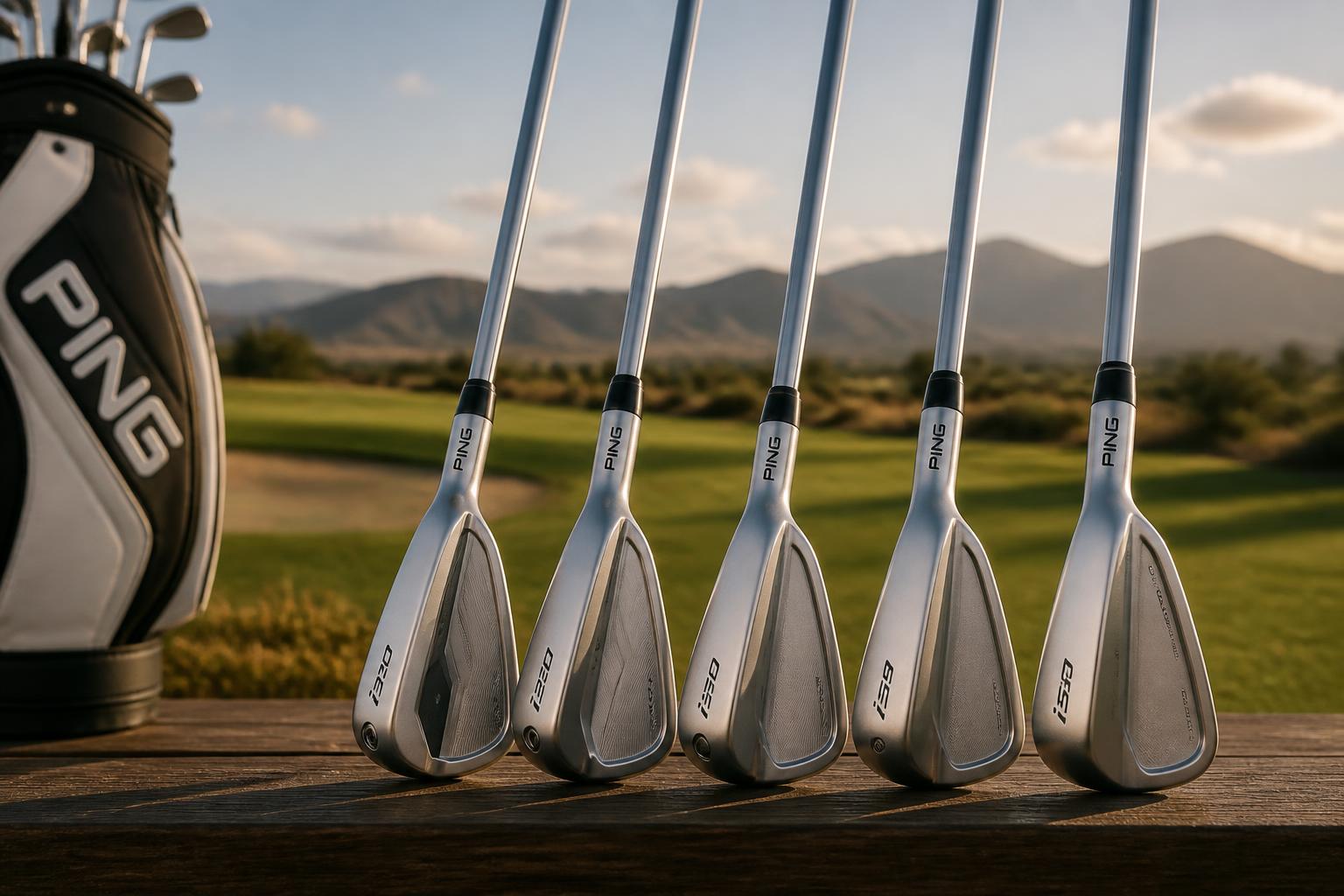
Where They Fit in PING’s Lineup
PING positions the i530 between the i230 (more traditional, higher spin) and the G430 (maximum forgiveness). The i530 uses a forged face, a titanium badge, and internal weighting to push ball speed while keeping the sole and topline looking closer to a player’s iron.
The key trade-off: you get distance and forgiveness, but you give up some workability and spin control compared to a blade or a compact cavity back. If you’re the type of player who likes to flight shots down or curve the ball both ways on command, the i530’s lower spin profile will feel limiting.
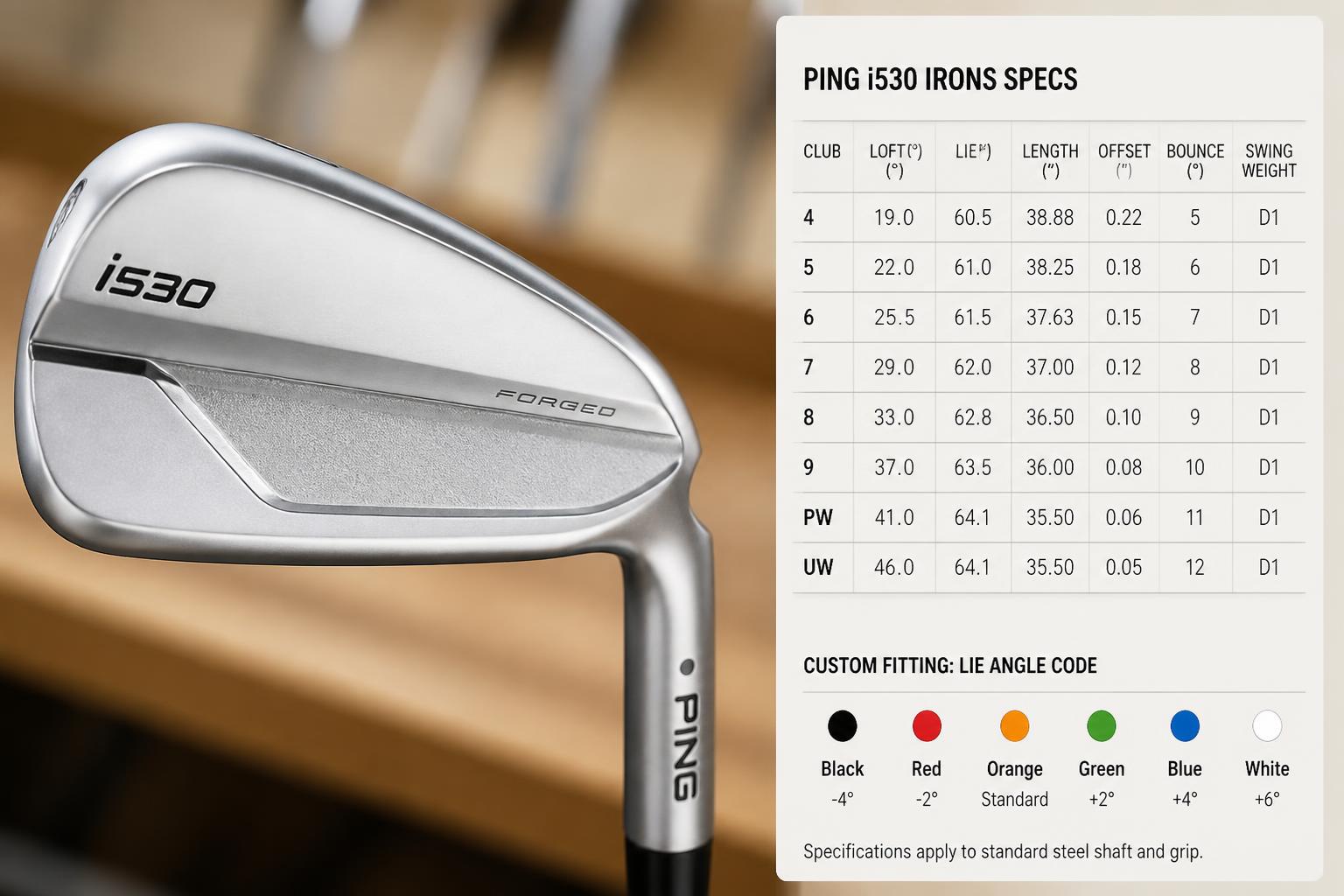
PING i530 Irons Specs Chart
Below are the stock specifications for the PING i530 irons. These are the standard numbers PING publishes for the set.
| Club | Loft | Lie | Length | Offset | Swing Weight (Steel) | Swing Weight (Graphite) |
|---|---|---|---|---|---|---|
| 4 Iron | 19.0° | 60.50° | 38.75″ | 0.16″ | D2 | D1 |
| 5 Iron | 21.5° | 61.00° | 38.25″ | 0.15″ | D2 | D1 |
| 6 Iron | 24.0° | 61.50° | 37.75″ | 0.14″ | D2 | D1 |
| 7 Iron | 27.0° | 62.00° | 37.25″ | 0.13″ | D2 | D1 |
| 8 Iron | 31.0° | 62.50° | 36.75″ | 0.12″ | D2 | D1 |
| 9 Iron | 36.0° | 63.00° | 36.25″ | 0.11″ | D2 | D1 |
| PW | 41.5° | 63.50° | 36.00″ | 0.10″ | D2 | D1 |
| UW | 46.5° | 63.50° | 36.00″ | 0.10″ | D2 | D1 |
Stock shaft options:
- Steel: PING Dynamic Gold Mid 100 (stiff, regular)
- Graphite: PING ALTA CB Black (stiff, regular, senior)
Stock grip: PING 360 Dyla-wedge Lite (standard, +1/32″, +1/16″)
How to verify your specs: Every PING iron comes with a color code dot on the hosel. If you’re buying used or checking a set in person, look for that dot — black means standard lie. You can also check the serial number on the hosel with PING’s customer service to confirm the original build sheet if you’re buying second-hand and want to know exactly what shafts and lie angles were ordered.
What the Specs Mean for Your Game
Lofts: Stronger Than Traditional, But Not Extreme
The 7-iron sits at 27.0°, which is about 3–4 degrees stronger than a traditional player’s iron (like the i230 at 30.5°). This is how PING gets the distance numbers up without relying solely on face technology.
What this means: Your 7-iron will fly farther than an older set, but the gaps between clubs stay consistent. If you’re replacing a set from 5+ years ago, expect about one club more distance through the bag.
The trade-off you need to plan for: Stronger lofts mean lower launch and less spin on approach shots. If you play on firm greens or courses with small landing zones, you’ll need to account for more roll-out. The i530’s internal weighting helps get the ball up, but it won’t produce the same drop-and-stop action you’d get from a higher-spinning iron like the i230.
Lie Angles: Standard PING Color Code
The stock lie angles are PING’s black dot (standard) specification. If you’ve been fitted for PING clubs before, you already know your color code. If not, the black dot is the neutral starting point.
Decision rule: If you tend to miss left (draw/hook), you may need a flatter lie (white or green dot). If you miss right (fade/slice), a more upright lie (blue or red dot) could help. A fitting is the reliable way to confirm this.
How to check your lie angle at home: Place a lie board or a piece of masking tape on the sole of the club and hit a few shots off a hard surface. If the impact mark is toward the toe, your lie is too upright. If it’s toward the heel, it’s too flat. This is a rough check — a proper fitting with a launch monitor is more accurate — but it will tell you if you’re significantly off from standard.
Offset: Moderate Progression
The i530 has a small amount of offset — 0.16″ in the 4-iron, dropping to 0.10″ in the wedges. That’s less than a game-improvement iron (G430 has 0.22″ in the 4-iron) but more than a blade.
What this means: You get some help squaring the face at impact, but the look at address still reads as a player’s iron. If you hate offset, the i530 is one of the more compact options in the distance-forgiveness category.
Who Should Play the PING i530?
The i530 targets golfers who:
- Want distance without a chunky, thick-topline look
- Have a moderate-to-fast swing speed (the stock steel shaft is 100g, lighter than traditional 120g+ shafts)
- Want forgiveness on off-center hits but still want to shape shots when needed
- Prefer a firmer feel at impact (the forged face gives a crisper sensation than a fully cast iron)
Who should look elsewhere:
- High handicappers (20+): The G430 or G440 line offers more forgiveness and higher launch. The i530’s compact head is less forgiving on severe mis-hits. If your miss is a heavy toe strike or a thin hit that slides down the face, you’ll lose more distance with the i530 than you would with a wider-sole game-improvement iron.
- Low handicappers who want max workability: The i230 or a blade gives you more spin control and shot-shaping ability. The i530 launches higher and spins less, which limits your ability to hold firm greens with long irons. If you regularly need to stop a 4-iron on a hard green, this set will frustrate you.
- Players who need a lot of help getting the ball airborne: The i530’s center of gravity is lower than a blade, but not as low as a super game-improvement iron. If you struggle with launch, the G430 is the safer choice.
PING i530 vs. PING i240: What’s the Difference?
If you’re comparing PING’s newer iron models, the PING i240 Men’s Iron Set – 25 Clubs is worth understanding. The i240 is a more recent release that sits in a similar category — distance with a compact look — but with some key differences:
| Feature | i530 | i240 |
|---|---|---|
| Construction | Forged face, titanium badge | Multi-material, hollow body |
| Feel | Firmer, more responsive | Slightly softer, more dampened |
| Spin | Lower | Slightly higher |
| Launch | Mid-high | Mid |
| Target player | Faster swing speeds | Moderate swing speeds |
The i240 is a better fit if you want a touch more spin and a softer feel. The i530 is the choice if you want maximum ball speed and don’t mind a firmer impact.
One important distinction: The i240 is designed for players who want the distance benefits of a hollow-body iron but need a bit more help stopping the ball on the green. If your iron game relies on spin to hold greens — especially from the rough — the i240’s slightly higher spin numbers will serve you better than the i530’s lower trajectory.
Common Questions About the PING i530
What handicap are PING i530 irons for?
The i530 is best suited for mid-handicap golfers — roughly 5 to 15 handicap. Better players (scratch to 5) can play them if they want extra distance, but they may find the lower spin limits their ability to stop the ball on firm greens. Higher handicaps (20+) will get more consistent help from the G430 or G440 line.
Is the Ping i530 forgiving?
Yes, but within limits. The i530 is forgiving for its size and shape — it maintains ball speed on off-center hits better than a blade or a compact cavity back. However, it’s not as forgiving as a true game-improvement iron. If you consistently miss toward the toe or heel, you’ll still lose noticeable distance and accuracy. The forgiveness is designed to help on slight mis-hits, not severe ones.
Who should play the Ping i530?
Golfers who want distance and forgiveness in a package that doesn’t look like a game-improvement club. It’s a strong fit for mid-handicappers with moderate-to-fast swing speeds who want to close the gap between their current irons and the distance their playing partners are getting from stronger-lofted sets.
What year did PING i530 irons come out?
The PING i530 irons were released in 2024 as part of PING’s i-series refresh. They sit alongside the i230 in the lineup, with the i530 offering more distance and the i230 offering more control.
Stock Shaft Options and Fitting Notes
The stock steel shaft is the PING Dynamic Gold Mid 100, which weighs 100 grams. This is lighter than the classic Dynamic Gold S300 (130g) or Dynamic Gold 105 (105g). The lighter weight helps generate clubhead speed, but it also changes the feel — the club will swing lighter than a traditional steel shaft.
The stock graphite option is the PING ALTA CB Black, available in stiff, regular, and senior flexes. This is a counter-balanced shaft that helps with launch and consistency, especially for players with moderate swing speeds.
Fitting note: If you’re between flexes, err toward the stiffer option with the i530. The strong lofts and low spin already produce a penetrating ball flight; a softer shaft can add unwanted spin and launch.
A common mismatch to avoid: If you’re coming from a set with heavier steel shafts (120g+), the stock 100g option will feel noticeably lighter. That’s not a flaw — it’s a design choice to help with speed. But if you prefer a heavier feel for tempo and timing, you’ll want to order the i530 with an aftermarket shaft option rather than the stock offering. Test the stock shaft first; if the club feels too light through the swing, that’s your signal to spec up in weight.
Final Thoughts on the PING i530 Specs
The i530’s spec sheet tells a clear story: PING engineered this set to maximize ball speed while keeping the head size and offset in a range that appeals to better players. The strong lofts, moderate offset, and lighter stock shaft all point toward distance as the primary goal.
If you’re deciding between the i530 and something like the TaylorMade Golf Qi Max HL Irons Graphite Ladies Righthand 6-PW,AW, the key difference is target player. The Qi Max HL is built for higher launch and maximum forgiveness — a different category entirely. The i530 asks for a bit more skill but rewards you with a cleaner look and more workability.
Before you buy, get fitted. The lie angle, shaft weight, and flex make a bigger difference in your results than the head design itself. The specs above are the starting point; your fitter will adjust from there based on your swing. If you’re buying online without a fitting, at minimum verify your lie angle color code and shaft flex against your current set’s specs so you’re not guessing on the two variables that matter most.

Michael Reeves is a PGA Professional with over 20 years of experience in competitive golf and instruction. A former Division I collegiate player at the University of Texas, he competed on the mini-tours before transitioning to full-time coaching and golf journalism. He has been a certified PGA teaching professional since 2005 and has worked with players at every level, from absolute beginners to collegiate champions.
His writing has appeared in Golf Digest, Golf Magazine, and The Left Rough. At GolfHubz, Michael leads the editorial team, overseeing fact-checking and ensuring every answer meets the same standard he demands on the lesson tee: clear, evidence-based, and immediately useful.
When he’s not writing or teaching, Michael plays to a +1.4 handicap at his home club in Austin, Texas. He has attended over 40 major championships as a journalist and fan, and has played more than 200 courses across 15 countries.
You can reach Michael at [email protected] or follow his occasional swing analysis posts on the site.