Lamkin Grip Guide
Lamkin has been making golf grips since 1917, and their lineup covers everything from soft rubber compounds to firm, tour-preferred textures. The challenge isn’t finding a Lamkin grip—it’s picking the right one from a catalog that spans multiple families, each with its own feel and performance profile.
This guide breaks down the main Lamkin grip families, what each does well, and how to match one to your swing characteristics.

The Three Questions That Determine Your Grip Choice
Before looking at specific models, answer these three questions:
1. Do you generate a lot of hand action through impact? If you tend to flip or release aggressively, you need more traction.
2. Do your hands sweat or do you play in humid conditions? This determines whether you need a cord or textured surface.
3. Do you prefer a firm, connected feel or a softer, shock-absorbing feel? This is largely personal preference, but it also relates to how much feedback you want.
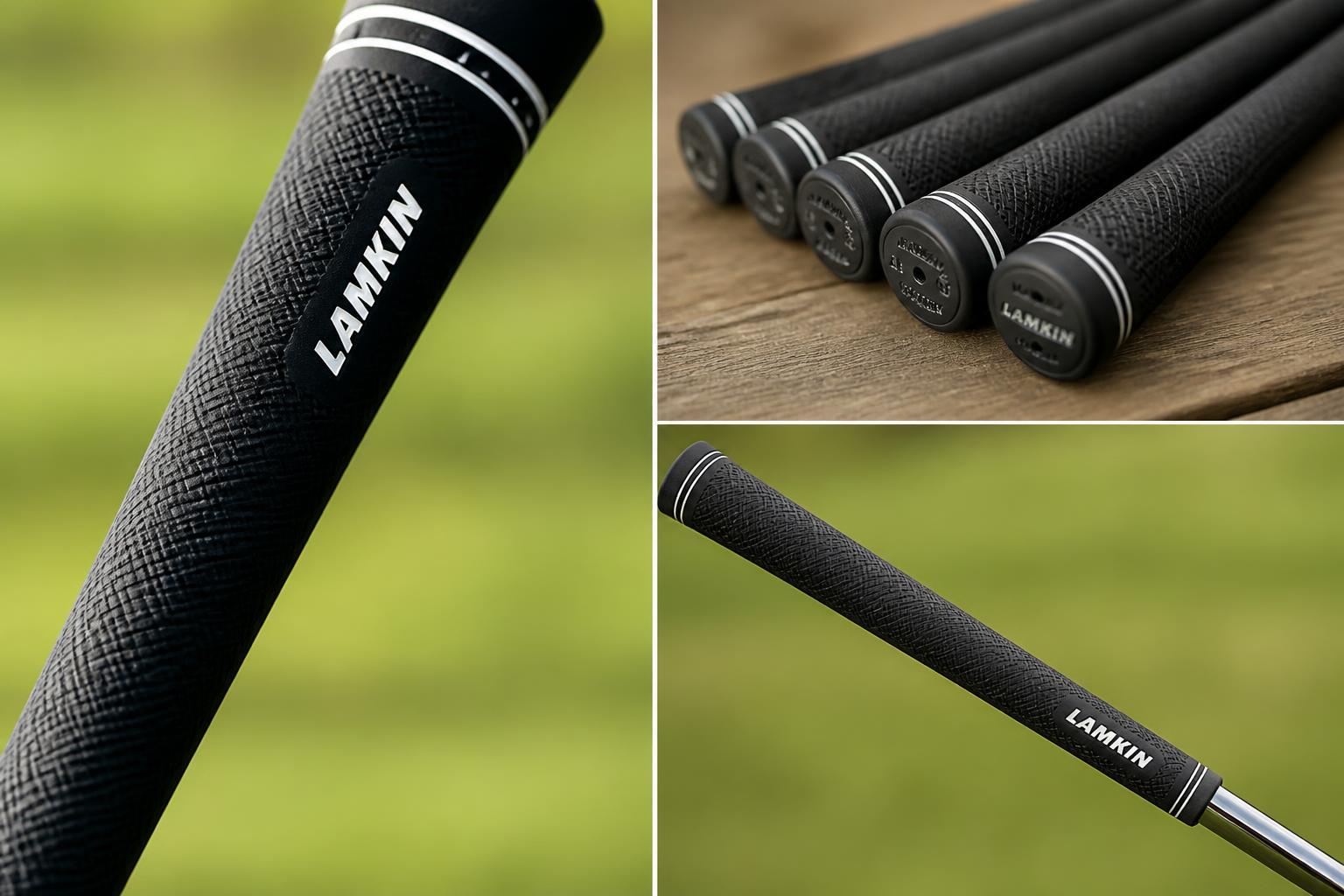
Your answers will point you toward one of the three main Lamkin families: Crossline, Sonar, or ST+2.
Lamkin Crossline: The Tour Standard
The Crossline is Lamkin’s most established design and the grip you’ll see on many OEM clubs straight from the factory. It uses a classic crosshatch pattern that provides traction without aggressive texture.
Key characteristics:
- Firm feel with minimal shock absorption
- Consistent surface texture that works in dry and light humid conditions
- Available in .580 and .600 core sizes — important for matching to your shaft butt diameter
- Standard weight around 50g in the standard size
The Lamkin Crossline Black Golf Grip Bundle (8 Piece), Standard gives you the classic Crossline pattern in a set of eight grips. This is a practical option if you’re regripping a partial set or want spares for frequent replacements.
If you prefer a smooth, uninterrupted surface, the Crossline 360 variant removes the seam and uses a continuous pattern. The Lamkin Crossline Black 360 Golf Grips Bundle Standard (13 Grips) covers a full set and includes OEM Taylormade branding on the grip cap only—the grip body itself is standard Lamkin Crossline.
Who should choose Crossline: Golfers who want a firm, proven grip with no surprises. If you play in dry conditions and like feeling the club head through the handle, this family is the safest starting point.
Lamkin Sonar: The Middle Ground
The Sonar family uses Lamkin’s “sonar” technology—a softer compound with a pattern of small, raised nodules that provide traction while absorbing more vibration than the Crossline.
Key characteristics:
- Softer compound than Crossline, with more shock absorption
- Nodule pattern provides grip in multiple directions
- Slightly heavier than Crossline in comparable sizes
- Better for players with arthritis or hand sensitivity
The trade-off is straightforward: you gain comfort and vibration dampening, but you lose some of the firm, direct feedback that better players often prefer.
Who should choose Sonar: Golfers who play frequently, want less hand fatigue, or have joint sensitivity. Also a good choice if you live in a humid climate where a softer compound helps maintain traction.
Lamkin ST+2: Maximum Traction
The ST+2 uses a dual-layer construction with a firmer core and a softer, high-traction outer layer. The surface pattern is more aggressive than the Crossline, with deeper channels that move moisture away from your hands.
Key characteristics:
- High-traction surface that performs well in humidity
- Dual-layer construction — firm stability with soft feel
- More surface texture than Crossline or Sonar
- Good for aggressive swingers who need the club to stay put through impact
This is the grip to consider if you’ve ever felt the club twist in your hands on off-center hits or when swinging hard.
Who should choose ST+2: Players with fast swing speeds, aggressive hand action, or those who play in humid or sweaty conditions.
Core Size Matters: .580 vs .600
Lamkin grips come in two core sizes, and this is where many golfers make mistakes.
- .580 core grips stretch more when installed, resulting in a slightly thicker finished grip. They work best on shafts with a standard butt diameter.
- .600 core grips fit standard shafts with less stretch, preserving the grip’s original feel and profile.
The rule of thumb: if you want a slightly thicker grip feel, choose .580. If you want the grip to feel as designed, choose .600. If you’re unsure about your shaft’s butt diameter, measure it with calipers or check the shaft manufacturer’s specifications.
A quick check before you buy: If you’re replacing grips on a set of clubs that came from a major OEM in the last five years, they almost certainly use .600 core grips. If you’re working with older clubs or aftermarket shafts, measure the butt diameter first—a .580 grip on a shaft that needs .600 will feel noticeably thicker and may affect your release through impact.
Step-by-Step: Sizing and Installing Lamkin Grips
1. Measure your hand. Wrist crease to middle-finger tip: under 7″ = undersize, 7-8.75″ = standard, over 8.75″ = midsize or jumbo. Lamkin’s softer compounds feel slightly thinner at the same nominal size.
2. Remove the old grip. Cut it off with a hook blade, peel away old tape, and clean the shaft with grip solvent.
3. Apply fresh double-sided tape. Add wraps for a firmer feel if you’re between sizes.
4. Slide the grip on. Apply solvent generously inside the grip and on the tape; Lamkin’s rubber compounds slide on easily compared with cord grips.
5. Align before it sets. Straighten the logo and any alignment aids immediately.
6. Wait before play. Let the grip set for at least 2 hours, ideally overnight.
Stop and escalate: If the grip won’t slide past the halfway point after two attempts, stop. Take the club to a shop — a professional installation costs less than a damaged grip.
Installation Considerations
Lamkin grips install the same way as most rubber grips: with solvent, tape, and a vise. If you’re doing it yourself, here’s the order:
1. Remove old grips and tape
2. Clean the shaft butt with solvent
3. Apply new double-sided tape
4. Apply solvent to the tape and inside the grip
5. Slide the grip on quickly, before the solvent evaporates
6. Align the grip before it sets
The Champkey X Rubber Golf Grips Set – 13 Grips & Repair Kit or Tapes (Midsize, Blue) is a different brand, but it’s worth mentioning because it includes the full installation kit—solvent, hook blade, and vise clamp—plus 15 tapes. If you’re new to regripping, having the tools bundled with the grips saves you a separate purchase. This set uses a .600 round core and comes in standard or midsize, with weights around 60g for standard and 72g for midsize.
A practical branch point during installation: After you slide the grip on, check alignment within the first 30 seconds. If the grip is twisted or the logo isn’t sitting square, you can still rotate it while the solvent is wet. If you wait longer and the grip starts to set, don’t force it—you’ll tear the rubber or create a bubble. Stop, cut the grip off, and start over with fresh tape. It’s faster than trying to salvage a misaligned grip.
When to stop and call a professional: If you’re regripping a putter with a delicate taper, a club with a graphite shaft that shows any cracking near the butt, or a set of vintage clubs with non-standard butt diameters, take them to a shop. Also stop if you notice the grip won’t slide on smoothly within a few seconds—forcing it can crease the rubber and create a permanent weak spot.
Grip Size: Standard vs Midsize vs Oversize
Lamkin offers most models in standard and midsize, with some in oversize. Your hand size and glove size are the starting point, but your swing characteristics matter too.
- Standard: Works for most golfers with glove sizes under XXL
- Midsize: Better for larger hands or players who grip too tightly — the thicker grip reduces tension
- Oversize: For very large hands or golfers with arthritis who need maximum cushioning
A quick check: when you hold the club, your left hand’s middle and ring fingers should just barely touch the pad of your thumb. If they dig in, you need a larger size. If there’s a gap, you need a smaller size.
When to Replace Your Lamkin Grips
Grips wear out gradually, so it’s easy to miss the signs. Replace your grips when you notice:
- Shiny, slick spots on the surface where your hands contact the grip
- Cracks or cuts in the rubber
- Loss of traction in humid conditions — if your hands slip more than they used to
- Hardening of the rubber compound, which reduces shock absorption
A common benchmark is replacing grips once per year for regular players, or every 30–40 rounds. But this varies based on how often you play, whether you store clubs in extreme temperatures, and how much you practice.
A failure mode to watch for: If you store your clubs in a garage or car trunk through summer heat, the rubber compound can harden faster than normal. The symptom is subtle—the grip still looks fine, but it feels slick and doesn’t absorb vibration like it used to. If your grips are less than a year old but feel hard and slippery, heat exposure is the likely cause. Move your clubs to a climate-controlled space before replacing them, or you’ll cook the new set too.
The Practical Takeaway
Lamkin’s lineup isn’t complicated once you understand the three families:
- Crossline for firm, proven performance
- Sonar for comfort and vibration dampening
- ST+2 for maximum traction in tough conditions
Match the grip to your swing characteristics, not just your hand size. If you’re aggressive through impact, prioritize traction. If you play often and your hands fatigue, prioritize comfort. And always verify the core size before buying—getting this wrong changes the finished grip size.
The right grip won’t fix a swing flaw, but it will give you consistent feedback and control so you can actually work on your game without fighting the club in your hands.

Michael Reeves is a PGA Professional with over 20 years of experience in competitive golf and instruction. A former Division I collegiate player at the University of Texas, he competed on the mini-tours before transitioning to full-time coaching and golf journalism. He has been a certified PGA teaching professional since 2005 and has worked with players at every level, from absolute beginners to collegiate champions.
His writing has appeared in Golf Digest, Golf Magazine, and The Left Rough. At GolfHubz, Michael leads the editorial team, overseeing fact-checking and ensuring every answer meets the same standard he demands on the lesson tee: clear, evidence-based, and immediately useful.
When he’s not writing or teaching, Michael plays to a +1.4 handicap at his home club in Austin, Texas. He has attended over 40 major championships as a journalist and fan, and has played more than 200 courses across 15 countries.
You can reach Michael at [email protected] or follow his occasional swing analysis posts on the site.