Graphite Design Tour AD Shaft Specs Chart
Graphite Design’s Tour AD line is one of the most played aftermarket shaft families on tour, but the lineup can be confusing. There are multiple series (DI, BB, IZ, XC, VR, MJ, HY), each with its own bend profile, launch characteristics, and weight options. This chart and guide break down what each model does so you can match a shaft to your swing, not just to a name.
One important boundary before you start comparing: these specs describe the shaft’s design intent, not a guaranteed result for your swing. The same model in the same flex can launch differently depending on your driver head weight, swing tempo, and how you release the club. The specs are a filter for narrowing options, not a promise of what you’ll see on a launch monitor.

How to Read This Chart
Before you compare numbers, understand the three variables that matter most:
- Weight – Heavier shafts (70g+) generally lower launch and tighten dispersion. Lighter shafts (50-60g) help increase swing speed.
- Torque – Lower torque (2.5-3.5°) means the shaft resists twisting. Higher torque (4.0°+) feels softer and can help players who want more feel.
- Bend Point – Where the shaft flexes most. Low bend = lower launch, high bend = higher launch.
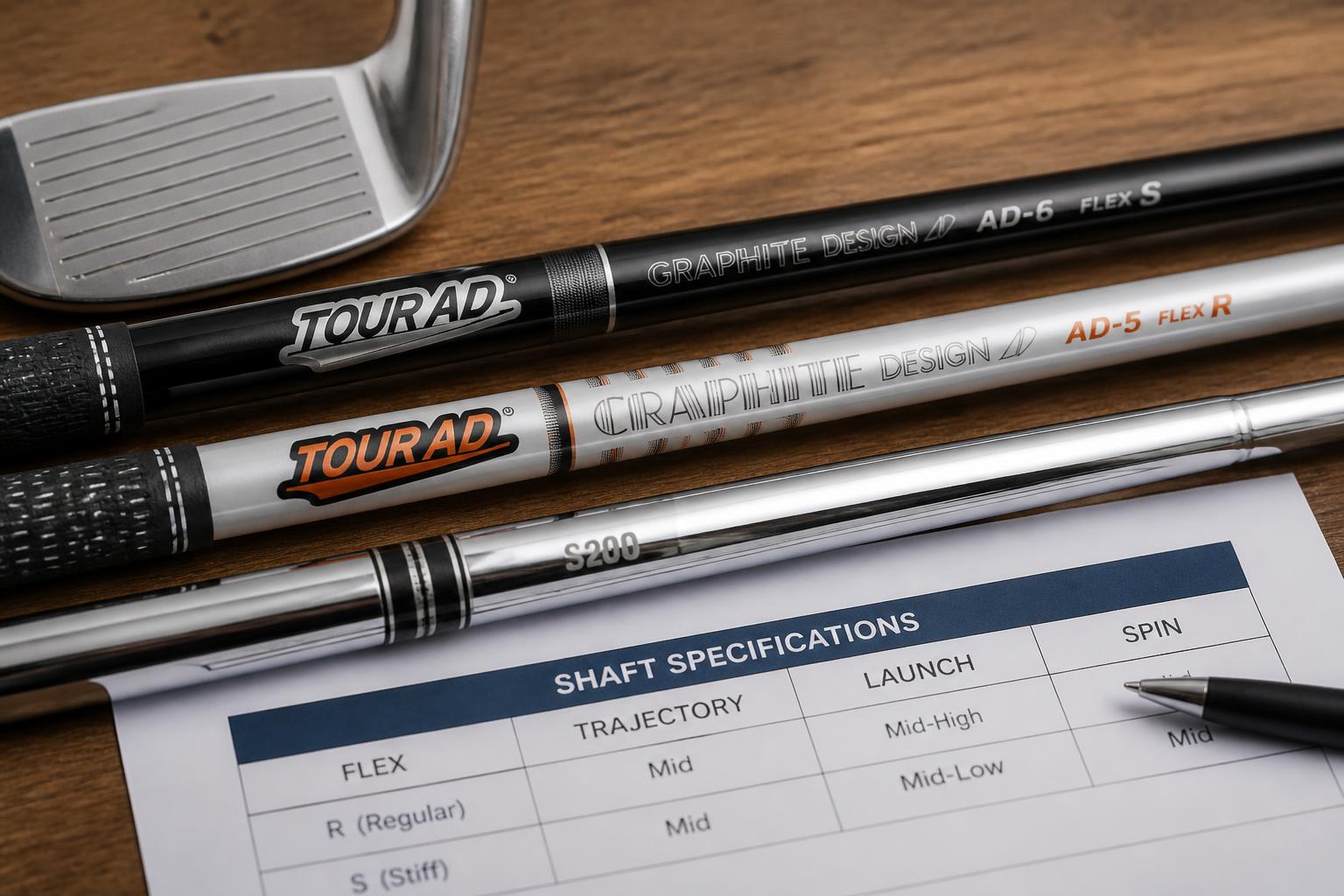
The Tour AD line is known for mid-launch, low-spin profiles across most models, but each series tweaks that formula differently.
Graphite Design Tour AD Specs Chart
| Model | Weight Range (g) | Torque Range (°) | Launch | Spin | Bend Profile |
|---|---|---|---|---|---|
| Tour AD DI | 55-85 | 2.8-4.1 | Mid | Low-Mid | Mid bend, smooth feel |
| Tour AD BB | 55-85 | 2.9-4.3 | Mid-High | Mid | High bend, active tip |
| Tour AD IZ | 55-85 | 2.8-4.0 | Mid-High | Low-Mid | Mid bend, firmer handle |
| Tour AD XC | 55-75 | 2.9-4.2 | Mid | Low | Low bend, stiff tip |
| Tour AD VR | 55-75 | 3.0-4.2 | Mid-High | Mid | High bend, soft mid |
| Tour AD MJ | 55-75 | 3.2-4.4 | High | Mid-High | High bend, soft tip |
| Tour AD HY | 65-105 | 2.8-4.0 | Mid | Low-Mid | Hybrid-specific profile |
Specs vary by flex and weight class. Always verify current specs on the manufacturer’s site before purchasing.
Tour AD DI: The Tour Favorite
The DI (Diamond Interface) is the most played Tour AD model on professional tours. It uses a mid-bend profile with a firmer handle section and a smoother mid-section. The result is a shaft that feels stable but not boardy.
- Best for: Players who want a predictable mid-launch flight with low-mid spin.
- Weight options: 55g to 85g in driver shafts.
- Feel: Firm but responsive. You feel the head load, but the shaft doesn’t whip.
If you’re coming from a stock stiff shaft and want more stability without giving up feel, the DI is the safest starting point in the lineup. The 6-weight class (around 60-65g) is the most common entry point for players moving from stock shafts, while the 7 and 8 weights are for players who want more heft and control.
Tour AD BB: Higher Launch, Active Tip
The BB (Boron Biaxial) uses a higher bend point with a more active tip section. It launches higher than the DI and spins slightly more. The boron material in the tip adds strength without adding weight, which keeps the tip lively.
- Best for: Players with smoother tempos who need help getting the ball airborne.
- Weight options: 55g to 85g.
- Feel: Softer tip feel. You’ll notice the tip load more aggressively through impact.
The BB is a common recommendation for players with moderate swing speeds (90-100 mph) who want more carry distance. If your current shaft launches the ball on a flat, boring trajectory that falls short of your target carry number, the BB’s higher launch is the practical fix — but only if you have a smooth enough tempo to let the tip work. Aggressive swingers will overpower the tip and see inconsistent face angles.
Tour AD IZ: The Stable Mid-Launch Option
The IZ (Impact Zone) is designed with a firmer handle and a stable mid-section. It’s slightly higher launching than the DI but with similar spin characteristics. The key difference is the feel: the IZ feels stiffer in the hands than the DI.
- Best for: Players who want DI-like performance but prefer a firmer overall feel.
- Weight options: 55g to 85g.
- Feel: Firm, stable, and less active through impact.
If you tend to get handsy through impact, the IZ’s firmer handle can help keep the face square. The trade-off is that you lose some of the DI’s smooth loading sensation — the IZ can feel “dead” to players who like to feel the shaft kick through impact. If you’re between the DI and IZ, the deciding question is simple: do you want more feedback (DI) or more stability (IZ)?
Tour AD XC: Low Launch, Low Spin
The XC (Xtreme Control) is the lowest-launching model in the current lineup. It uses a low bend point with a stiff tip section. This is a “hitter’s shaft” — it rewards aggressive tempo swings that would make softer shafts feel unstable.
- Best for: High swing speed players (105+ mph) who launch the ball too high and need to bring spin down.
- Weight options: 55g to 75g.
- Feel: Firm throughout. Minimal kick sensation.
The XC is not a good fit for smooth tempo swings. It needs speed to load properly. If your swing speed is under 100 mph, the XC will feel like a board and you’ll likely lose both carry distance and clubhead speed trying to force it. The practical test: if you currently balloon your driver shots or see spin numbers above 3,000 RPM on a launch monitor, the XC is worth trying. If your spin is already in a healthy range, this shaft will likely take too much spin off and reduce your carry.
Tour AD VR: The Feel-First Option
The VR (Variable Radius) uses a high bend point with a soft mid-section. This creates a shaft that feels active through the swing but still launches on a mid-high trajectory.
- Best for: Players who prioritize feel and rhythm over raw stability.
- Weight options: 55g to 75g.
- Feel: Soft mid-section with a firmer tip. You’ll feel the shaft load and release.
The VR is a good option for players who previously played senior or regular flex shafts and want to keep a smooth feel while moving into a stiffer flex. The catch: the soft mid-section can feel unstable to players with quick transition moves. If you tend to jerk the club from the top, the VR’s active mid-section will amplify that inconsistency rather than tame it.
Tour AD MJ: Maximum Launch
The MJ (Mid-Joint) is the highest-launching model in the driver lineup. It uses a high bend point and a soft tip, which helps players with slower swing speeds (under 90 mph) get the ball up quickly.
- Best for: Players who struggle to launch the ball high enough.
- Weight options: 55g to 75g.
- Feel: Soft tip, active release.
The MJ spins more than other Tour AD models. If you already have a high spin rate, this is not the shaft for you. But if your miss is a low, knuckling ball that runs out of carry, the MJ’s added launch and spin will help you hold greens and carry hazards. The trade-off is that the MJ can feel whippy to players who are used to firmer shafts — it’s designed for a specific swing profile, not as a general-purpose option.
Tour AD HY: Hybrid-Specific Shafts
The HY series is designed specifically for hybrids, not drivers. They come in heavier weights (65g to 105g) to match the swing weight and length of hybrid clubs.
- Graphite Design Tour AD HY 65 Hybrid Shaft (Stiff) – Good for players using hybrids as fairway wood replacements.
- Graphite Design Tour AD HY 85 Hybrid Shaft (X-Stiff) – Heavier option for players who want more control and a lower launch.
The HY profile is mid-launch with low-mid spin, which works well for most hybrid players. The heavier weights help keep the hybrid from feeling too light compared to your irons. Before you buy, check the tip diameter of your hybrid head — most modern hybrids use a .370″ parallel tip, but some older models and certain OEM heads use a .355″ taper. Installing the wrong tip diameter requires a shim or reaming, which can affect performance.
How to Choose Between Tour AD Models
Use this decision tree to narrow down your options:
1. What’s your swing speed?
- Under 90 mph: Look at the MJ or BB
- 90-105 mph: Look at the DI or IZ
- 105+ mph: Look at the XC or DI in heavier weights
2. What’s your miss?
- Too high, too much spin: XC or DI
- Too low, not enough carry: BB or MJ
- Inconsistent direction: IZ or DI
3. What’s your tempo?
- Smooth and rhythmic: BB or VR
- Aggressive and quick: XC or IZ
Common Mistakes When Buying a Tour AD Shaft
Mistake 1: Buying based on flex only. The Tour AD line has multiple models in the same flex. A stiff flex DI and a stiff flex XC feel completely different. Flex is just one variable.
Mistake 2: Ignoring weight. Moving from a 60g stock shaft to a 70g Tour AD will change your swing more than the bend profile will. Make sure you can still generate the same clubhead speed with the heavier weight. A quick verification: hit 10 balls with your current setup and note your average clubhead speed, then test the heavier shaft and compare. If you lose more than 1-2 mph, the heavier shaft is costing you distance regardless of how stable it feels.
Mistake 3: Assuming “tour” means “for pros.” The Tour AD line includes high-launch options like the MJ and BB that are designed for moderate swing speeds. The name refers to the technology, not the target player.
Mistake 4: Skipping the adapter check. If you’re buying a shaft with an adapter for a specific driver head, confirm the adapter is compatible with your driver model. Adapters are not universal across brands — a TaylorMade adapter won’t fit a Callaway head, and even within a brand, newer models may use different adapter designs. Check your driver’s hosel type before ordering.
Final Note on Fitting
Shaft specs are a starting point, not a guarantee. The same shaft can perform differently based on your driver head, swing weight, and grip size. If you’re serious about a Tour AD shaft, get fitted or at least test it against your current setup on a launch monitor. The specs chart tells you what the shaft is designed to do — only a fitting tells you what it will do for your swing.

Michael Reeves is a PGA Professional with over 20 years of experience in competitive golf and instruction. A former Division I collegiate player at the University of Texas, he competed on the mini-tours before transitioning to full-time coaching and golf journalism. He has been a certified PGA teaching professional since 2005 and has worked with players at every level, from absolute beginners to collegiate champions.
His writing has appeared in Golf Digest, Golf Magazine, and The Left Rough. At GolfHubz, Michael leads the editorial team, overseeing fact-checking and ensuring every answer meets the same standard he demands on the lesson tee: clear, evidence-based, and immediately useful.
When he’s not writing or teaching, Michael plays to a +1.4 handicap at his home club in Austin, Texas. He has attended over 40 major championships as a journalist and fan, and has played more than 200 courses across 15 countries.
You can reach Michael at [email protected] or follow his occasional swing analysis posts on the site.