Ping S159 Wedge Bounce & Grind Chart
The PING S159 wedge lineup gives you six sole grinds to choose from, and each one changes how the club interacts with the turf, sand, and rough. The right combination of loft, bounce, and grind determines whether you get clean contact or fat and thin shots. This chart breaks down every S159 grind option, what it does, and which golfer it fits best.

The Six S159 Grinds and What They Do
PING offers the S159 in six grinds: T, S, W, E, H, and K. Each has a different sole shape, bounce angle, and turf interaction profile.
| Grind | Bounce Options | Best For | Turf Type |
|---|---|---|---|
| T (Toe) | 6°–10° | Skilled players who open the face | Firm turf, tight lies |
| S (Standard) | 10°–14° | All-around play | Medium turf, most conditions |
| W (Wide) | 14°–18° | Steep swingers, soft conditions | Soft turf, fluffy rough |
| E (Eye2) | 16°–20° | Versatile sand play | Sand, soft turf |
| H (High) | 8°–12° | Full shots, higher trajectory | Firm to medium turf |
| K (Kick) | 14°–18° | Bunker escapes, high handicap | Soft conditions, sand |
If you only buy one wedge, the S grind is the safest starting point. If you’re building a full wedge set, plan to mix grinds based on how you’ll use each club—a 50° wedge for full shots needs different sole geometry than a 58° wedge for bunker play.
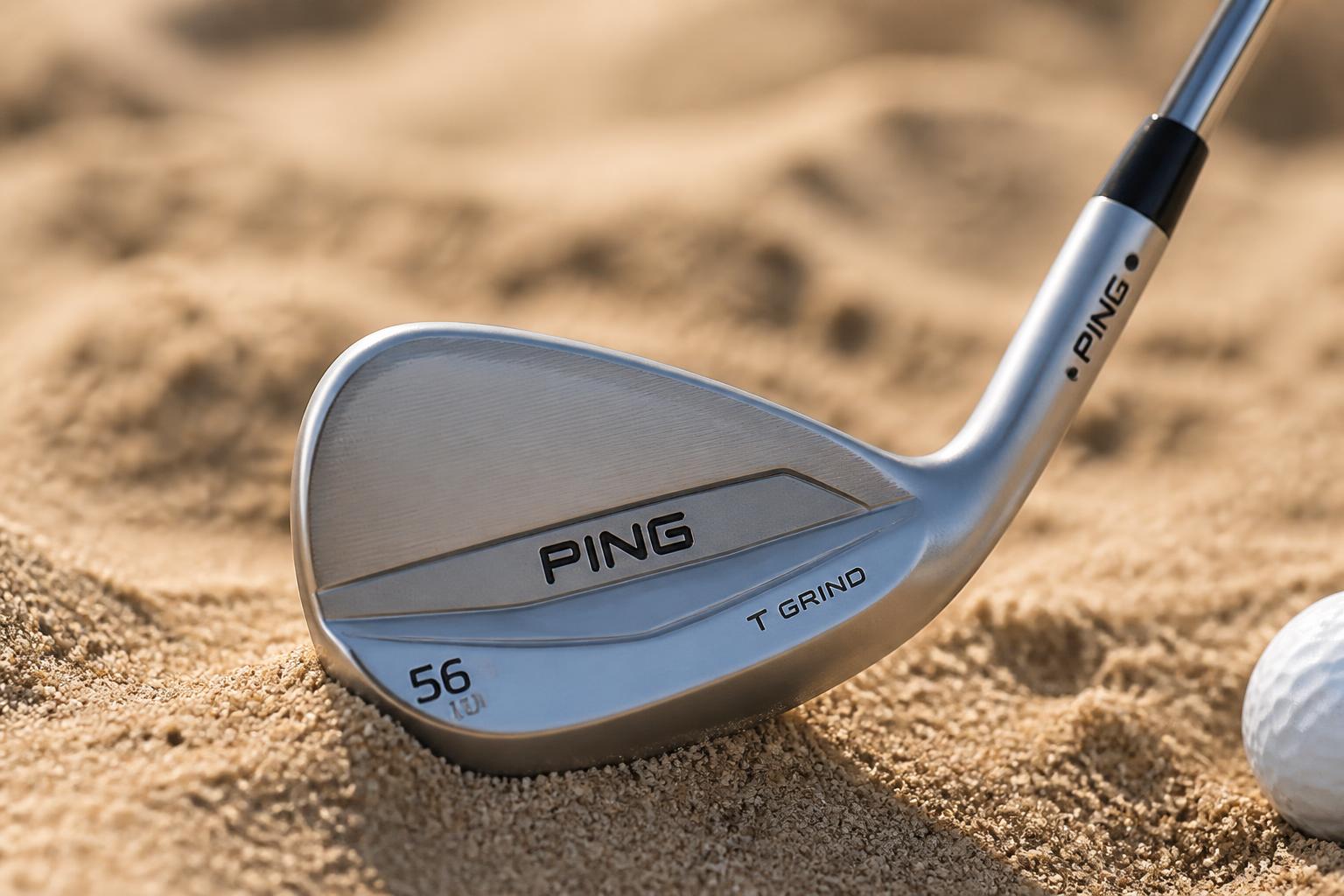
T Grind: Precision for Skilled Players
The T grind has a narrow sole with heel and toe relief. This design lets you open the face dramatically without the leading edge bouncing into the ball. It’s built for shot-making, not forgiveness.
Bounce options: 6°, 8°, 10°
The T grind suits low-handicap players who hit a variety of creative shots, golfers who open the face for flop shots and high soft lobs, and players on firm, tight fairways where the ball sits down.
The trade-off is that the narrow sole offers less forgiveness on slight mis-hits. If your contact is inconsistent, the T grind will expose that with thin shots and fat strikes. A player with a steep swing who regularly takes deep divots should avoid this grind—the low bounce will dig hard into soft turf.
Before committing, check the bounce number stamped on the head. If you’re on firm turf and have a shallow swing, the 6° version gives you the most versatility for opening the face. If you’re not sure about your angle of attack, have a fitter measure it on a launch monitor before ordering.
S Grind: The All-Rounder
The S grind is the most versatile option in the S159 lineup. It has a moderate sole width with slight heel and toe relief, providing a balance between turf interaction and forgiveness.
Bounce options: 10°, 12°, 14°
The S grind fits most golfers from mid to low handicap, players who use their wedge for full shots, chips, and bunker play, and those who play on varied course conditions.
The S grind doesn’t favor one shot type over another. If you’re unsure which grind to choose, it’s the safest starting point because it handles the widest range of lies without demanding a specific swing type.
The limitation is that the S grind is a compromise. It won’t give you the extreme shot-making ability of the T grind on tight lies, and it won’t save you from digging like the K grind on soft turf. If your home course is consistently firm or consistently soft, a more specialized grind will serve you better.
W Grind: Wide Sole for Steep Swingers
The W grind features a wider sole with more bounce, designed for golfers with a steeper angle of attack. The extra bounce prevents the club from digging into the turf.
Bounce options: 14°, 16°, 18°
The W grind fits golfers with a steep, descending swing, players who take divots on wedge shots, and those who play on soft, wet, or spongy turf.
The trade-off is that the wider sole makes it harder to manipulate the face angle. You’ll get consistency, but less shot-making flexibility. If you like to open the face for flop shots, the W grind will feel clumsy—the wide sole catches the turf and resists the face rotation you’re trying to create.
The most common mismatch happens when players take this grind to a firm, dry course. The high bounce causes the leading edge to skip into the ball, producing thin shots that run past the hole. Players buy it for forgiveness and then struggle on hardpan.
E Grind: The Eye2 Heritage
The E grind is a modern interpretation of the classic PING Eye2 sole design. It features a wider sole with a distinct camber that helps the club glide through sand and soft turf.
Bounce options: 16°, 18°, 20°
The E grind fits golfers who struggle with bunker shots, players on courses with deep, soft sand, and those who want maximum forgiveness from the sand.
The cambered sole means the club doesn’t dig, even when you hit behind the ball slightly. This is the most forgiving grind for sand play in the lineup.
The mismatch risk appears on firm turf, where the wide sole can cause the leading edge to bounce into the ball, producing thin shots. Check your course’s sand type before choosing this grind—fluffy, deep sand rewards the E grind; compacted, shallow sand punishes it.
H Grind: High Launch for Full Shots
The H grind has a narrower sole with a slightly different bounce profile, designed to produce a higher trajectory on full swings.
Bounce options: 8°, 10°, 12°
The H grind fits golfers who want more height on approach shots, players who use their wedges primarily for full swings, and those who prefer a more traditional wedge feel.
The trade-off is that the H grind offers less help around the greens compared to the S or E grinds. It’s a specialist tool for full-shot performance. If you use your wedges for a lot of chipping and pitching, the H grind’s narrower sole gives you less margin for error on partial shots.
If you’re choosing between the H and S grinds, hit 10 full shots with each and compare your dispersion. Then hit 10 chip shots with each. The H grind should show tighter full-shot dispersion; the S grind should show tighter short-game dispersion. Pick based on which part of your game needs more help.
K Grind: Maximum Forgiveness
The K grind has the widest sole in the S159 lineup, with substantial bounce across the entire sole. It’s designed to prevent digging in any condition.
Bounce options: 14°, 16°, 18°
The K grind fits high-handicap golfers who want maximum forgiveness, players who struggle with fat shots, and those who play on consistently soft turf.
The trade-off is that the K grind is the least versatile for creative shot-making. You’ll sacrifice the ability to open the face for the safety of a forgiving sole. If you’re a low-handicap player who likes to manufacture shots around the green, the K grind will feel like a blunt instrument.
On tight fairway lies, the wide sole can bounce the leading edge into the ball, causing thin shots that fly low and hot. The K grind is a safety net, but it comes with a ceiling on shot-making potential.
How to Match Bounce to Your Swing
Bounce and grind work together, but they address different problems.
Bounce angle controls how much the club resists digging into the ground. Higher bounce means less digging, but also less ability to get the leading edge under the ball on tight lies.
Grind shape determines where the sole contacts the turf. Relief in the heel or toe lets you manipulate the face angle without the sole catching.
Use this decision rule:
- Steep swing + soft turf = High bounce (14°+) with a wide grind (W, K, or E)
- Shallow swing + firm turf = Low bounce (6°–10°) with a narrow grind (T or H)
- Mixed conditions + average swing = Medium bounce (10°–14°) with the S grind
To verify your angle of attack, ask a fitter to measure it with a launch monitor, or use a simple divot test. Hit a few wedges off grass and look at your divot depth. Deep divots mean you’re steep and need more bounce. Shallow or no divots mean you’re sweeping and can handle less bounce.
Common Mistakes When Choosing an S159 Wedge
1. Buying the same grind for every wedge
Your lob wedge and gap wedge serve different purposes. A 50° wedge used mostly for full shots needs different bounce than a 58° wedge used for bunker play. Mix grinds across your set.
2. Choosing high bounce because you’re a high handicapper
High bounce helps in soft conditions, but it hurts on tight fairways and hardpan. If your course is firm, high bounce will cause thin shots, not prevent them.
3. Ignoring your angle of attack
Your swing shape matters more than your handicap. A low-handicap player with a steep swing still needs more bounce than a high-handicap player with a shallow, sweeping motion.
4. Not considering sand type
Course sand varies from fine and fluffy to coarse and compacted. Fluffy sand requires more bounce; compacted sand requires less. Check the bunkers at your home course before committing to a grind.
Loft and Bounce Combinations That Work
Here are practical setups based on common wedge configurations.
Three-wedge setup (50°, 54°, 58°):
- 50° S grind (10° bounce) — full shots and pitching
- 54° S grind (12° bounce) — all-around play
- 58° E grind (16° bounce) — bunkers and soft lies
Four-wedge setup (46°, 50°, 54°, 60°):
- 46° H grind (8° bounce) — full shots
- 50° S grind (10° bounce) — approach shots
- 54° W grind (14° bounce) — soft turf protection
- 60° T grind (8° bounce) — flop shots and tight lies
High-handicap setup (52°, 56°, 60°):
- 52° S grind (12° bounce) — all-around
- 56° K grind (16° bounce) — maximum forgiveness
- 60° E grind (18° bounce) — sand play
These setups prioritize different strengths. The four-wedge setup gives you the most versatility but requires more skill to use effectively. The high-handicap setup is more forgiving but limits your ability to hit creative shots. Match the setup to your skill level, not your aspirations.
Testing Before You Buy
If you’re unsure which grind fits, test before committing. Most golf retailers with a launch monitor can help you evaluate:
- Turf interaction: Hit off real grass if possible. Mats don’t show digging tendencies.
- Bunker performance: Practice sand facilities vary, but any sand test beats no test.
- Full shot consistency: Hit 10 full shots with each grind and compare dispersion.
Check your divot pattern on the range. If your divots are deep and start well behind the ball, you need more bounce. If your divots are shallow or you’re hitting thin shots, you need less. This one observation will tell you more than any chart.
If you can’t test, the S grind with 12° bounce is the most commonly recommended starting point for average players. It handles the widest range of conditions without demanding a specific swing type.
Frequently Asked Questions
What is the most popular S159 grind?
The S grind is the most popular because it works for the widest range of golfers and conditions. Its balanced sole design handles full shots, chips, and bunker play without favoring one shot type.
Can I change the bounce on my S159 wedge?
No, bounce is built into the clubhead design. You cannot adjust it after purchase. You can have the sole modified by a club fitter, though this voids the manufacturer warranty and permanently alters the club.
Should I match my wedge grind to my iron type?
Not necessarily. Your wedges need more versatility than your irons because you use them for partial shots, bunker play, and delicate chips. A game-improvement iron setup doesn’t require a corresponding wedge grind.
Does the E grind work on firm turf?
The E grind is designed for sand and soft conditions. On firm turf, the wide sole can cause the leading edge to bounce into the ball, producing thin shots. If your course is firm, choose the S or T grind instead.
What grind do tour players use in the S159?
Tour players typically use the T grind in lower lofts and the S or E grind in higher lofts. However, tour conditions are often firm and fast, so their choices don’t necessarily translate to recreational course conditions.
How do I know if I need more or less bounce?
Look at your divots. Deep divots that start well behind the ball indicate you need more bounce. Thin shots on soft turf indicate you need less bounce. If you’re hitting fat shots consistently, move to a higher bounce option; if you’re hitting thin shots on soft ground, move to a lower bounce option.

Michael Reeves is a PGA Professional with over 20 years of experience in competitive golf and instruction. A former Division I collegiate player at the University of Texas, he competed on the mini-tours before transitioning to full-time coaching and golf journalism. He has been a certified PGA teaching professional since 2005 and has worked with players at every level, from absolute beginners to collegiate champions.
His writing has appeared in Golf Digest, Golf Magazine, and The Left Rough. At GolfHubz, Michael leads the editorial team, overseeing fact-checking and ensuring every answer meets the same standard he demands on the lesson tee: clear, evidence-based, and immediately useful.
When he’s not writing or teaching, Michael plays to a +1.4 handicap at his home club in Austin, Texas. He has attended over 40 major championships as a journalist and fan, and has played more than 200 courses across 15 countries.
You can reach Michael at [email protected] or follow his occasional swing analysis posts on the site.