Srixon ZXi5 Irons Specs Chart
If you’re comparing the Srixon ZXi5 irons against the ZXi4 or ZXi7, the spec sheet is where the real differences show up. The ZXi5 sits in the middle of Srixon’s 2025 lineup—a hollow-bodied players distance iron designed to blend forgiveness with a compact shape. Here’s the full breakdown of lofts, lengths, lie angles, offsets, and swing weights, plus what those numbers actually mean for your bag.

Full Spec Breakdown for the ZXi5
| Iron | Loft | Lie Angle | Offset (mm) | Length (Steel) | Length (Graphite) | Swing Weight (Steel) | Swing Weight (Graphite) |
|---|---|---|---|---|---|---|---|
| 4 | 20.0° | 60.5° | 3.2 | 38.75″ | 39.00″ | D2 | D1 |
| 5 | 23.0° | 61.0° | 2.9 | 38.25″ | 38.50″ | D2 | D1 |
| 6 | 26.0° | 61.5° | 2.6 | 37.75″ | 38.00″ | D2 | D1 |
| 7 | 30.0° | 62.0° | 2.3 | 37.25″ | 37.50″ | D2 | D1 |
| 8 | 34.0° | 62.5° | 2.0 | 36.75″ | 37.00″ | D2 | D1 |
| 9 | 38.0° | 63.0° | 1.7 | 36.25″ | 36.50″ | D2 | D1 |
| PW | 43.0° | 63.5° | 1.4 | 35.75″ | 36.00″ | D2 | D1 |
| AW | 48.0° | 63.5° | 1.2 | 35.50″ | 35.75″ | D2 | D1 |
| GW | 52.0° | 63.5° | 1.0 | 35.50″ | 35.75″ | D2 | D1 |
| SW | 57.0° | 63.5° | 0.8 | 35.25″ | 35.50″ | D2 | D1 |
Specs reflect stock configurations. Lengths and lie angles vary by shaft choice; verify locally with a fitter for custom builds.
Applicability note: These specs apply to the standard ZXi5 model only. The ZXi4 and ZXi7 have different lofts, offsets, and sole designs, so don’t assume these numbers carry across the lineup. Also, if you order through a custom program with non-stock shafts, length and swing weight can shift by up to half an inch and a full swing weight point depending on the shaft’s balance point.
How the ZXi5 Specs Compare to ZXi4 and ZXi7
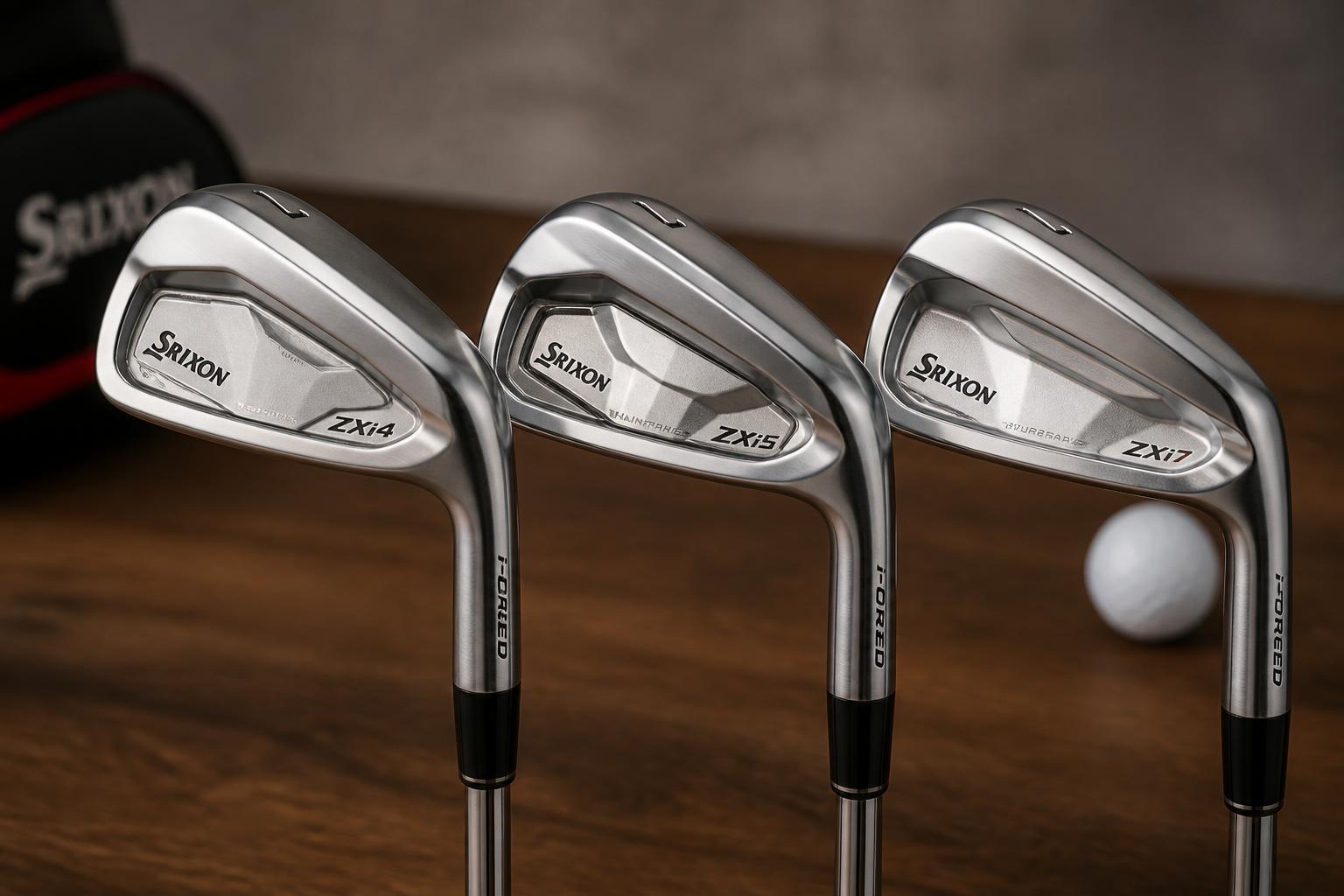
The three ZXi models share the same basic construction family, but the lofts and offsets tell you where each iron is aimed.
- ZXi4: 21.0° 5-iron, 4.0mm offset — max forgiveness, highest launch, most offset
- ZXi5: 23.0° 5-iron, 2.9mm offset — middle ground, moderate offset, compact look
- ZXi7: 26.0° 5-iron, 1.8mm offset — traditional lofts, minimal offset, blade-like shape
The ZXi5’s 23° 5-iron is 3° stronger than the ZXi7’s. That’s roughly one full club of distance difference at the same swing speed. If you’re coming from a game-improvement set with strong lofts, the ZXi5 will feel familiar. If you’re moving from a players cavity back, you’ll likely pick up half a club to a full club of distance.
What this means for your decision: If your current 7-iron goes about 150 yards and you switch to the ZXi5, expect that same 7-iron to carry roughly 155-158 yards—not because you’re swinging faster, but because the 30° loft is closer to what your old 6-iron had. That’s useful if you’re trying to close a gap at the top of your bag, but it also means your current wedge setup may no longer gap correctly. Check your distances after a demo session before committing to a full set.
What the Specs Mean for Your Game
Loft Gapping and Wedge Flow
The ZXi5 set starts at 20° in the 4-iron and runs through a 57° sand wedge. The 5° gaps between the 4-iron through 9-iron are consistent, which helps with predictable distance spacing. The PW at 43° is strong by traditional standards, so you’ll want to check your current wedge setup.
If your existing gap wedge is 50°, you’ll have a 7° gap between the ZXi5 PW and your wedge. That’s too large. The AW at 48° and GW at 52° are designed to solve this—consider adding at least the AW to keep your scoring clubs properly spaced.
Verification step: Before ordering, write down the lofts of your current wedges. If your set makeup is PW (43°), AW (48°), GW (52°), SW (57°), you’re covered. If you already carry a 48° wedge and a 52° wedge, you can skip the AW and GW and just order 5-PW. If your current gap wedge is 50°, you’ll need to either bend it 2° strong or order the AW to avoid a noticeable distance dead zone around 100-110 yards.
Offset Progression
Offset drops from 3.2mm in the 4-iron to 0.8mm in the SW. That’s a steady progression that helps with draw bias in the long irons while keeping the scoring clubs neutral. The 2.9mm offset in the 5-iron is moderate—enough to help with launch and forgiveness, but not so much that the club looks closed at address.
The trade-off: If you naturally fade the ball or prefer a neutral look at address, the 4-iron and 5-iron offset may look excessive. The 3.2mm offset in the 4-iron is clearly visible behind the ball. You have two options: blend in a ZXi7 4-iron (1.8mm offset) to keep the set looking consistent, or accept the draw bias in the long irons and aim accordingly. Most players who dislike offset find the ZXi5’s short irons fine—it’s specifically the 4- and 5-irons that trigger the visual concern.
Length and Swing Weight
Steel shafts come in at D2 swing weight across the set, which is a standard, comfortable weight for most better players. Graphite builds come in at D1—slightly lighter, which helps with swing speed but may feel different if you’re used to heavier clubs.
The half-inch length progression (38.75″ 4-iron down to 35.25″ SW) is conventional. If you’re between standard and +1/2″, get fitted rather than guessing—length changes affect lie angle needs.
Mismatch warning: If you order graphite shafts but you’ve played steel your whole life, the D1 swing weight combined with a lighter overall shaft can cause you to swing faster but lose control of low-point. You’ll see a higher launch but also more variance in strike location. If you’re switching shaft materials, budget for at least one full practice session to adjust timing before you judge the clubs.
Key Technology Behind the Specs
The ZXi5 uses a hollow-body design with a forged face. The face is made from a material Srixon calls “i-FORGED” construction, which is a softer SUS17-47 material compared to previous ZX5 generations. This softer material allows fitters to adjust loft and lie more easily without compromising the face structure.
The MainFrame variable-thickness pattern on the back of the face saves weight and increases MOI. In practical terms, that means the club is designed to maintain ball speed on off-center hits—especially low on the face, which is where most amateurs miss.
The Srixon ZXi 5 Iron Set, 5-PW/AW, Steel, Stiff, Right Hand uses a condensed forging that stretches from the high-toe area along the topline. This enhances durability and feel, and the forged face is then softened further for improved feedback.
Stock Shaft Options and Fitting Notes
Srixon offers the ZXi5 with several stock shaft options. Steel builds typically come with a mid-weight shaft around 105-110 grams, while graphite options run lighter. The stock steel stiff flex is a common choice for players with driver swing speeds around 95-105 mph.
Fitting priorities for the ZXi5:
1. Lie angle first — the ZXi5’s sole is designed to interact with turf smoothly, but only if the lie angle matches your swing. Get measured on a lie board.
2. Shaft weight second — if you’re between flexes, err toward the heavier shaft for control unless your launch is too low.
3. Length last — only adjust length if you have a clear need, since it changes swing weight and lie requirements.
How to confirm your fit: Ask your fitter to check your current iron lie angles with a lie board or impact tape. If your strikes are consistently toward the heel, you need a flatter lie; toward the toe, a more upright lie. The ZXi5’s softer face material means loft and lie adjustments are easier to make than on previous generations, but that doesn’t mean you should skip the measurement. A 2° lie error will show up as a consistent 5-10 yard miss direction.
Common Mistakes When Ordering ZXi5 Irons
Skipping the AW. The 43° PW means your old 50° gap wedge leaves a big hole. Order the AW at 48° unless you already have a wedge at 46-48°.
Assuming ZXi5 = ZXi7 distance. The ZXi5 is stronger-lofted, so it will go farther with the same swing. That’s not because it’s “better”—it’s a different design goal. If you want traditional lofts and more workability, the ZXi7 is the correct choice.
Ignoring offset in the long irons. The 3.2mm offset in the 4-iron is noticeable at address. If you hate offset, look at the ZXi7 or consider ordering the ZXi5 4-iron and switching to a ZXi7 4-iron to blend sets. Srixon’s sets are designed to blend between models.
Ordering the wrong flex based on feel alone. The stock stiff shaft in the ZXi5 is designed for a specific swing speed window. If you’re swinging your driver around 90-95 mph, a stiff flex may feel boardy and reduce launch. Get a shaft fitting or at least hit a demo club with a launch monitor before you commit. A regular flex in the right weight will outperform a stiff flex that’s too much club for your tempo.
Who Should Play the ZXi5?
The ZXi5 fits a specific player: someone who wants the forgiveness and distance of a modern cavity back but doesn’t want a chunky game-improvement look. If you’re a mid-single-digit handicap who struggles with consistent contact on long irons, or a higher-handicap player who’s improving and wants a set that will grow with you, the ZXi5 is the middle option that makes sense.
If you’re a lower-handicap player who wants maximum workability and traditional lofts, the ZXi7 is the better fit. If you need maximum forgiveness and don’t care about blade length, the ZXi4 offers more help.
The Srixon ZXi 4 Iron Set, 5-PW/AW, Steel, Stiff, Right Hand and the Srixon ZXi 4 Iron Set, 4-PW, Steel, Regular, Right Hand are the more forgiving options if you decide the ZXi5’s specs aren’t quite right for your game.
Final Thoughts on ZXi5 Specs
The ZXi5’s spec sheet shows a well-balanced players distance iron: strong lofts for distance, moderate offset for forgiveness, and a consistent weight progression. The 43° PW is the most important number to remember—plan your wedge setup accordingly. And as with any iron purchase, get fitted for lie angle and shaft weight before you order. The specs are the starting point, not the final answer. Take the time to hit a demo club, check your gaps, and confirm your lie angle before committing to a full set.

Michael Reeves is a PGA Professional with over 20 years of experience in competitive golf and instruction. A former Division I collegiate player at the University of Texas, he competed on the mini-tours before transitioning to full-time coaching and golf journalism. He has been a certified PGA teaching professional since 2005 and has worked with players at every level, from absolute beginners to collegiate champions.
His writing has appeared in Golf Digest, Golf Magazine, and The Left Rough. At GolfHubz, Michael leads the editorial team, overseeing fact-checking and ensuring every answer meets the same standard he demands on the lesson tee: clear, evidence-based, and immediately useful.
When he’s not writing or teaching, Michael plays to a +1.4 handicap at his home club in Austin, Texas. He has attended over 40 major championships as a journalist and fan, and has played more than 200 courses across 15 countries.
You can reach Michael at [email protected] or follow his occasional swing analysis posts on the site.