Callaway Chrome Soft Golf Ball Specs
The Callaway Chrome Soft is one of the most popular premium golf balls on the market, and for good reason: it balances distance off the tee with a genuinely soft feel around the greens. If you are comparing it against the Chrome Soft X, the Titleist Pro V1, or the TaylorMade TP5, here is what the spec sheet actually tells you and what it means for your game.

Core Construction: What “Dual Soft Fast” Actually Does
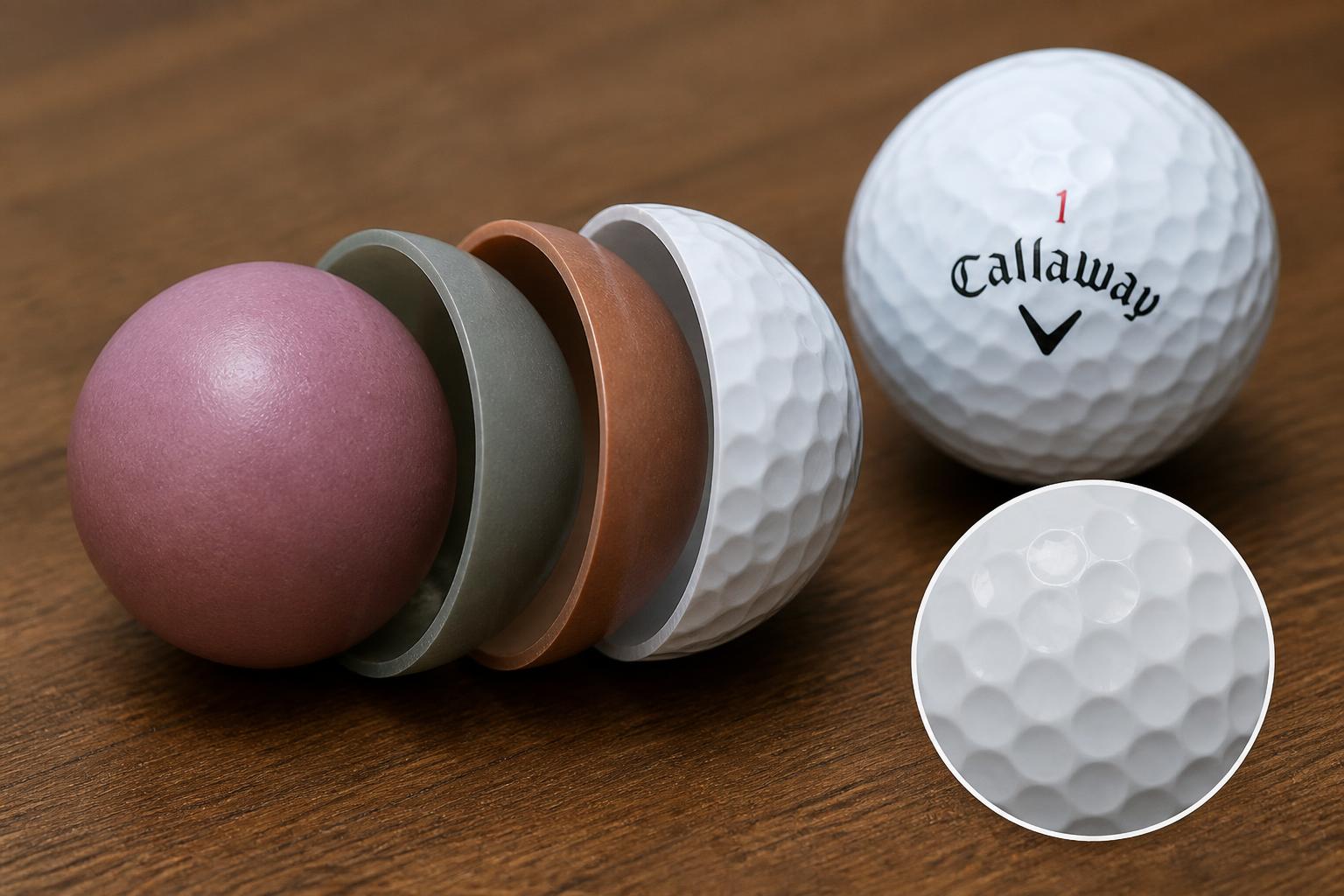
The Chrome Soft uses a dual-core design. Callaway calls this the “Dual Soft Fast” core, and it is the defining feature of the ball.
The larger inner core is softer and its job is to compress easily on high-speed impacts, which helps reduce spin on driver shots. The firmer outer ring controls the compression rate and helps transfer energy back into the ball for ball speed.
The practical result is a ball that feels soft when you hit it but does not turn into a marshmallow off the tee. The firmer outer layer keeps ball speed up, so you are not sacrificing distance for feel.
The trade-off to understand: A ball that feels soft at impact is not necessarily a low-spin ball. The Chrome Soft is designed to lower spin on driver shots specifically, but it still generates plenty of spin on wedge shots because the cover and core work together differently at those slower swing speeds.
Cover and Dimple Design: The 332 Hex Pattern
The Chrome Soft has a urethane cover, which is the standard for premium balls. Urethane covers are softer than Surlyn (found on cheaper balls) and allow the cover to grab the grooves of your wedges, which creates spin.
The dimple pattern is Callaway’s “Hex Aerodynamics” design with 332 dimples. The hexagonal shape is not just cosmetic; it reduces drag more efficiently than round dimples at similar depths.
What this means on the course:
- In the wind: The hex pattern helps the ball hold its line better than a ball with a more chaotic dimple design. It is not wind-proof, but it will not balloon as much into a headwind.
- On approach shots: The urethane cover grabs the green. You will see a noticeable difference in how quickly the ball stops compared to a two-piece distance ball.
Compression Rating: Who Should Play This Ball?
The Chrome Soft has a compression rating of around 75. Compression measures how much the ball deforms under load. Lower numbers mean softer; higher numbers mean firmer.
For reference:
- Chrome Soft: ~75 compression
- Chrome Soft X: ~95 compression
- Titleist Pro V1: ~90 compression
- Titleist Pro V1x: ~100 compression
The decision rule:
- If your driver swing speed is under 95 mph, the Chrome Soft is likely a better fit than the Chrome Soft X. The softer core compresses more fully, which helps you generate ball speed without extra effort.
- If your driver swing speed is above 105 mph, the Chrome Soft may feel too soft. You might compress it fully and see slightly higher spin than you want. The Chrome Soft X is designed for that higher speed range.
A concrete example: A golfer with a 90 mph swing speed hitting a Chrome Soft will get more consistent distance than hitting a Pro V1x, because the softer ball does not require as much speed to reach its optimal compression point. That is not a marketing claim; it is how compression physics work.
Chrome Soft vs. Chrome Soft X: Key Spec Differences
If you are deciding between the two Callaway models, the differences come down to spin and trajectory.
| Spec | Chrome Soft | Chrome Soft X |
|---|---|---|
| Compression | ~75 | ~95 |
| Driver spin | Lower | Higher |
| Wedge spin | High | Higher |
| Trajectory | Mid | Mid-high |
| Best for | Moderate swing speeds | High swing speeds |
The Chrome Soft X is not “better”; it is firmer and spins more. If you already generate plenty of spin and want a lower, flatter ball flight, the standard Chrome Soft is the better choice. If you struggle to hold greens and want more spin on approach, the X version gives you more.
Real-World Performance: What to Expect on the Course
Off the tee: The Chrome Soft launches mid-height with low spin. You should see a penetrating ball flight that rolls out slightly more than a high-spin tour ball. It is not the longest ball on the market, but it is within a few yards of the longest options for most players.
Approach shots: This is where the ball earns its keep. The urethane cover and soft core combine to create stopping power. A well-struck 7-iron will take one hop and check. You do not need to be a tour player to see this; it works at 80 mph swing speeds too.
Around the green: The feel is soft but not mushy. Chips and pitches come off the face with a muted sound, and you get consistent check on short shots. If you prefer a firmer, clickier feel on chips, this ball will feel different than what you are used to.
Putting: The soft feel transfers to the putter face. Some players love this; others find it too muted. If you like audible feedback on putts, the Chrome Soft X or a firmer ball like the TP5 will give you more sound.
Common Mistakes When Choosing This Ball
Mistake 1: Buying it because tour players use it. The Chrome Soft is not the same ball Jon Rahm or Xander Schauffele plays in competition; they typically play the Chrome Soft X with custom specs. The retail Chrome Soft is designed for the broader market, not for tour conditions.
Mistake 2: Ignoring your swing speed. If you swing the driver over 105 mph, the standard Chrome Soft will feel too soft and may spin slightly more than you want. That is not a flaw in the ball; it is a fit issue.
Mistake 3: Assuming softer always means less distance. The Chrome Soft is soft, but the firmer outer core prevents the energy loss you might expect. It is not a short ball, but it is also not the longest. If pure distance is your only priority, a firmer ball like the Chrome Soft X or a distance-focused ball will go further.
How to Confirm This Ball Fits You
The only reliable way to know if the Chrome Soft works for your game is to test it against one alternative. Here is a simple protocol:
1. Buy a sleeve of Chrome Soft and a sleeve of Chrome Soft X.
2. Play three rounds alternating balls on the same holes.
3. Track three things: driver distance, spin on approach shots (does the ball stop or roll out?), and feel on putts.
4. Choose based on which ball gives you the best combination of stopping power and distance, not which one feels best on the practice green.
This head-to-head test takes about a week and gives you real data instead of marketing claims.
Frequently Asked Questions
Is the Callaway Chrome Soft a tour-level ball?
Yes, it is a premium urethane-covered ball that meets tour standards, but the retail version is tuned for a wider range of swing speeds. Tour players typically use the firmer Chrome Soft X.
Does the Chrome Soft spin too much off the driver?
For most players, no. The dual-core design is specifically engineered to reduce driver spin. If you have a very high swing speed (over 105 mph), you may see more spin than you want, and the Chrome Soft X is a better fit.
How long does the Chrome Soft cover last?
A urethane cover will scuff faster than a Surlyn cover, especially if you hit wedges with sharp grooves. Expect noticeable wear after 3–5 rounds, depending on course conditions and how often you hit bunker shots.
Is the Chrome Soft good for high handicappers?
It can be, but it depends on your swing speed. If you swing under 90 mph, the soft core helps you compress the ball more easily, which can add distance. If you struggle with slicing, the low driver spin may help reduce curve, but no ball fixes a swing fault.
What is the difference between Chrome Soft and Chrome Soft X?
The X version has a higher compression rating (~95 vs. ~75), spins more on all shots, and launches higher. It is designed for players with faster swing speeds who need more spin to hold greens.
The Callaway Chrome Soft is a balanced premium ball that prioritizes feel and control over raw distance. It is an excellent choice for golfers with moderate swing speeds who want tour-level spin without the firmer feel of the X version. If you are between models, the compression rating is the spec that matters most for your fit.

Michael Reeves is a PGA Professional with over 20 years of experience in competitive golf and instruction. A former Division I collegiate player at the University of Texas, he competed on the mini-tours before transitioning to full-time coaching and golf journalism. He has been a certified PGA teaching professional since 2005 and has worked with players at every level, from absolute beginners to collegiate champions.
His writing has appeared in Golf Digest, Golf Magazine, and The Left Rough. At GolfHubz, Michael leads the editorial team, overseeing fact-checking and ensuring every answer meets the same standard he demands on the lesson tee: clear, evidence-based, and immediately useful.
When he’s not writing or teaching, Michael plays to a +1.4 handicap at his home club in Austin, Texas. He has attended over 40 major championships as a journalist and fan, and has played more than 200 courses across 15 countries.
You can reach Michael at [email protected] or follow his occasional swing analysis posts on the site.