Golf Training Aids Guide
Golf training aids fall into two categories: tools that build a specific physical feel, and gadgets that gather data. Both can improve your game, but only if they target a real flaw in your swing. This guide breaks down the main types, what each one does, and how to choose based on your actual miss pattern.

Start With Your Miss, Not the Marketing
Before buying anything, identify your most common error. That determines which aid will help.
| Your Most Common Miss | Likely Root Cause | Aid Category That Helps |
|---|---|---|
| Slice (ball curves right for right-handers) | Over-the-top swing path, open clubface | Swing path trainers, alignment sticks |
| Hook (ball curves left) | Closed clubface, inside-out path with hands flipping | Wrist hinge trainers, grip trainers |
| Thin shots (hitting the equator) | Early extension, standing up at impact | Impact bags, posture trainers |
| Fat shots (hitting behind the ball) | Weight on back foot, steep angle of attack | Weight shift trainers, alignment sticks |
| “Chicken wing” (left arm collapses after impact) | Arms separating from body | Arm band connectors |
| Inconsistent contact | Poor tempo and rhythm | Tempo trainers, swing sticks with audible feedback |
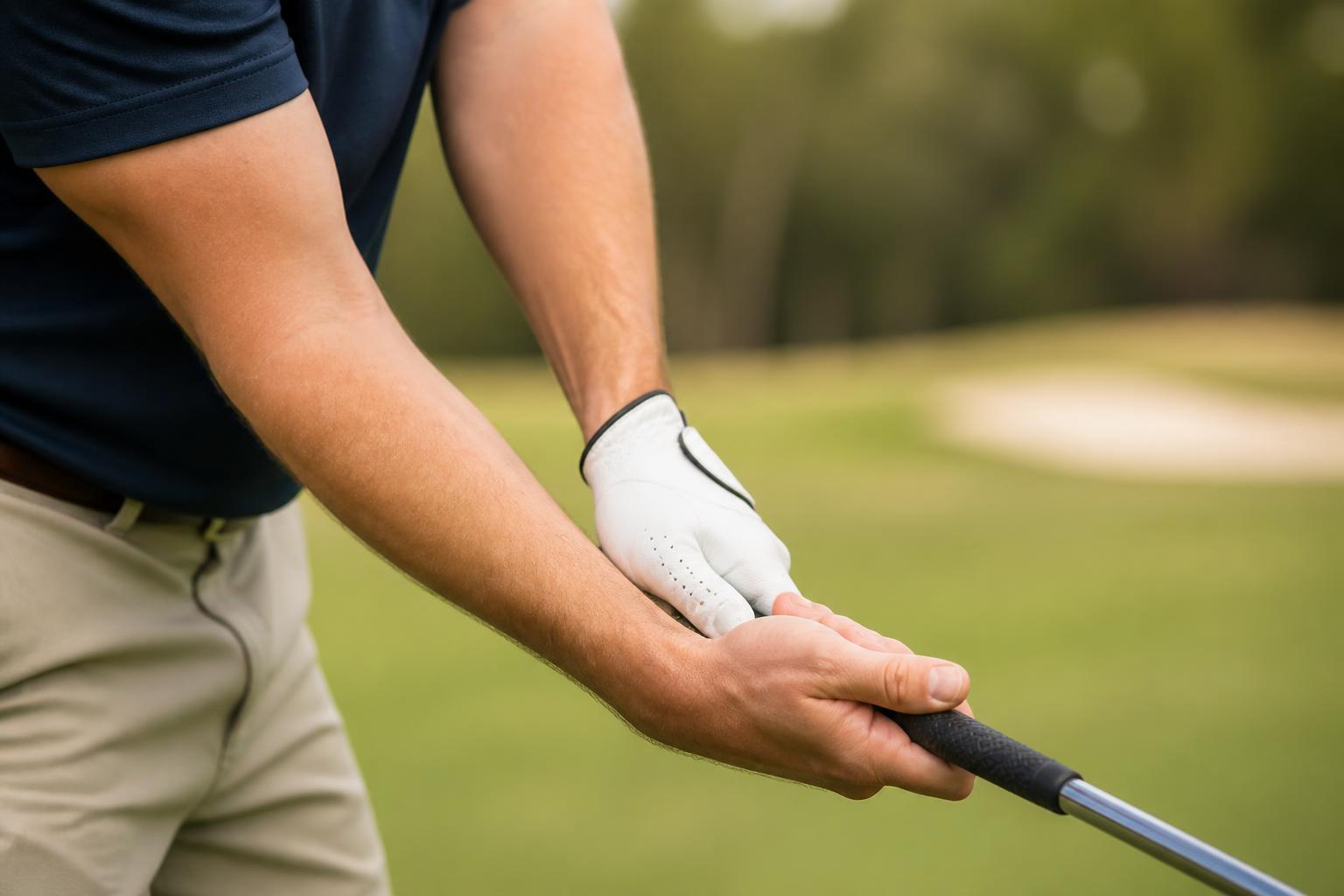
If you’re not sure what your miss is, spend one range session hitting 30 balls and write down what happens. You’ll see a pattern quickly. If you can’t identify a dominant miss after 30 balls — say, you hit a mix of thin, fat, and off-line shots with no clear theme — that points to a tempo or rhythm problem rather than a single mechanical fault, so start with a tempo trainer instead of a position-specific aid.
Arm and Wrist Trainers: Fixing the “Chicken Wing” and Wrist Hinge
The most common swing faults amateurs have involve the left arm (for right-handed golfers) collapsing through impact, and the wrists not hinging properly on the backswing.
Arm band connectors keep your upper arms connected to your torso. The TrueBirdie Golf Swing Training Aid – Swing Correcting Arm Band works by restricting your arms from separating during the swing. The “chicken wing” happens when your lead arm folds and pulls away from your chest after impact, which causes you to lose power and accuracy. Wearing this type of band forces your arms to stay in sync with your body rotation. The trade-off: it feels restrictive at first, and you should start with half-swings to avoid developing an overly rigid motion.
Wrist hinge trainers attach to the shaft and your forearm to control the angle between them. The GreenHaven Golf Training Wrist Hinge Golf Swing Training Aid restricts the wrist angle during the backswing, which helps build muscle memory for the correct hinge position. If you struggle with a flat backswing or casting the club from the top, this type of aid gives you immediate feedback — you literally cannot move the club the wrong way without feeling the restriction. The downside: it only works on the backswing, so you still need to practice the downswing and follow-through separately.
How to use them effectively:
- Use them for 10–15 minutes at a time, not entire practice sessions
- Start with slow, half-speed swings to feel the correct position
- Hit 20–30 balls with the aid, then remove it and hit 10 without it to see if the feel transfers
A practical branch point: After your first session with an arm band, take note of where you feel the restriction. If you feel it most during the backswing, the band is doing its job — keep using it. If you feel it mostly at impact or after, the band may be too tight or positioned too high on your arms. Adjust the strap so it sits mid-bicep, not near the elbow, and try again. If it still restricts your follow-through after adjusting, stop using it and switch to a wrist hinge trainer instead — the problem may be arm separation, not arm collapse.
Swing Path and Tempo Trainers: Building Repeatable Rhythm
If your problem is consistency rather than a specific mechanical flaw, tempo and path trainers are a better fit.
The MIKOSI Retractable Golf Swing Trainer combines two features: a retractable shaft that extends during the swing and an audible click when you reach the correct position. The retractable design means you can use it indoors without a ball, and the click gives you audio feedback on whether your swing is reaching the right length and speed. This is useful for grooving rhythm because you’re training your body to complete the swing at a consistent pace, not just hitting balls.
The evidence for tempo training is straightforward: a consistent swing tempo produces more repeatable contact than a fast, jerky one. The click sound acts as a pacing cue — if you hear it at the same point in every swing, your tempo is consistent.
A practical drill: Set up the trainer and take 20 swings focusing only on the sound. The click should happen at the same moment in your follow-through each time. If it varies, slow down until it becomes consistent, then gradually speed up.
How to verify it’s working: After 20 swings with the trainer, put it down and hit 10 normal balls with a 7-iron. You’re looking for two things: consistent strike location (check the wear mark on the clubface) and a tighter shot dispersion. If your shots still spray wildly even though your tempo sounded consistent, the problem isn’t tempo — it’s path or face angle, and you need a different aid.
What Training Aids Won’t Do
No aid will fix your game by itself. Here’s what to expect:
- Aids build feel, not skill. The aid creates a physical constraint or feedback loop. Once you remove it, your body needs to reproduce that feeling on its own. This takes repetition.
- Aids don’t replace lessons. If you have a fundamental grip or setup issue, a training aid will only reinforce a flawed motion. A lesson identifies the root cause; an aid helps you practice the fix.
- Aids can mask problems. Some devices force a “correct” position that may not fit your body type or swing style. If an aid feels painful or extremely unnatural, stop using it and get a professional opinion.
A concrete failure mode to watch for: If you use a wrist hinge trainer for two weeks and your ball flight doesn’t change — same slice, same distance, same contact — the aid is either addressing the wrong fault or you’ve adapted to it without changing your actual swing. One way to tell the difference: video your swing with the aid on and off. If the swing looks identical in both, the aid isn’t creating a new movement pattern. If the swing looks different with the aid but reverts immediately without it, you haven’t practiced the transfer phase enough. Either way, two weeks without measurable improvement means it’s time to reassess.
When to stop and escalate: If you experience joint pain — wrist, elbow, or shoulder — while using any training aid, stop immediately. Mild muscle soreness is normal; joint pain is not. Also stop if the aid leaves bruising, restricts circulation, or causes numbness. These are signs the device doesn’t fit your body, not signs that you need to push through. At that point, consult a PGA professional or teaching pro before continuing with any aid, and consider whether a lesson might be a better investment than another device.
How to Choose: A Decision Framework
| Your Situation | Recommended Approach |
|---|---|
| Beginner, still developing a consistent swing | Start with alignment sticks and a tempo trainer. Learn the basic motion before adding constraints. |
| You slice consistently | Try an arm band connector to keep your arms connected, plus path training with alignment sticks. |
| You hook or pull the ball | Wrist hinge trainer to control clubface position through impact. |
| You have a fast, jerky swing | Tempo trainer with audible feedback. Slow down your backswing count. |
| You practice indoors or have limited space | Retractable trainers or aids that don’t require a ball. |
| You’ve had lessons but can’t translate them to the course | Use aids that match the specific feel your instructor gave you. Ask them which aid reinforces that feel. |
Common Mistakes When Using Training Aids
Mistake 1: Practicing with the aid too long. Your body adapts to the constraint, and when you remove it, the swing falls apart. Use aids in short bursts — 10–15 minutes — then swing without it.
Mistake 2: Using the aid at full speed immediately. The point is to feel the correct position, not to hit the ball as hard as possible. Slow swings build the right muscle memory faster.
Mistake 3: Ignoring the feedback. If the aid is supposed to click or restrict movement and it isn’t doing either, you’re not using it correctly. Stop and re-read the instructions.
Mistake 4: Buying multiple aids at once. You can’t fix three swing faults simultaneously. Pick one, work on it for 2–3 weeks, then reassess.
A Simple Practice Plan
Here’s a 15-minute routine that works with most aids:
1. Minutes 0–5: Slow swings with the aid, focusing on the feel it creates. No ball.
2. Minutes 5–10: Full swings with the aid, hitting balls. Focus on one cue (e.g., “keep arms connected”).
3. Minutes 10–15: Remove the aid. Hit 10 balls trying to reproduce the same feel without the constraint.
This sequence builds the feel, applies it to a real swing, then tests whether it transfers. If you can’t reproduce the feel without the aid after 10 balls, go back to step 1 and repeat.
A note on measuring progress: Don’t judge success by ball flight alone during the first week. The aid is building a new feel, and your body needs time to integrate it. Instead, track one metric: strike quality. Use foot powder spray on your clubface or check the wear pattern on a range mat. If your strikes move from the toe and heel toward the center of the face over two weeks, the aid is working even if your scores haven’t dropped yet. Ball flight will follow once contact improves.
Making the Final Call
Training aids work best when they target one specific flaw, are used in short sessions, and are paired with some form of feedback — a coach, video, or your own ball flight. They are practice tools, not quick fixes. Choose based on your most common miss, use them consistently for a few weeks, and be honest about whether your ball flight actually improves. If it doesn’t, the aid may be addressing the wrong problem — or you may need a professional to diagnose the root cause first. A single lesson that identifies your core fault is often more valuable than three aids that each address a different symptom.

Michael Reeves is a PGA Professional with over 20 years of experience in competitive golf and instruction. A former Division I collegiate player at the University of Texas, he competed on the mini-tours before transitioning to full-time coaching and golf journalism. He has been a certified PGA teaching professional since 2005 and has worked with players at every level, from absolute beginners to collegiate champions.
His writing has appeared in Golf Digest, Golf Magazine, and The Left Rough. At GolfHubz, Michael leads the editorial team, overseeing fact-checking and ensuring every answer meets the same standard he demands on the lesson tee: clear, evidence-based, and immediately useful.
When he’s not writing or teaching, Michael plays to a +1.4 handicap at his home club in Austin, Texas. He has attended over 40 major championships as a journalist and fan, and has played more than 200 courses across 15 countries.
You can reach Michael at [email protected] or follow his occasional swing analysis posts on the site.