The Speed of Golf Balls in Flight
← Golf Equipment | Golf Balls
BLOCKQUOTE_0
Quick Answer
- Golf ball speed is a complex interplay of your swing, the club, and the ball’s design, not just one factor.
- Pro golfers can launch drivers at speeds well over 180 mph.
- Ball construction, especially compression and cover material like urethane, significantly impacts how fast golf balls travel and perform.
Who This Is For
- Golfers who want to understand the science behind their shots and gain an edge.
- Players aiming to fine-tune their equipment choices for maximum distance and control.
What to Check First
- Your Clubhead Speed: This is the engine. Get a reliable reading from a launch monitor or a good simulator. Don’t guess.
- Golf Ball Compression: What’s the number on your current gamer golf balls? This is crucial for matching to your swing.
- Club and Ball Specifications: Check the manuals or manufacturer websites for your clubs and balls to understand their intended performance.
- Cover Material: Is it a soft urethane cover or a firmer ionomer? This affects greenside spin and durability.
- Launch Conditions: Beyond speed, look at launch angle and spin rate. These tell a bigger story about your ball’s flight.
The Science Behind How Fast Golf Balls Travel
It’s not just about swinging hard. How fast a golf ball travels is a finely tuned equation. Think of it like this: your swing is the horsepower, your club is the transmission, and the golf ball is the fuel and aerodynamics all rolled into one. Understanding this can seriously boost your game.
Step-by-Step Plan to Optimize Golf Ball Speed
1. Action: Measure your clubhead speed accurately.
- What to look for: Consistent clubhead speed readings across multiple swings with the same club. You want a stable baseline.
- Mistake: Relying on feel or guesswork. A launch monitor is your best friend here. Trust the data, not your gut. I remember trying to guess my speed for years – big mistake.
2. Action: Analyze your launch conditions.
- What to look for: Launch angle (the initial upward trajectory) and spin rate (how fast the ball is rotating). These, combined with ball speed, determine carry distance and overall flight.
- Mistake: Focusing only on ball speed. Too much spin off the tee can kill your distance, no matter how fast the ball leaves the clubface. Conversely, too little spin on an iron can mean it won’t stop.
3. Action: Test different golf balls.
- What to look for: Which golf balls feel best to you and deliver the longest, most consistent carry distance for your specific swing and launch conditions. Don’t assume your usual ball is still the best.
- Mistake: Sticking with the same brand or model out of habit. Your swing might have evolved, or new ball technology could be a better fit.
4. Action: Understand and select golf ball compression.
- What to look for: A ball that matches your swing speed. Generally, faster swing speeds (around 100 mph+ for drivers) benefit from higher compression balls (80s and 90s), while slower swings (under 90 mph) perform better with lower compression balls (70s).
- Mistake: Using a high-compression ball with a slower swing. You won’t compress it enough to get the optimal energy transfer, leading to less speed and distance. It’s like trying to start a race car with a weak battery.
5. Action: Evaluate the cover material.
- What to look for: Urethane covers are premium. They offer superior greenside spin for control and feel, especially on chips and pitches. If you’re a player who relies on stopping power around the green, urethane is usually the way to go.
- Mistake: Sacrificing greenside spin for a slight increase in driver distance. For many amateurs, the ability to stop the ball on the green is more valuable than an extra 5 yards off the tee.
6. Action: Check the condition of your golf balls.
- What to look for: Balls that are free of significant cuts, scuffs, or dents. Even minor damage can disrupt the aerodynamics.
- Mistake: Playing with damaged golf balls. They fly erratically, lose speed, and spin unpredictably. It’s a cheap way to shave strokes, just swap ’em out.
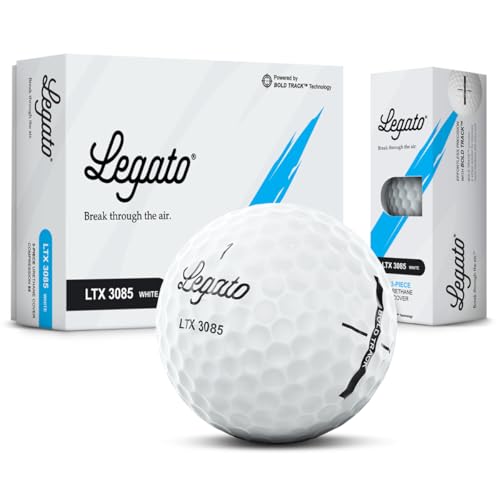 Legato Golf Balls LTX3085 | Maximized Distance with Soft Feel | 3 Piece | Urethane Cover | 85 Compression | White | 1 Dozen (12 Balls)Check price on AmazonWe may earn a commission
Factors Influencing How Fast Golf Balls Travel
It’s a complex dance between physics and engineering. Several key elements dictate how fast your golf ball will rocket off the clubface and through the air.
Common Mistakes in Understanding Golf Ball Speed
- Mistake: Focusing solely on driver swing speed.
- Why it matters: Your game isn’t just about the tee shot. Iron and wedge speeds are critical for accurate approach shots and scoring. Knowing your speed across the bag gives you a complete picture.
- Fix: Track your clubhead speed for every club you hit, not just your driver. Use a launch monitor to get these readings.
- Mistake: Using worn-out or damaged golf balls.
- Why it matters: A scuffed cover or a nick in the ball disrupts the airflow over its surface. This leads to reduced aerodynamic efficiency, less lift, more drag, and ultimately, lower ball speed and erratic flight.
- Fix: Regularly inspect your golf balls and replace any that show significant wear or damage. I always keep a sleeve of “new” balls for the first tee and when playing important shots.
- Mistake: Ignoring golf ball compression differences.
- Why it matters: Higher compression golf balls are designed to deform significantly at high impact speeds, transferring energy efficiently. If your swing speed is too low, you won’t achieve this necessary deformation, and the ball won’t reach its potential speed.
- Fix: Match your golf ball’s compression rating to your swing speed. If you swing under 90 mph with your driver, look for lower compression balls (typically in the 70s). If you’re 95 mph or faster, higher compression (80s-90s) might be beneficial.
- Mistake: Not understanding the role of spin.
- Why it matters: Spin is a double-edged sword. Too much backspin off the tee causes the ball to balloon and lose significant distance. Too little spin on approach shots means the ball won’t stop near the pin.
- Fix: Use a launch monitor to understand your spin rates for different clubs. Then, experiment with golf balls designed to help balance your spin – some balls are engineered for lower driver spin, while others offer higher greenside spin.
- Mistake: Assuming all golf balls are created equal.
- Why it matters: Golf ball construction varies wildly. The core, mantle layers, and cover material (like urethane vs. ionomer) all play a role in how the ball compresses, spins, and flies. A ball designed for maximum distance might sacrifice greenside feel and spin.
- Fix: Experiment with different brands and models. Consider your priorities: distance, spin, feel, or durability. Testing is the only way to find what truly works for your game.
- Mistake: Overestimating the impact of dimple patterns alone.
- Why it matters: While dimples are critical for aerodynamics, they work in conjunction with the ball’s construction. A great dimple pattern on a poorly designed ball won’t perform miracles. The overall design is key.
- Fix: Look at the complete picture. Consider the dimple pattern as one piece of the puzzle, alongside compression, core technology, and cover material when choosing golf balls.
FAQ
- What is the average speed of a golf ball off the tee?
For the average amateur golfer, ball speed off the tee typically ranges from 120 mph to 150 mph. Professional golfers, with their higher clubhead speeds and optimized technique, can achieve ball speeds exceeding 180 mph, and sometimes even pushing 190 mph.
- How does ball compression affect golf ball speed?
Ball compression is a measure of how much a golf ball deforms upon impact. Higher compression golf balls require a faster swing speed to deform sufficiently and transfer energy efficiently, resulting in higher ball speeds. Lower compression balls are more forgiving and designed to perform well with slower swing speeds, as they deform more easily.
- Does the material of a golf ball (e.g., urethane) influence its speed?
Yes, the cover material significantly influences a golf ball’s performance, though not always directly its initial ball speed off the clubface. While compression is the primary driver of initial speed, urethane covers, compared to ionomer covers, offer superior greenside spin due to their softer feel and tackiness. This enhanced spin can improve control on approach shots and around the green, indirectly affecting overall scoring and how the ball behaves in flight.
- What’s the fastest a golf ball can travel?
In controlled testing environments with extremely high clubhead speeds and optimal launch conditions, golf balls have been recorded traveling at speeds exceeding 200 mph. However, this is well beyond the capabilities of most golfers and is not representative of typical play.
- Does the dimple pattern affect how fast golf balls travel?
Absolutely. Dimple patterns are crucial for aerodynamics. They create lift and reduce drag as the ball flies through the air. Different dimple designs are engineered to optimize trajectory, stability, and how the ball maintains its speed over distance. A well-designed dimple pattern helps the ball fly straighter and further.
- How does temperature affect golf ball speed?
Temperature can have a noticeable effect. Colder temperatures make golf balls harder and less resilient, which can lead to slightly lower ball speeds and reduced distance. Warmer temperatures make them softer, potentially increasing compression and ball speed slightly. It’s why some golfers notice a difference in performance between summer and winter rounds.

Michael Reeves is a PGA Professional with over 20 years of experience in competitive golf and instruction. A former Division I collegiate player at the University of Texas, he competed on the mini-tours before transitioning to full-time coaching and golf journalism. He has been a certified PGA teaching professional since 2005 and has worked with players at every level, from absolute beginners to collegiate champions.
His writing has appeared in Golf Digest, Golf Magazine, and The Left Rough. At GolfHubz, Michael leads the editorial team, overseeing fact-checking and ensuring every answer meets the same standard he demands on the lesson tee: clear, evidence-based, and immediately useful.
When he’s not writing or teaching, Michael plays to a +1.4 handicap at his home club in Austin, Texas. He has attended over 40 major championships as a journalist and fan, and has played more than 200 courses across 15 countries.
You can reach Michael at [email protected] or follow his occasional swing analysis posts on the site.