Golf Ball Compression Chart: All Brands
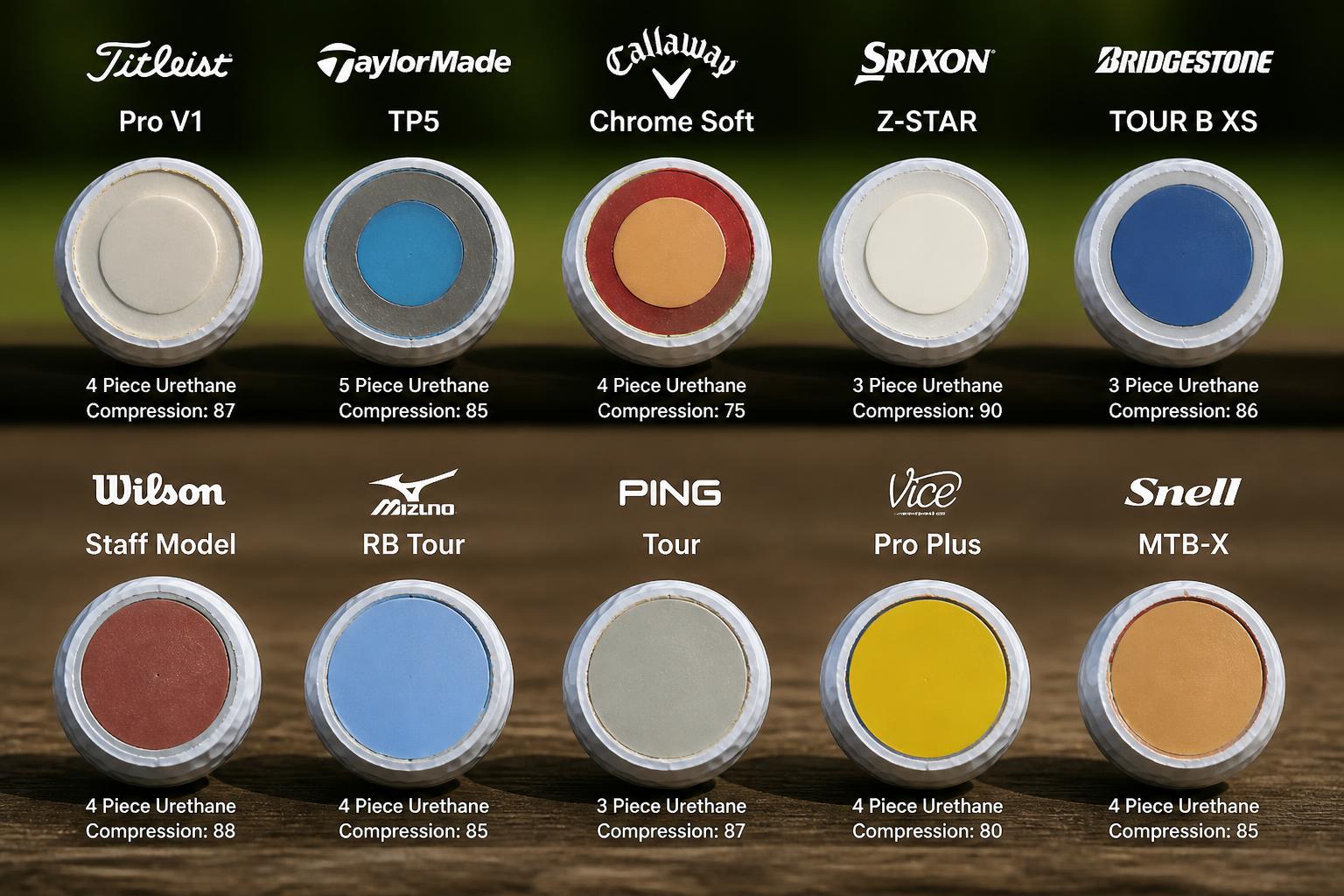
Compression is the most misunderstood number on a golf ball box. It measures how much the ball deforms under load — lower numbers mean the ball compresses more easily, higher numbers mean it feels firmer. This chart covers the compression ratings for major golf ball models so you can match a ball to your swing speed without guessing.

What Compression Actually Tells You
Compression is a single number (typically 30–110) that describes how much a golf ball squishes when struck. A ball rated at 70 compression requires more force to deform than one rated at 50. That’s it. It does not directly measure spin, distance, or feel — it only measures firmness.
The practical effect works like this:
- Low compression (under 70): Easier to compress with slower swing speeds. Produces less “hot” feeling off the face and can help maximize distance when your clubhead speed is below 90 mph.
- Mid compression (70–90): The broadest category. Suits most recreational golfers with moderate swing speeds (90–100 mph).
- High compression (90+): Firm feel, designed for high swing speeds (100+ mph) that can fully load the ball. Softer balls may feel “mushy” to these players.
Your swing speed — not your handicap — should drive the decision. A 15-handicap with a 105 mph driver speed will compress a high-compression ball better than a scratch golfer swinging at 88 mph.
Compression Chart by Brand
Compression ratings vary by manufacturer and are sometimes published, sometimes estimated from feel. The numbers below reflect the most commonly cited figures for current models.
| Brand | Model | Compression | Swing Speed Fit |
|---|---|---|---|
| Titleist | Pro V1 | 90 | 95–110 mph |
| Titleist | Pro V1x | 100 | 100–115 mph |
| Titleist | AVX | 75–80 | 85–100 mph |
| Titleist | Tour Speed | 85 | 90–105 mph |
| Callaway | Chrome Soft | 75 | 85–100 mph |
| Callaway | Chrome Soft X | 95 | 95–110 mph |
| Callaway | Supersoft | 38 | Under 85 mph |
| Callaway | ERC Soft | 60 | 80–95 mph |
| TaylorMade | TP5 | 85 | 90–105 mph |
| TaylorMade | TP5x | 95 | 95–110 mph |
| TaylorMade | Soft Response | 50 | Under 90 mph |
| TaylorMade | Tour Response | 70 | 85–100 mph |
| Srixon | Z-Star | 90 | 95–110 mph |
| Srixon | Z-Star XV | 100 | 100–115 mph |
| Srixon | Q-Star Tour | 80 | 85–100 mph |
| Srixon | Soft Feel | 60 | Under 85 mph |
| Bridgestone | Tour B X | 95 | 100–115 mph |
| Bridgestone | Tour B RX | 85 | 85–100 mph |
| Bridgestone | e12 Contact | 55 | Under 90 mph |
| Bridgestone | e6 | 50 | Under 85 mph |
| Maxfli | Tour S | 90 | 95–110 mph |
| Maxfli | Tour X | 100 | 100–115 mph |
| Maxfli | Softfli | 40 | Under 85 mph |
| Wilson | Staff Model | 100 | 100–115 mph |
| Wilson | Triad | 70 | 85–100 mph |
| Wilson | Duo Soft | 35 | Under 80 mph |
| Vice | Pro Plus | 95 | 100–115 mph |
| Vice | Pro Soft | 75 | 85–100 mph |
| Vice | Tour | 85 | 90–105 mph |
| Snell | MTB Prime | 90 | 95–110 mph |
| Snell | MTB-X | 100 | 100–115 mph |
| Pinnacle | Soft | 50 | Under 85 mph |
| Pinnacle | Rush | 80 | 85–100 mph |
| Kirkland | Signature | 90 | 90–105 mph |
How to Read the Chart for Your Game
Find your driver swing speed first. Most golf simulators, launch monitors, and fitting carts measure this. If you don’t know your number, here’s a rough gauge: if you hit your 7-iron about 140 yards, your driver speed is likely around 85 mph. Each 10 yards of 7-iron distance roughly equals 5 mph of driver speed.
If your driver speed is under 85 mph: Look at balls in the 35–60 compression range. The Callaway Supersoft at 38 compression and Wilson Duo Soft at 35 are designed for exactly this profile. These balls launch higher and maintain distance when you can’t generate high clubhead speed. You’ll also feel less “boardy” impact at impact.
If your driver speed is 85–100 mph: The 70–90 range is your sweet spot. The Srixon Q-Star Tour (80) and TaylorMade Tour Response (70) give you a balance of distance and greenside spin without feeling too hard. The Callaway Chrome Soft (75) is another strong match — it’s soft enough to compress fully but firm enough for control.
If your driver speed is over 100 mph: You can handle 90+ compression balls. The Titleist Pro V1x (100) and Bridgestone Tour B X (95) are built for this speed. At these swing speeds, a low-compression ball will feel dead and may spin too little around the greens.
Common Compression Mistakes
Mistake 1: Buying the softest ball because you have a high handicap. Handicap doesn’t determine compression needs — swing speed does. A high-handicap player with a fast swing will lose feel and spin control with a 40-compression ball.
Mistake 2: Assuming lower compression always means more distance. For slower swingers, yes. For faster swingers, a too-soft ball can actually reduce distance because it deforms too much and wastes energy.
Mistake 3: Ignoring the difference between “soft feel” and “low compression.” Some balls feel soft because of their cover material but have mid-range compression. The Titleist AVX feels soft but sits around 75–80 compression. Don’t judge by feel alone — check the number.
Mistake 4: Using one ball for every condition. Cold weather makes balls feel firmer and compress less. If you play in temperatures below 60°F, a ball one compression tier softer than your normal choice will perform closer to what you’re used to in summer.
Compression vs. Spin: What Matters More
Compression gets the attention, but spin characteristics often matter more for scoring. A ball’s compression tells you about feel and distance potential; its spin rating tells you about control.
Here’s the trade-off: low-compression balls (under 60) typically generate less spin on wedge shots, which makes them harder to hold on firm greens. Mid-compression balls (70–90) offer the best balance of distance and greenside control for most players. High-compression balls (90+) give tour-level spin but require speed to access it.
If you have to choose between matching compression perfectly or matching spin characteristics, prioritize spin around the greens. A ball that feels slightly too firm but stops on the green will save you more strokes than a perfectly compressed ball that rolls out 15 feet past the pin.
Testing Without a Launch Monitor
You don’t need expensive equipment to find your compression range. Buy one ball from each of three tiers — low (around 50), mid (around 80), and high (around 95) — and play a round with each. Pay attention to three things:
1. Feel off the putter: The ball should feel solid, not clicky or dead.
2. Driver distance: Note your average carry on well-struck drives.
3. Wedge spin: Hit full wedge shots and see whether the ball checks up or releases.
Pick the ball that gives you the best combination of distance and stopping power. If two balls feel equal, choose the softer one — it will be more comfortable on cold days and off-center hits.
FAQ
Does compression affect ball flight?
Yes, indirectly. Lower compression balls tend to launch higher because they deform more at impact, which can increase dynamic loft. Higher compression balls launch lower for players with enough speed to compress them properly.
Can women and seniors use low-compression balls?
Yes. Players with driver swing speeds under 80 mph — regardless of age or gender — benefit from balls in the 35–55 compression range. The Wilson Duo Soft (35) and Callaway Supersoft (38) are popular choices for this group.
Is higher compression always better for low handicaps?
No. Low handicaps with moderate swing speeds (under 100 mph) often play better with mid-compression balls. The Pro V1 (90) is the most played ball on tour, but many tour players actually use lower-compression versions of their preferred model.
Does compression matter for putting?
Yes, but less than you might think. Lower compression balls feel softer off the putter face, which some players prefer for distance control. Higher compression balls feel firmer and can help with consistent pace on fast greens.
Are compression ratings standardized across brands?
No. Each manufacturer tests compression differently, so a “90” from Titleist may not feel identical to a “90” from Bridgestone. Use the chart as a starting point, not a precise specification. The actual feel depends on the ball’s construction, cover material, and internal layer design.

Michael Reeves is a PGA Professional with over 20 years of experience in competitive golf and instruction. A former Division I collegiate player at the University of Texas, he competed on the mini-tours before transitioning to full-time coaching and golf journalism. He has been a certified PGA teaching professional since 2005 and has worked with players at every level, from absolute beginners to collegiate champions.
His writing has appeared in Golf Digest, Golf Magazine, and The Left Rough. At GolfHubz, Michael leads the editorial team, overseeing fact-checking and ensuring every answer meets the same standard he demands on the lesson tee: clear, evidence-based, and immediately useful.
When he’s not writing or teaching, Michael plays to a +1.4 handicap at his home club in Austin, Texas. He has attended over 40 major championships as a journalist and fan, and has played more than 200 courses across 15 countries.
You can reach Michael at [email protected] or follow his occasional swing analysis posts on the site.