Taylormade TP5 vs TP5x: Specs & Differences
Two premium tour balls, two different flight profiles. The TP5 and TP5x share the same five-layer construction, but they are not interchangeable. The differences come down to launch, spin, and feel — and those differences matter more for your game than the price tag.
Here is the short version before we dig into the details: the TP5 flies lower, spins more, and feels softer. The TP5x launches higher, spins less off the driver, and feels firmer. Which one you should play depends on your swing speed and what you need the ball to do around the green.
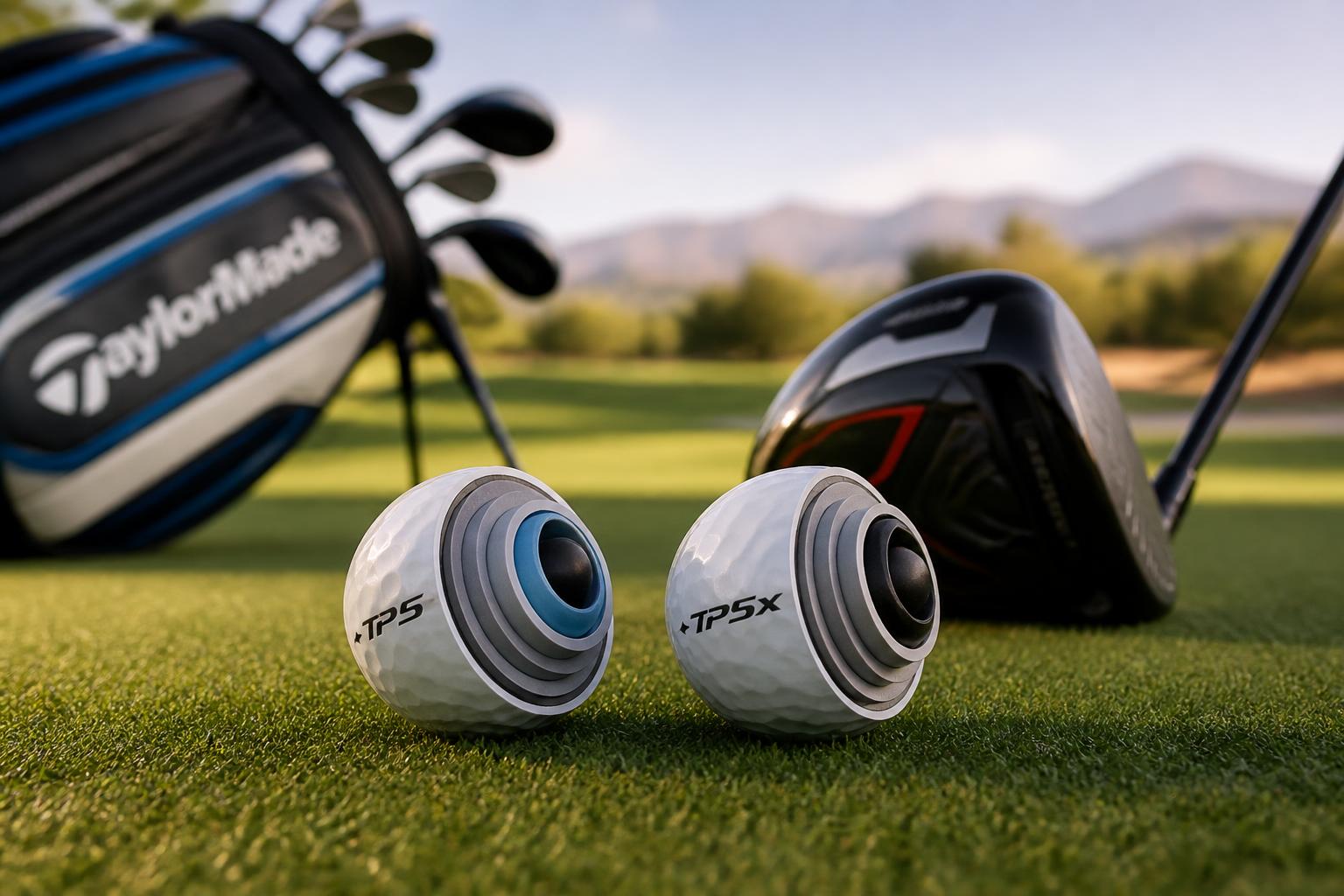
The Core Difference: Same Five Layers, Different Tuning
Both balls use TaylorMade’s five-layer Tour construction with a Tri-Fast core system. The architecture is identical. The materials are not.
The TP5 uses a lower-compression core that produces less spin and lower launch through the bag. The TP5x uses a higher-compression core that generates more ball speed and higher launch, especially with the driver and long irons.
That single difference cascades through the entire ball. The TP5x is built for players who need help getting the ball in the air and who generate enough clubhead speed to compress a firmer ball. The TP5 is built for players who already have plenty of launch and want more control.
What this means for your next purchase: If you’re currently playing a firmer tour ball and losing distance off the tee, the TP5’s lower compression core is the safer switch. If you’re playing a soft ball and watching your drives land short of your playing partners, the TP5x’s higher ball speed is worth the firmer feel. Don’t buy based on the Tour players you watch — buy based on what your launch monitor or playing partners tell you about your own flight.
Spec Comparison Table
| Spec | TaylorMade TP5 | TaylorMade TP5x |
|---|---|---|
| Construction | 5-layer Tour | 5-layer Tour |
| Core | Lower compression | Higher compression |
| Launch | Lower | Higher |
| Driver Spin | Lower | Higher (off driver) |
| Iron Spin | Higher | Lower |
| Wedge Spin | High | High |
| Feel | Softer | Firmer |
| Best for Swing Speed | Moderate (85–105 mph) | Faster (100+ mph) |
| Cover | Urethane | Urethane |
Specs reflect TaylorMade’s published design intent. Exact compression numbers and spin rates vary by swing and launch conditions.
Launch and Flight: What You’ll See in the Air
The most visible difference between the two balls is trajectory.
The TP5 produces a lower, more piercing flight. If you already hit the ball high or play in windy conditions, this ball keeps your shots under the breeze and holds its line better. The lower launch also helps with distance control on long irons, where a ballooning flight can cost you yards.
The TP5x produces a higher, more towering flight. This is a distance advantage for players with faster swing speeds who can keep the ball on a playable trajectory. The higher launch also helps with carry distance on soft fairways and into greens that demand a steep descent angle.
Decision rule: If your miss with the driver is low and flat, the TP5x gives you more carry. If your miss is high and spinny, the TP5 tightens the flight.
How to verify on the course: On your next range session, hit five drives with each ball and watch the apex with a friend standing downrange. The TP5x should peak visibly higher. If you can’t see a difference, your swing speed may be too low to compress the TP5x — that’s a sign to stick with the TP5.
Spin: The Trade-Off You Need to Understand
Here is where most golfers get confused. The TP5x is not simply “the more spinny version” of the TP5. The spin relationship flips depending on the club in your hand.
- Off the driver: The TP5x spins more than the TP5. That extra spin helps faster swingers keep the ball in the air and maximizes carry distance. For slower swing speeds, that same spin can kill distance.
- With irons: The TP5 spins more than the TP5x. The softer core of the TP5 grabs the face and produces the stopping power you need on approach shots.
- Around the greens: Both balls use a soft urethane cover with similar wedge spin performance. The feel differs — the TP5 feels softer off the putter face — but both will check up on short chips and pitches.
The practical takeaway: The TP5 is the better choice if you want maximum spin on approach shots and don’t need help launching the ball. The TP5x is the better choice if you need help getting the ball airborne and want to reduce spin on your long irons.
Where this goes wrong: Golfers who buy the TP5x expecting more spin on approach shots are often disappointed. The TP5x actually spins less with irons than the TP5. If your misses into greens are short-sided and you rely on one-hop-and-stop shots, the TP5’s extra iron spin is the safer choice. The TP5x’s lower iron spin means your approaches will release more — a problem on firm greens.
Feel and Sound: Not Just a Preference
The TP5 is noticeably softer off every club. It sounds muted at impact, almost dull on full shots. The TP5x feels firmer and sounds crisper, closer to a traditional tour ball.
This is not just about preference. The firmer feel of the TP5x gives faster swingers better feedback on mishits — you can feel when you’ve caught one thin. The softer TP5 masks some of that feedback but provides a more comfortable feel for players who prefer a plush response off the putter.
If you play a lot of short game practice, the feel difference will influence your touch on chips and putts. The TP5’s softer feel makes delicate shots around the green easier to judge. The TP5x’s firmer feel gives you more feedback on distance control but can feel harsh on cold days.
Trade-off to consider: If you play early-morning rounds in cooler weather, the TP5x’s firmer feel becomes noticeably harsher below 60°F. The TP5 maintains a more consistent feel in cold conditions. If you’re a fair-weather golfer, this won’t matter. If you play year-round, it’s a real factor.
Who Should Play the TP5?
Choose the TP5 if:
- Your driver swing speed is under 100 mph
- You already launch the ball high and want to flatten your flight
- You want maximum spin on approach shots
- You prefer a soft feel off the putter
- You play in windy conditions and need a penetrating ball flight
The TP5 is the better fit for the majority of single-digit and mid-handicap golfers. It offers more control where it matters — into greens — and the lower flight helps in the wind.
Who Should Play the TP5x?
Choose the TP5x if:
- Your driver swing speed is over 100 mph
- You struggle to get the ball in the air, especially with long irons
- You want more carry distance off the driver
- You prefer a firmer feel and more feedback
- You play on soft fairways where roll-out is minimal
The TP5x rewards speed. If you can compress it, you get the distance benefits. If you can’t, the ball will feel hard and you’ll lose carry distance to the higher spin.
Are TP5x Good for High Handicappers?
The TP5x is not the ideal choice for most high handicappers. The firmer core and higher spin off the driver require swing speed to perform as designed. A high handicapper with a slower swing will likely see shorter drives and a harsher feel.
That said, a high handicapper with an unusually fast swing speed (above 105 mph) might benefit from the TP5x’s higher launch. The key is swing speed, not handicap index. If you’re a 20-handicap who swings hard, the TP5x can help you carry the ball farther. If you’re a 15-handicap with a moderate swing, the TP5 is the safer play.
The mismatch to watch for: High handicappers often buy the TP5x because they want the “tour” ball their favorite player uses. The firmer core won’t compress properly at slower speeds, which produces a boardy feel and reduced carry. You’ll get better results from the TP5 — or from a two-piece distance ball if your swing is still developing.
Is TP5 or TP5x Better for Slower Swing Speeds?
The TP5 is the better choice for slower swing speeds. The lower compression core makes it easier to compress, and the lower spin off the driver helps maximize distance when you don’t generate much clubhead speed.
A player with a driver swing speed under 95 mph will likely see more distance with the TP5. The TP5x will feel boardy and produce less carry because the higher compression core won’t deform enough at impact.
Verification step: Check your driver swing speed on a launch monitor at your local golf shop or during a fitting. If you’re under 95 mph, the TP5 is the clear choice. If you’re between 95–100 mph, test both balls on the monitor and compare carry distance — that data will settle the debate faster than any spec sheet.
TP5 vs TP5x: The One-Swing Test
If you’re still unsure, here’s a simple test to run at your next practice session. Hit five drives with each ball and note the following:
1. Peak height: Which ball flies higher?
2. Carry distance: Which ball carries farther?
3. Feel at impact: Which ball feels better to you?
4. Dispersion: Which ball keeps your misses tighter?
The ball that wins three out of four categories is your answer. Don’t overthink the marketing claims — your swing will tell you which ball works.
One caution: Make sure you’re comparing the same generation of both balls. TaylorMade updates these models periodically, and a previous-generation TP5x may perform differently than the current version. Check the box for the current model year before you test.
FAQ
Is the TaylorMade TP5 or TP5X better?
Neither ball is universally better. The TP5 suits players who want lower launch, more iron spin, and a softer feel. The TP5x suits players with faster swing speeds who need higher launch and more carry distance. Your swing speed and ball flight preferences determine the right pick.
Are TP5X good for high handicappers?
The TP5x is generally not recommended for high handicappers with average swing speeds. The firmer core requires speed to compress properly, and the higher driver spin can reduce distance for slower swings. High handicappers with unusually fast swing speeds may benefit, but most will find the TP5 easier to play.
Who should play TP5 vs TP5X?
Play the TP5 if you have a moderate swing speed, want more spin on approach shots, and prefer a soft feel. Play the TP5x if you have a fast swing speed, need help launching the ball, and want more carry distance off the driver.
Is TP5 or TP5X better for slower swing speed?
The TP5 is better for slower swing speeds. Its lower compression core is easier to compress, and the lower driver spin helps maximize distance when clubhead speed is limited. The TP5x will feel hard and produce less carry for most players under 95 mph driver speed.

Michael Reeves is a PGA Professional with over 20 years of experience in competitive golf and instruction. A former Division I collegiate player at the University of Texas, he competed on the mini-tours before transitioning to full-time coaching and golf journalism. He has been a certified PGA teaching professional since 2005 and has worked with players at every level, from absolute beginners to collegiate champions.
His writing has appeared in Golf Digest, Golf Magazine, and The Left Rough. At GolfHubz, Michael leads the editorial team, overseeing fact-checking and ensuring every answer meets the same standard he demands on the lesson tee: clear, evidence-based, and immediately useful.
When he’s not writing or teaching, Michael plays to a +1.4 handicap at his home club in Austin, Texas. He has attended over 40 major championships as a journalist and fan, and has played more than 200 courses across 15 countries.
You can reach Michael at [email protected] or follow his occasional swing analysis posts on the site.