Review of Golf Pressure Plate Training Aids
← Golf Instruction & Improvement | Swing Mechanics & Fundamentals
BLOCKQUOTE_0
Quick Answer
- Golf pressure plate reviews are your roadmap to understanding how these training aids truly refine swing mechanics and boost your game.
- They pinpoint which swing trainers offer the most accurate, actionable feedback on balance and weight transfer, key to a powerful, consistent shot.
- Reviews cut through the noise, guiding you to select the best practice aid that aligns with your specific training goals and budget.
Who This Is For
- Golfers who are serious about improving their swing balance, weight transfer, and overall shot consistency, whether you’re a weekend warrior or a dedicated player.
- Golf instructors and coaches looking for effective, data-driven training aids to help their students identify and correct swing flaws more efficiently.
What to Check First for Golf Pressure Plate Training Aids
Before you even think about buying, give these a quick once-over. It’ll save you a heap of trouble later.
- Compatibility with Your Setup: This is huge. Does the pressure plate system integrate smoothly with your existing practice setup? Whether it’s a home simulator, a backyard net, or just your living room carpet (with a mat, obviously), make sure it’s designed to work there. You don’t want to buy a fancy gadget that won’t play nice with your space. Some systems require specific mats or are better suited for indoor vs. outdoor use. Check the specs.
- Power Source and Battery Life: How does this thing get juice? Is it battery-powered? If so, what kind of batteries, and how long do they last? A rechargeable unit is often more convenient and eco-friendly. If it’s USB-powered, do you have a convenient outlet or power bank? Nothing kills practice momentum faster than a dead device. I learned that lesson the hard way with a headlamp once.
- Durability and Build Quality: You’re going to be stepping on this thing, repeatedly, with the force of your golf swing behind you. It needs to be built like a tank. Look for reviews that mention its sturdiness, materials used, and how well it holds up to consistent use. A flimsy plate will crack or malfunction quickly, turning your investment into a paperweight. I’ve seen cheap plastic break just looking at it.
- Sensor Sensitivity and Accuracy: This is the heart of the matter. How well does it pick up subtle shifts in your weight? Does it provide clear, distinct feedback for different pressure zones? Reviews are your best friend here, as they often detail the user experience with accuracy. Some plates are better at detecting minute changes than others, which is crucial for fine-tuning your technique.
- Connectivity and App Integration: Many modern pressure plates come with companion apps that provide detailed analysis, track your progress, and offer drills. Check if the app is user-friendly, available for your device (iOS/Android), and if it receives regular updates. A clunky or buggy app can be more frustrating than helpful.
When considering compatibility, remember that a quality golf practice mat is essential for most setups, ensuring the pressure plate sits stable and flat for accurate readings.
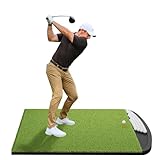
- 1. Patented Arc-Shaped Ball Tray Design: Featuring a unique arc-shaped built-in ball tray, this patented all-in-one golf hitting mat allows effortless practice. The ergonomic arc design helps you hit continuously without bending down to pick up balls, keeping your rhythm and focus on every swing.
- 2. Two Size & Thickness Options For Real Feel: Available in 5x4ft (26mm / 31mm) and 6x4ft (26mm / 31mm) versions. Choose your preferred size and turf thickness for a realistic fairway feel—perfect for golfers of all levels who want professional-grade feedback.
- 3. Easy Storage & Portable Setup: Foldable and lightweight construction makes it easy to store or transport. Simply roll it up and place it in your garage, trunk, or practice room. Great for both indoor and outdoor golf training.
- 4. Durable Eva Base For Stability & Comfort: Built with a non-slip EVA foam base, this mat absorbs shock and reduces strain on wrists and elbows. The high-density turf layer resists wear and tear, maintaining consistent performance even after thousands of swings.
- 5. Quality Guarantee & Reliable Support: Our responsive customer service team is always ready to assist you. So you can focus on improving your game.
Step-by-Step Plan: Evaluating Golf Pressure Plate Training Aids
Once you’ve got your eye on a specific pressure plate, here’s how to put it through its paces. Treat it like you’re checking out a new piece of gear on the trail – thorough and practical.
1. Unbox and Inspect All Components: When that box arrives, don’t just rip it open and toss the packaging. Lay everything out.
- Action: Carefully unpack the pressure plate, any sensors, cables, power adapters, and the user manual.
- What to look for: Verify that every item listed in the manual is present and accounted for. Check for any visible damage like cracks, dents, or loose connections.
- Mistake to avoid: Assuming everything is there. A quick, methodical check against the packing list prevents the frustration of realizing a crucial piece is missing after you’ve set it all up.
2. Connect Power and Initial Power-On: Get the device ready to go.
- Action: Connect the pressure plate to its designated power source – install batteries, plug in the USB, or connect the AC adapter.
- What to look for: The device should power on without issue. Look for indicator lights to illuminate, a screen to activate, or any confirmation that it’s receiving power and is ready for the next step.
- Mistake to avoid: A device that won’t turn on. This is a clear sign of a defect or a dead battery, requiring an immediate return or exchange. Don’t waste time troubleshooting a DOA unit.
3. Download and Install Companion App (If Applicable): If your pressure plate comes with a digital sidekick, get it set up.
- Action: Search for the official companion app in your smartphone’s app store (Apple App Store or Google Play Store) and download/install it.
- What to look for: The app should be easily found, have a decent star rating, and recent positive reviews indicating it’s functional and user-friendly.
- Mistake to avoid: Finding the app is unavailable, has extremely poor reviews, or is riddled with bugs. This can severely limit the training aid’s functionality and your ability to get meaningful data.
4. Perform Initial Calibration: This step is non-negotiable for accurate readings.
- Action: Follow the user manual’s instructions precisely for the initial calibration process. This usually involves standing on the plate in a specific way.
- What to look for: The device or app should confirm that calibration was successful. There might be a specific light, sound, or message indicating this.
- Mistake to avoid: Skipping calibration or doing it incorrectly. This is like trying to navigate with a compass that hasn’t been set – your data will be off, leading to flawed analysis and incorrect adjustments to your swing.
5. Strategic Placement on Your Practice Surface: Where you put the plate matters.
- Action: Position the pressure plate on your intended practice surface (mat, turf, etc.) according to the manufacturer’s guidelines for proper stance alignment.
- What to look for: The plate should sit stable and flat on the surface, without rocking or shifting. Ensure it’s positioned so your feet will naturally land on it during your swing.
- Mistake to avoid: Placing the plate haphazardly or assuming it will stay put. An unstable or misaligned plate will provide inaccurate pressure readings and can even be a tripping hazard.
6. Conduct First Practice Swings and Analyze Feedback: Time to see it in action.
- Action: Take a few practice swings, focusing on your balance and weight shift. Pay close attention to the feedback provided by the pressure plate (visual displays, audio cues, app data).
- What to look for: Does the feedback feel intuitive? Does it seem to reflect what you felt during your swing? For instance, if you felt a strong shift to your lead foot, does the plate show that?
- Mistake to avoid: Ignoring the feedback or dismissing it if it doesn’t immediately make sense. The goal is to understand what the plate is telling you about your body’s mechanics. This might require a few swings to start correlating the data with your physical sensations.
Why Golf Pressure Plate Reviews Matter for Your Game
Understanding how these devices work and what they offer is crucial. Reviews are the best way to get a real-world perspective before you invest your hard-earned cash.
- Understanding Swing Mechanics: A golf pressure plate is essentially a sophisticated balance board for your feet. It uses a grid of sensors to measure the distribution of your weight throughout your golf swing. When you step on it, it registers how much pressure is on your heel, toe, the balls of your feet, and the inside/outside edges. During your backswing, transition, and downswing, your weight shifts dynamically. The plate captures this movement, showing you where your weight is at any given moment. For example, it can tell you if you’re hanging back on your heels too much in the backswing, or if you’re getting too much weight on your lead foot too early in the downswing. This real-time data is invaluable for identifying imbalances that lead to inconsistency. Reviews often detail how clearly and effectively a specific model communicates this information, whether through an app interface, colored lights, or audible cues. They help you understand if the feedback is actionable and easy to interpret for your specific needs.
- Improving Balance and Weight Transfer: The benefits of excellent balance and efficient weight transfer are undeniable in golf. A solid foundation allows for a more powerful and controlled swing. If your weight isn’t moving correctly, your body mechanics will suffer, leading to off-center hits, loss of power, and directional issues. A pressure plate provides objective data on this crucial aspect of your swing. You can see exactly how your weight shifts from backswing to downswing and impact. Are you transferring power efficiently through the ball? Are you losing balance at the top of your backswing? Reviews will highlight which pressure plates excel at providing clear, granular data on these specific movements. They can tell you if a plate is sensitive enough to detect subtle shifts that might be causing your slice or hook, and if the associated software provides drills or insights to correct these tendencies. This direct feedback loop is what makes pressure plates such powerful training tools, and reviews help you find one that delivers.
- Identifying and Correcting Swing Flaws: We all have swing flaws, big or small. Sometimes, we don’t even realize they exist until we see them on video or get feedback from a coach. A pressure plate can act as your personal swing diagnostician. It can reveal patterns you might be unaware of. For instance, a review might mention how a specific plate helped a golfer realize they were consistently “lifting” their weight off their trail foot too early in the downswing, causing a loss of power and a tendency to swing across the ball. By seeing this data, the golfer can then focus on keeping pressure on the trail foot longer. Similarly, it can highlight if you’re “reverse pivoting” or not properly loading your hips. Reviews often detail specific examples of how golfers have used these devices to diagnose and correct common issues like slices, hooks, or inconsistent contact. This makes them incredibly practical for self-improvement, and reading about others’ success stories can be highly motivating and informative.
Common Mistakes
Don’t let these trip you up. A little foresight goes a long way.
- Incorrect Placement — Why it matters: The plate needs to be positioned correctly relative to your stance. If it’s too far forward, backward, or angled, the pressure readings will be completely skewed, giving you bad data. You’ll be practicing the wrong thing and reinforcing bad habits. — Fix: Always refer to the manufacturer’s placement guide for your specific stance and swing. Mark the ideal spot if necessary, and ensure it’s stable.
- Ignoring Calibration Instructions — Why it matters: Calibration is the process that tells the device what “zero” pressure looks like and sets its baseline. Skipping this step, or doing it incorrectly, means all subsequent readings will be faulty. It’s like trying to measure with a ruler that’s missing the first inch. — Fix: Always calibrate the pressure plate before your first use, and periodically thereafter, especially if you move it or notice inconsistent readings. Follow the manual’s steps meticulously.
- Over-Reliance on Visual Feedback Only — Why it matters: Many pressure plates offer visual data (graphs, heatmaps) and sometimes audio cues or haptic feedback. Focusing only on the screen can make you miss crucial physical sensations or auditory signals that are just as important for learning. — Fix: Engage all your senses. Feel the pressure shift in your feet, listen to any sounds the device makes, and correlate that with what you see on the screen or in an app. The goal is to develop a feel for correct weight transfer.
- Expecting Miracles Overnight — Why it matters: A pressure plate is a tool, not a magic wand. Improvement in golf takes time, practice, and consistent effort. Getting discouraged after a few sessions because you haven’t shaved ten strokes off your game will lead you to abandon the tool prematurely. — Fix: Be patient and consistent with your practice. Focus on making small, incremental improvements based on the feedback. Celebrate the little wins, like a more balanced backswing or a smoother transition.
- Not Checking Reviews Before Buying — Why it matters: You might end up with a pressure plate that’s inaccurate, poorly built, has a terrible app, or simply doesn’t suit your needs. Reviews from other golfers offer real-world insights into a product’s performance and reliability. — Fix: Dedicate time to reading multiple reviews from various sources (golf websites, forums, retailer sites) before making your purchase. Look for patterns in feedback regarding accuracy, durability, and ease of use.
- Using It as a Sole Training Tool — Why it matters: While fantastic for balance and weight transfer, a pressure plate doesn’t address every aspect of the golf swing, like clubface control, swing path, or tempo. Relying on it exclusively can lead to a swing that’s balanced but ineffective. — Fix: Integrate the pressure plate into a broader practice routine that includes other drills, video analysis, and potentially lessons from a qualified instructor. It’s one piece of the puzzle.
FAQ
- How do golf pressure plates work?
They use an array of sensors embedded in the surface to detect and measure the distribution of pressure across your feet during your golf swing. This data is then translated into visual or auditory feedback, showing you how your weight shifts and where your balance lies throughout the swing motion.
- What are the primary benefits of using a golf pressure plate?
The main benefits include improving swing balance, enhancing weight transfer efficiency, identifying and correcting swing flaws related to foot pressure, and ultimately leading to more consistent ball striking, increased power, and better control over your shots.
- Can a pressure plate help with a golf slice?
Absolutely. Many slices are caused by improper weight transfer or balance issues, such as hanging back on the trail foot too long or shifting weight too early onto the lead foot. A pressure plate can help you identify these specific imbalances, allowing you to make corrections that can lead to a straighter ball flight.
- Do I need a special mat or surface to use a pressure plate?
Typically, no. Most pressure plates are designed to be used on a flat, stable surface, like a practice mat in your garage, a dedicated indoor putting green, or even firm ground at the driving range. The key is a level surface to ensure accurate readings.
- How accurate are golf pressure plates, and does accuracy vary by model?
Accuracy can vary significantly between different models and price points. Higher-end, professional-grade units generally offer more precise and sensitive readings. Reviews are your best resource for gauging the accuracy of a specific model, as users often comment on its responsiveness and reliability.
- Can I use a golf pressure plate indoors for practice?
Yes, many pressure plates are specifically designed for indoor use and are an excellent tool for practicing swing mechanics year-round, regardless of weather conditions. They are a great way to maintain your feel and technique when you can’t get to the golf course or driving range.
- What kind of feedback does a pressure plate provide?
Feedback varies by model. It can range from simple LED lights indicating pressure zones, to detailed real-time graphs on a smartphone app showing weight distribution over time, to audible cues that signal correct or incorrect weight shifts. Some advanced systems offer swing analysis reports and personalized drills.