Hybrid Loft Comparison Chart: All Brands
If you’re shopping for hybrids, the first thing you’ll notice is that loft numbers don’t tell the whole story. A “4 hybrid” from one brand might be 22 degrees, while another brand’s 4 hybrid sits at 24 degrees. This chart and guide break down how hybrid lofts compare across major brands, what those numbers mean for your bag gaps, and how to match a hybrid to the iron or fairway wood it’s replacing.
Why Hybrid Lofts Vary by Brand
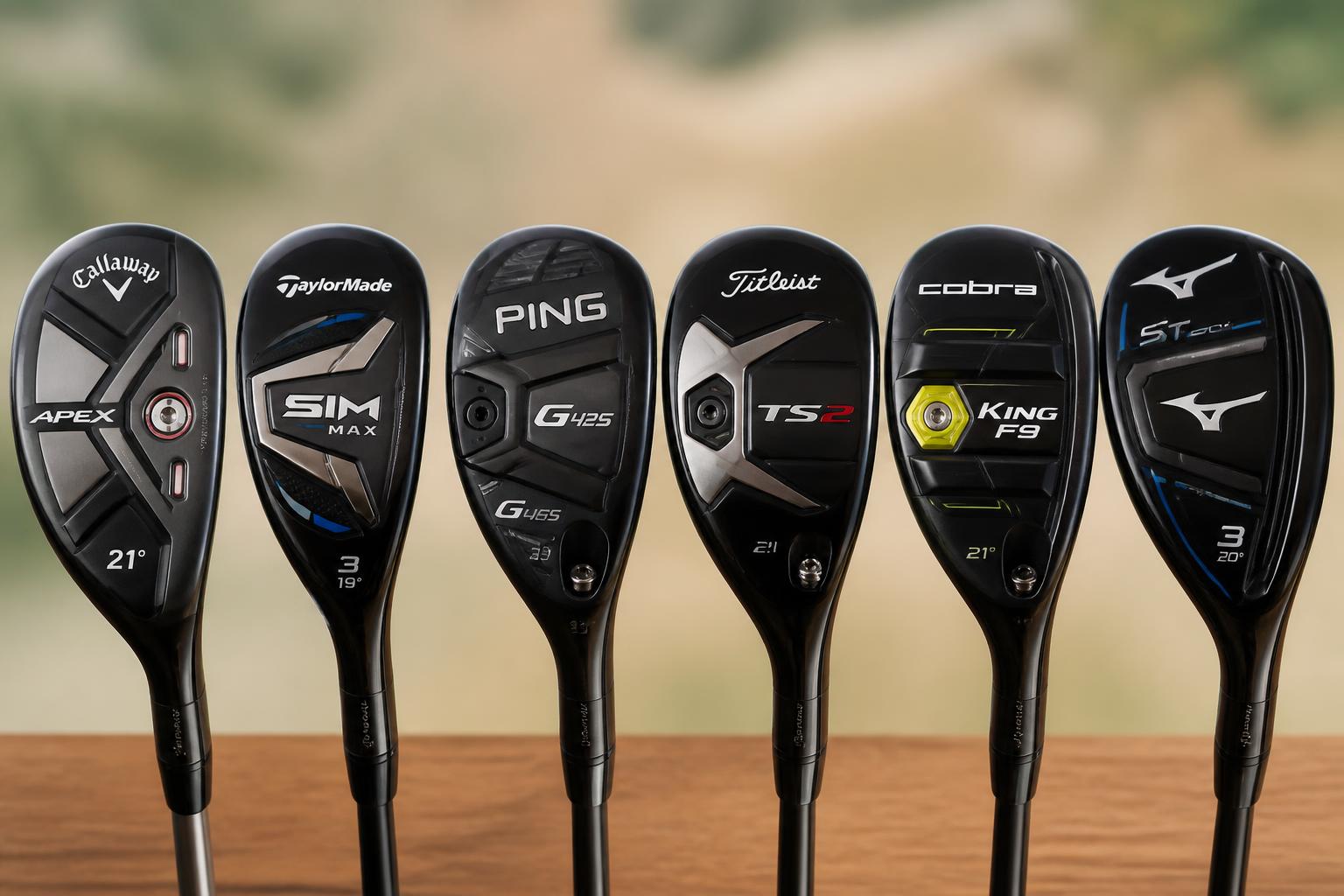
Hybrid lofts aren’t standardized. Unlike irons, where a 7-iron is usually around 30–34 degrees, hybrid numbering follows each manufacturer’s own gapping philosophy. Some brands design hybrids to replace long irons directly; others design them to bridge the gap between fairway woods and irons.
The practical result: a 3 hybrid from one brand might be 19 degrees, while another brand’s 3 hybrid is 21 degrees. That’s a two-club difference in distance potential, so you can’t just grab any “4 hybrid” and expect it to fill the same slot in your bag.
What this means for your next purchase: If you’re replacing a single club in an existing set, you cannot rely on the number stamped on the sole. A golfer replacing a 4-iron with a “4 hybrid” from a brand that builds strong lofts could end up with a club that flies a full club longer than the iron it replaced, leaving a gap between the hybrid and the next club up. Conversely, a weaker-lofted brand could leave you with a hybrid that doesn’t carry far enough to justify removing the iron from your bag. Always compare the actual loft, not the number.
Hybrid Loft Comparison Chart (All Major Brands)
The table below shows typical lofts for men’s hybrids across the major OEMs. These are current production specs, but verify the exact loft on the club you’re buying — older models and custom orders vary.
| Brand | 2 Hybrid | 3 Hybrid | 4 Hybrid | 5 Hybrid | 6 Hybrid | 7 Hybrid |
|---|---|---|---|---|---|---|
| Callaway | — | 18° | 21° | 24° | 27° | — |
| TaylorMade | 17° | 19° | 22° | 25° | 28° | — |
| Titleist | — | 19° | 21° | 24° | 27° | — |
| Ping | — | 19° | 22° | 26° | 30° | — |
| Cobra | — | 19° | 22° | 25° | 28° | — |
| Tour Edge | 16° | 18° | 20° | 23° | 26° | — |
| Cleveland | — | 19° | 22° | 25° | 28° | — |
| PXG | — | 19° | 22° | 25° | — | — |
| Majek | — | 20° | 23° | 26° | 29° | 32° |
Key takeaways from the chart:
- Callaway runs strong. A Callaway 4 hybrid at 21° is closer to most brands’ 3 hybrid. If you’re replacing a 4-iron (typically 24°), you might need a Callaway 5 hybrid instead.
- Titleist gaps tightly. Titleist’s 3 and 4 hybrids are only 2 degrees apart (19° and 21°), which suits players who want precise distance control rather than big loft jumps.
- Ping’s 5 hybrid is weaker than most. At 26°, it’s closer to a traditional 6-iron loft. That’s intentional — Ping designs hybrids to launch high and land soft, so the weaker loft still carries like a long iron.
- Tour Edge offers the widest range. With lofts from 16° to 26°, Tour Edge covers everything from a 5-wood replacement down to a 5-iron replacement.
How to verify your exact club: Before you buy, look up the spec sheet on the manufacturer’s website for the specific model year you’re considering. Lofts can shift between generations — a 2023 model 4 hybrid may differ by 1–2 degrees from the 2025 version of the same club. If you’re buying used, check the hosel or sole stamping; many hybrids list the loft in degrees right on the club. When in doubt, ask the seller to confirm the loft before you commit.
How to Match a Hybrid to Your Iron Set
Use this rule of thumb: match the hybrid loft to the iron loft you’re replacing, then account for the hybrid’s higher launch.
| Iron Being Replaced | Typical Iron Loft | Recommended Hybrid Loft |
|---|---|---|
| 3-iron | 20–22° | 19–21° |
| 4-iron | 23–25° | 21–23° |
| 5-iron | 26–28° | 24–26° |
| 6-iron | 29–31° | 27–29° |
The adjustment: Hybrids launch the ball higher than irons of the same loft because of their lower center of gravity and longer shaft. If you hit your 4-iron 190 yards, a 22° hybrid will likely carry that distance with a steeper descent angle, so it stops faster on greens.
Common mistake: Buying a hybrid numbered the same as the iron you’re replacing. A 4 hybrid is not automatically the same as a 4 iron — check the actual loft before you commit.
The trade-off you need to accept: A hybrid that matches your iron’s loft will likely fly 5–10 yards farther because of the longer shaft and hotter face. That means you’re not just swapping one club for another — you’re changing your distance gaps. If you want the hybrid to slot into the exact distance your iron used to cover, you may need to choose a hybrid one degree weaker than the iron it replaces. If you want maximum distance and forgiveness, match the loft and accept that your long-iron slot now plays longer.
Hybrid vs. Fairway Wood: Where the Lofts Overlap
Hybrids and fairway woods overlap in the 16–21 degree range. A 2 hybrid (17°) and a 5-wood (18°) are nearly the same loft, but they perform differently:
| Club | Typical Loft | Shaft Length | Typical Use |
|---|---|---|---|
| 5-wood | 17–19° | 42–43″ | Long approach shots, tight fairways |
| 2 hybrid | 16–17° | 40–41″ | Long par-3s, fairway bunkers, tee shots |
| 3 hybrid | 18–21° | 39–40″ | Replacing 3-iron, long par-3s |
| 4 hybrid | 21–24° | 38–39″ | Replacing 4-iron, approach shots |
Decision rule: If you’re more accurate with fairway woods off the deck, keep a 5-wood and skip the 2 hybrid. If you struggle with fairway woods from tight lies, a 2 or 3 hybrid is easier to hit from short grass because the shorter shaft gives you more control.
Where this overlap causes problems: Carrying both a 5-wood and a 2 hybrid creates a nearly identical distance slot — roughly 200–215 yards for most players. That’s a wasted spot in your bag. If you have 14 clubs, you’re better off choosing one and using the open slot for a wedge or an extra scoring iron. The exception is if you use one off the tee and the other from the fairway with different shot shapes, but most amateurs don’t need that level of specialization.
What the “Number” Actually Means
Hybrid numbers are shorthand for the iron they replace, not a universal loft standard. Here’s how the numbering works across the industry:
- 3 hybrid = replaces a 3-iron (usually 19–21°)
- 4 hybrid = replaces a 4-iron (usually 21–24°)
- 5 hybrid = replaces a 5-iron (usually 24–27°)
- 6 hybrid = replaces a 6-iron (usually 27–30°)
But as the chart shows, brands like Callaway and Tour Edge skew stronger, while Ping skews weaker. Always verify the loft on the specific club you’re considering.
Why the numbering persists: Golfers think in club numbers, not degrees. A “4 hybrid” feels intuitive because it tells you which iron it’s meant to replace, even if the loft doesn’t match that iron exactly. Manufacturers keep the numbering system because it helps you build a bag without doing math at the store. The catch is that the system only works if you know your own iron lofts first.
Choosing Between a 19° and 22° Hybrid
If you’re deciding between a 19° and a 22° hybrid, the choice comes down to what you’re replacing and how you use the club:
Choose the 19° hybrid if:
- You’re replacing a 3-iron or a 5-wood
- You need distance off the tee on long par-3s
- You have a faster swing speed (95+ mph with driver)
- You want a club that covers 200–215 yards
Choose the 22° hybrid if:
- You’re replacing a 4-iron
- You want a club that’s easier to launch from the fairway
- You need more stopping power on approach shots
- You want a club that covers 185–200 yards
The middle ground: If you’re between the two, consider a 20.5° or 21° hybrid. Some brands offer adjustable hosels that let you change loft by 1.5–2 degrees, which gives you flexibility to tune the club to your gap.
The risk of picking wrong: Choosing a 19° hybrid when you actually need a 22° creates two problems. First, you’ll likely lose distance because you can’t generate enough clubhead speed to launch a low-lofted hybrid properly — the ball comes out low and rolls out instead of carrying. Second, you’ll have a gap between the hybrid and your next longest iron that’s too wide to cover. A 19° hybrid that you hit 185 yards leaves a 15-yard gap down to your 5-iron at 170. That’s a scoring problem on long par-4s where you need precise approach distances.
How to Check Your Bag Gaps
Here’s a simple process to find the right hybrid loft for your bag:
1. Write down the lofts of your current clubs — irons, woods, and any hybrids you already own.
2. Identify the gap you’re trying to fill. If your 5-wood goes 215 yards and your 5-iron goes 185, you need a club that covers 195–205.
3. Match the loft to the distance, not the number. Use the chart to find a hybrid loft that fits between your existing clubs.
4. Test with your actual swing. Loft charts are starting points, not guarantees. Your swing speed and launch angle will shift distances by 5–10 yards per club.
5. Check the shaft length. A hybrid with the right loft but a shaft that’s too long or short will throw off your gaps.
How to confirm the fit before buying: If you’re shopping online, compare the hybrid’s stated loft to your iron set’s spec sheet. Most manufacturers publish full loft specs for current iron sets on their websites. If you have a 2020 iron set, look up those exact specs — don’t assume your 4-iron is 24° just because that’s the current industry average. Write down your actual iron lofts, then match the hybrid loft to that number, not to the club number.
Common Loft Mistakes to Avoid
- Assuming all 4 hybrids are the same. A Callaway 4 hybrid (21°) and a Ping 4 hybrid (22°) are close, but a Tour Edge 4 hybrid (20°) is a full club stronger. Check the spec sheet.
- Ignoring the adjustability. Many hybrids from TaylorMade, Callaway, and PXG have adjustable hosels. A 22° hybrid can be set to 20.5° or 23.5°, which changes its role in your bag.
- Replacing your longest iron with a hybrid that’s too strong. If you hit your 5-iron 170 yards, don’t buy a 19° hybrid expecting to hit it 190 — you’ll likely hit it 180 and have a gap problem.
- Forgetting about the fairway wood slot. A 2 hybrid and a 5-wood overlap significantly. Carrying both creates a distance gap elsewhere in your bag.
What can go wrong with adjustable hosels: Adjusting loft also changes the face angle and lie angle. Setting a 22° hybrid to 20.5° opens the face slightly, which can promote a fade for some players. Setting it to 23.5° closes the face, which can promote a draw. If you’re using the adjustment to fix a distance gap, you may unintentionally change your ball flight. Test the club at the adjusted loft before you commit to it as your gapping solution.
Budget Hybrids with Consistent Lofts
If you’re looking for a hybrid without paying premium prices, several brands offer solid options with predictable lofts:
- Majek Golf Mens All Hybrid #7 Senior Flex Right Handed New Utility A Flex Graphite Golf Club — Majek offers a full range from 3 through 7 hybrid, with the 7 hybrid at 32° for players who want to replace their longest irons entirely. The senior flex graphite shaft and 38-inch length make it a good option for slower swing speeds.
- XINGGM Hybrid Golf Clubs for Men,Premium Rescue 3 Hybrid/4 Hybrid/5 Hybrid Golf Club & Utility Golf Clubs Easier Green Approaches and Precise Landing Control (Graphite, 7 Hybrid, Regular, Right) — XINGGM’s X-shaped perimeter weighting raises MOI for stability, and the ultra-low CG helps with launch. Available in 3 through 7 hybrid, so you can match the loft to your iron gaps.
- PGF Men’s Gold Tour Precision Hybrid Golf Club [RH][# 8] — PGF’s Gold Tour Precision hybrid uses perimeter weighting and a low CG for forgiveness. The #8 option gives you a 35–36° hybrid that can replace your 8-iron or serve as a high-launching approach club.
A note on budget-brand loft consistency: Budget brands often use stronger lofts to make clubs appear longer off the face. If you’re buying a budget hybrid to fill a specific gap, verify the loft against the chart above and your iron specs. The number stamped on the sole is less reliable on budget lines than on major OEMs, so the loft spec sheet matters even more here.
FAQ
Is a 19 degree hybrid a 3 or 4?
A 19-degree hybrid is typically a 3 hybrid. Most major brands — TaylorMade, Titleist, Ping, Cobra, Cleveland — set their 3 hybrid at 19 degrees. Callaway and Tour Edge are exceptions: Callaway’s 3 hybrid is 18 degrees, and Tour Edge’s is 18 degrees as well. If you’re buying a 19-degree hybrid, it will function as a 3-iron replacement.
Is a 4 hybrid the same loft as a 4 iron?
No. A 4 hybrid is typically 21–24 degrees, while a 4 iron is usually 23–25 degrees. The hybrid’s lower center of gravity launches the ball higher, so even when the lofts are close, the hybrid will fly higher and land softer than a 4 iron of the same loft. You’re not getting a direct replacement — you’re getting a club that’s easier to hit.
Which is better, a 19 degree hybrid or a 22 degree hybrid?
Neither is universally better — it depends on what you’re replacing. A 19-degree hybrid suits faster swing speeds and players replacing a 3-iron or 5-wood. A 22-degree hybrid is better for players replacing a 4-iron or those who want a higher launch and more stopping power. If you’re between the two, a 20.5-degree adjustable hybrid gives you the flexibility to tune it either way.
What club is a 4 hybrid equivalent to?
A 4 hybrid is equivalent to a 4 iron in terms of the club it replaces, but not in loft. Most 4 hybrids are 21–24 degrees, while most 4 irons are 23–25 degrees. The hybrid will launch higher, carry similar or slightly longer distances, and be more forgiving on off-center hits. For most players, a 4 hybrid is easier to hit than a 4 iron from any lie.

Michael Reeves is a PGA Professional with over 20 years of experience in competitive golf and instruction. A former Division I collegiate player at the University of Texas, he competed on the mini-tours before transitioning to full-time coaching and golf journalism. He has been a certified PGA teaching professional since 2005 and has worked with players at every level, from absolute beginners to collegiate champions.
His writing has appeared in Golf Digest, Golf Magazine, and The Left Rough. At GolfHubz, Michael leads the editorial team, overseeing fact-checking and ensuring every answer meets the same standard he demands on the lesson tee: clear, evidence-based, and immediately useful.
When he’s not writing or teaching, Michael plays to a +1.4 handicap at his home club in Austin, Texas. He has attended over 40 major championships as a journalist and fan, and has played more than 200 courses across 15 countries.
You can reach Michael at [email protected] or follow his occasional swing analysis posts on the site.