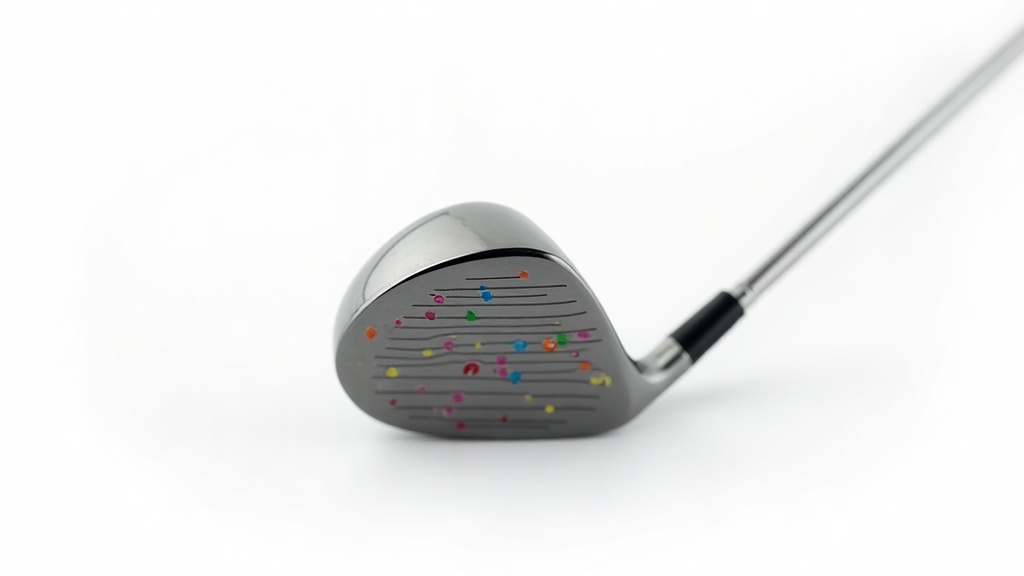
PING Color Code Chart: What The Dots Mean
The colored dot on your PING iron tells you exactly how the club’s lie angle has been adjusted from standard. A black dot means standard lie; a blue dot means 1° upright; a green dot means 2° upright. On the flat side, a red dot is 1° flat and an orange dot is 2° flat. This system lets you quickly read whether a set of irons is fitted to your swing or built for someone else.

How the PING Color Code System Works
PING assigns a specific lie-angle offset and, in some cases, a length adjustment to each dot color. The chart below lists the most common codes found on current production irons.
| Dot Color | Lie Adjustment | Length Adjustment (if marked) |
|---|---|---|
| Red | 1° flat | Standard |
| Orange | 2° flat | Standard |
| Black | Standard | Standard |
| Blue | 1° upright | Standard |
| Green | 2° upright | Standard |
| Yellow | 3° upright | Standard |
| Silver | 4° upright | Standard |
| Maroon | 1° flat | +¼ inch |
Exact values may vary slightly between model years or special-order runs. The PING fitting chart inside the clubhead’s hosel (or printed on the original build ticket) gives the precise specs for that club.
Why lie angle matters. Lie angle affects the direction the clubface points at impact relative to the swing path. A lie that’s too upright can produce a pull or draw; a lie too flat can cause a push or fade. Matching the dot color to your swing’s natural plane helps you hit the ball straighter without changing your swing mechanics.
Example in Action

Take a golfer who consistently hits the ball left of target with black-dot (standard lie) irons. The toe of the club is digging too low, closing the face. Switching to a red dot (1° flat) raises the toe, reduces the over-draw, and sends the ball more toward the target line. A real-world PING fitting at a demo day showed this exact pattern: the player went from a 15‑yard hook with black dot to a straight 5‑yard draw with red dot after a lie-board test.
What the Dots Mean for Your Game
Choosing the right dot color is not about preference—it’s about geometry. If you already know your typical shot shape, you can form a starting hypothesis, but the only reliable method is a dynamic fitting with a lie board and impact tape.
- If you hit shots left of target (pull/hook): suspect the lie is too upright. Consider a flatter dot (red or orange) if your ball flight is also low or the clubface appears closed at address.
- If you hit shots right (push/slice): the lie may be too flat. Try a more upright dot (blue or green).
- If you hit the center of the face but the ball flies offline without a consistent pattern: the issue may be length or shaft flex, not lie. The color code alone cannot solve that.
Do not assume that a darker dot equals a “better” or “pro” club. The color is purely a fitting measurement; a red dot is no less capable than a blue dot.
How to Find Your Correct PING Dot Color
Follow these steps in order. Each step tells you what to look for and what to do next based on what you see.
Step 1: Take your static measurements
Measure your height and wrist-to-floor distance (with golf shoes on, standing naturally). PING’s static fit chart uses these two numbers to suggest a starting dot color. For example, a 5’8″ player with a 33″ wrist-to-floor typically starts at black dot. Write down that starting dot.
Branch based on what you see: If your static chart suggests a dot color that is more than two steps away from black (e.g., green or orange), you likely have a non-average body proportion. Do not assume the static recommendation is final—proceed to Step 2 with extra attention to the dynamic test. A large static offset often changes after a lie-board session.
Step 2: Dynamic testing with a lie board and impact tape
This is the only way to confirm your correct dot. You can do this at a PING fitting event, a clubfitter, or a demo day. Hit five to seven shots off a lie board with a 6-iron or 7-iron that has impact tape on the sole. Check the mark:
- Mark centered on the sole: your current lie is correct for that swing.
- Mark toward the toe (heel of club is too low): the lie is too upright. You need a flatter dot (e.g., move from black to red).
- Mark toward the heel (toe of club is too low): the lie is too flat. You need a more upright dot (e.g., move from black to blue).
Concrete verification step: After you hit a few shots with a new dot color (borrowed or adjusted), place fresh impact tape on the same club and repeat the test. If the mark is now centered, you’ve confirmed the correct lie. If the mark is still off-center, adjust one more step in the same direction and test again. You’re done when you see a centered wear pattern on three out of five shots.
Stop/escalate threshold: If after three tests in the same direction (e.g., you’ve tried red, then orange, then maroon) the mark still moves toward the toe, stop. Do not bend the club further. The problem may be a swing flaw (e.g., extreme early extension or a very steep plane), not a lie issue. See a teaching pro or a PING-certified fitter for a full swing analysis before making any more adjustments. Bending a PING iron beyond ±2° from its original spec risks cracking the hosel or deforming the head.
Step 3: Check your existing clubs
If you already own PING irons, look at the dot color stamped on the hosel (near the ferrule) or on the original build sticker. Write it down. Then compare that dot to the result from Step 2. If they match, your clubs are likely correct for you. If they don’t, consider having them adjusted or resold.
Watch out for used clubs. A previous owner may have bent the lie angle without repainting the dot. If your dynamic test suggests a different dot than the one stamped, have a fitter measure the actual lie angle with a gauge before assuming the dot is correct.
Common Misconceptions About PING Dots
- “The dot tells me the shaft flex.” False. The color code is strictly for lie (and sometimes length). Shaft flex is indicated by a separate code (often a letter or number) on the shaft band.
- “All PING clubs use the same dot meanings.” Mostly true, but some older models (pre‑2000) had a different mapping. If you have clubs from the 1990s, consult the PING vintage fitting guide or a fitter before assuming the dot matches today’s chart.
- “I can change my dot by bending the club myself.” You can, but only within a safe range (usually ±2°). Bending beyond that risks damaging the head. Always have adjustments done by a professional with a PING lie‑angle gauge.
Knowing your PING color code helps you play clubs that match your swing plane. For accurate fitting, always consult a certified PING fitter or use the official PING fitting chart to confirm the correct dot for your game.

Michael Reeves is a PGA Professional with over 20 years of experience in competitive golf and instruction. A former Division I collegiate player at the University of Texas, he competed on the mini-tours before transitioning to full-time coaching and golf journalism. He has been a certified PGA teaching professional since 2005 and has worked with players at every level, from absolute beginners to collegiate champions.
His writing has appeared in Golf Digest, Golf Magazine, and The Left Rough. At GolfHubz, Michael leads the editorial team, overseeing fact-checking and ensuring every answer meets the same standard he demands on the lesson tee: clear, evidence-based, and immediately useful.
When he’s not writing or teaching, Michael plays to a +1.4 handicap at his home club in Austin, Texas. He has attended over 40 major championships as a journalist and fan, and has played more than 200 courses across 15 countries.
You can reach Michael at [email protected] or follow his occasional swing analysis posts on the site.